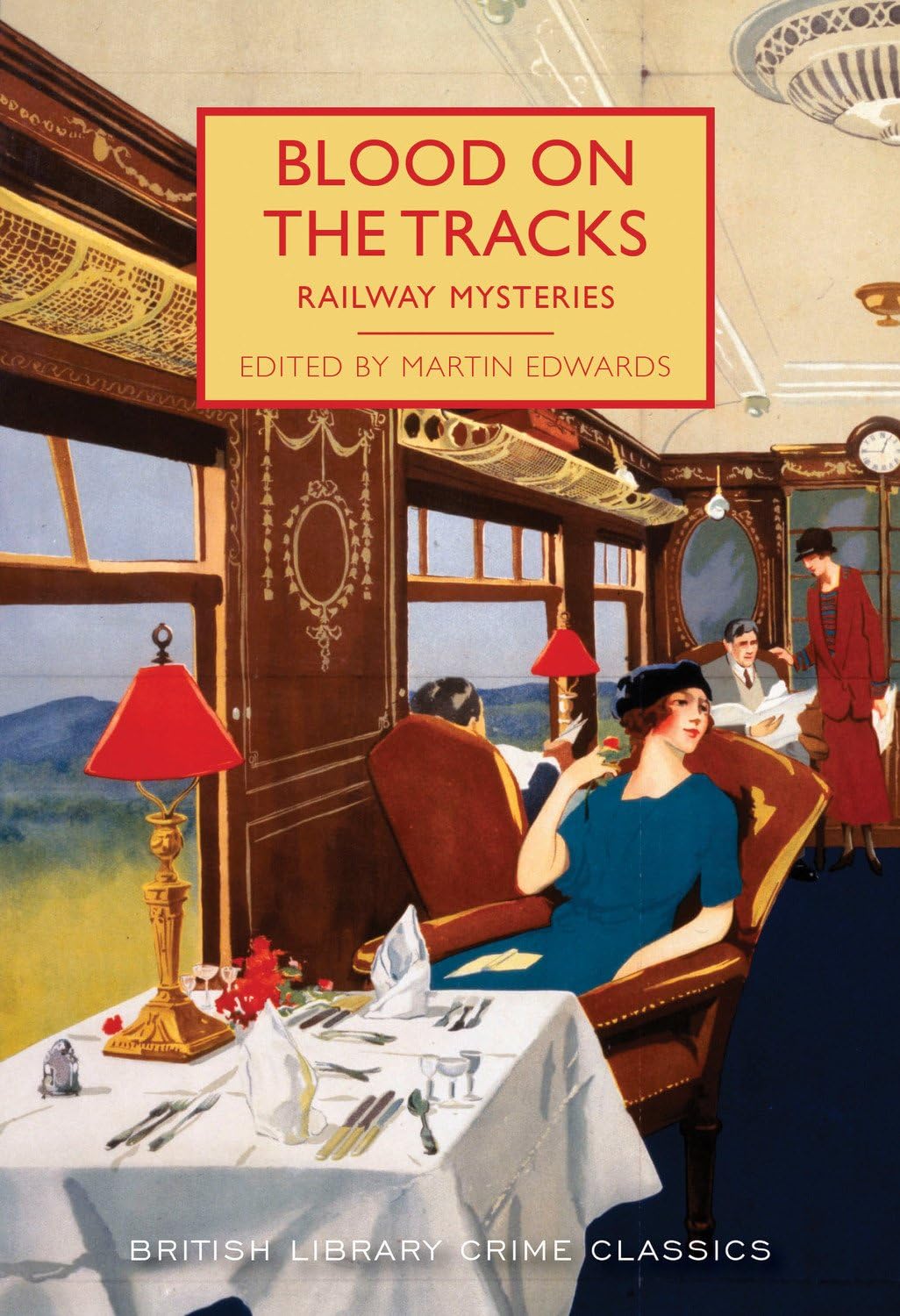
Comprising fifteen stories of murder and malfeasance linked to that most Golden Age of associations — the romance of travel as provided by the early 20th century train — Blood on the Tracks [ss] (2018) is an early example of the British library Crime Classics anthology, brought together for your delectation by President of the Detection Club Martin Edwards.
Interesting to reflect that, when this was first published, it would have been difficult to predict just how popular these short story collections would become in this range, and the need to hold back certain stories for later collections wouldn’t have been paramount. So with all of GAD and its many railway stories before him Edwards would have been positively rubbing his hands at the possibilities. So, how does this collection stand up? Let me see if I can explain my train of thought…

I’ve enjoyed how Edwards has brought more of the fiction of Arthur Conan Doyle to my attention in these collections, and ‘The Man with the Watches’, a.k.a. ‘The Story of the Man with the Watches’ (1898) continues that. It’s not really all that baffling — a dead man appears in a railway carriage from which three people have disappeared — but it’s pacy and shows good invention for its era. I love the false solution from a well-respected detective of the day, too: tongue firmly in cheek here (“The excessive wearing of jewellery is an early symptom in some forms of mania.”), Doyle knows exactly what he’s doing and is in masterful control of it all.
Edwards has also introduced me to much of the work of L.T. Meade & Robert Eustace, with ‘The Mystery of the Felwyn Tunnel’ (1897) once again delving into their volume A Master of Mysteries (1898). This sees John Bell trying to solve the mysterious deaths of two men near the mouth of a railway tunnel when it would have been impossible for anyone to approach them unseen.
This is good, era-appropriate stuff, with an ending that’s clever without falling into the realm of ‘Oh, come on…’. This strengthens my intention to read A Master of Mysteries in due course; though, if I keep up with these British Library collections, maybe Edwards will have included all the good tales by the time I’m done.
Actually, a little research shows that only ‘How Siva Spoke’ and ‘To Prove an Alibi’ remain unexperienced by me in that collection. So I could just read those two, eh?
I have previously read ‘How He Cut His Stick’ (1900) by Matthias McDonnell Bodkin in The Penguin Book of Victorian Women in Crime [ss] (2011), and thoroughly enjoyed revisiting it here. When a trusted bank clerk is rendered unconscious on a train and comes to to discover that the train has not stopped and yet the £5,000 he was escorting has been stolen, it’s a case for Miss Dora Myrl!
We’re very much in the idiom of the detective who Knows All and only explains at the end, but I like Miss Myrl’s dynamism and confidence, and enjoy Bodkin making his characters human enough to want to get in a (very) little personal vengeance once the thief is run to earth (“…if he strained the knots extra tight it’s hard to blame him.”). I would read the collection Dora Myrl, Lady Detective (1900) with great interest, so let’s hope it comes into my orbit before too long.
Another reread, ‘The Mysterious Death on the Underground Railway’ (1901) by Baroness Orczy is familiar from The Old Man in the Corner [ss] (1908). I see that I didn’t exactly love it at first encounter, and that’s borne out by rereading it. How a woman might end up dead in a railway carriage is a good problem, especially given the under-constant-observation nature of the victim, but the case is so damn full of holes — why the last guy in the carriage never comes under suspicion, for one thing — you could sell it as cheese.
Also, Edwards knows better than to call the Old Man in the Corner an “armchair detective” in his introduction. Why, in this story alone he attends an inquest and goes out and digs into the financial situation of the central couple, providing himself with information not otherwise brought to him by others and thus voiding the appellation.
‘The Affair of the Corridor Express’ (1905) Victor L. Whitechurch sounds like a familiar title, but upon reading it I don’t think I’ve encountered it before. This story of the kidnapping of the progeny of a millionaire is pretty simple and not terribly interesting, but I do quite like the detective Thorpe Hazell.
I appreciate that a certain amount of unexceptional detective fiction has attempted to make up for its flaws by introducing something of ‘character’ about the central detective — especially in the wake of Holmes — and that Whitechurch is really doing little more than that here, but I particularly enjoy the moment that everyone else looks at Hazell askance after he’s drunk some milk and eaten a few biscuits and is indulging in “digestive exercises”. That alone would make me pick up another one of these.
Jeepers, though, this is the second time someone has failed to consider that the train slowing down is the perfect opportunity to carry out a crime that could only be done on a slow-moving train. I know this was a less suspicious age, but our ancestors weren’t idiots. Were they?
I had read ‘The Case of Oscar Brodski’ (1910) by R. Austin Freeman previously in The Singing Bone [ss] (1912), but it’s such a masterpiece that of course I was going to read it again here. True, serendipity is involved in putting the diamond merchant Brodski innocently into the clutches of thief Silas Hickler, but Freeman does well to build up the horror of realisation as Hickler’s brain, unbidden, begins to form “a succession of events, rational, connected and coherent” that will result in Brodski’s murder.
Dr. John Thorndyke is equally on the scene serendipitously, and the intelligence he displays is truly one of the great joys of this style of detective fiction. It does, of course, seem ludicrous to the people around him (“[T]his is a judicial inquiry, not a prize competition in a penny paper.”), but the efficacy of that great man’s insight, and the way Freeman makes it feel believable, is simply wonderful.
I’d happily declare this one of the ten best detection stories ever written, were Freeman’s place on that list not already take by the somehow even better ‘Percival Bland’s Proxy’ (1913).
Roy Vickers is probably best remembered in GAD circles these days for his Department of Dead Ends stories, but ‘The Eighth Lamp’ (1916) predates those. It concerns George Raoul, a signalman on the London Underground, who, when turning out the lamps on a station platform at the end of the day, experiences some uncanny visions.
This is very much not the sort of thing one expects to find in these collections — it would have worked perfectly in Ghosts from the Library [ss] (2022) — but it’s so beautifully atmospheric, and so unlike Vickers’s other writing, that I can completely understand why Edwards included it. Difficult not to wish that Vickers had continued in this vein rather than the slightly bland DoDE work that seems (from a detection perspective, at least) to have dominated his later career.
Another second encounter for me, I first read ‘The Knight’s Cross Signal Problem’, a.k.a. ‘The Mystery of the Signals’ (1913) by Ernest Bramah in the Max Carrados [ss] (1914) collection. The plot of this is completely fine — a steam train goes through a green signal and crashes into a new, light electric train coming the other way…who is to blame? — but the closing stages are exceptional. Not only does the guilt party rallying against British imperialism feel astonishingly bold for the time, it’s one of the few instances in which a racist term feels justified in its usage — and the BL are to be commended for including it here for maximum impact.
Bramah is also to be commended for the paragraph in which Carrados holds forth on the mindset of a criminal waiting to be hanged; death was such a common implication in so many of the mysteries from this era, and it’s rare to find someone who actually dwells on what it means to be found guilty of these crimes.
The opening stags of ‘The Unsolved Puzzle of the Man with No Face’ (1928) by Dorothy L. Sayers take the form of a superb piece of conversation among passengers in a railway carriage. A man has been found on a quiet stretch of coast, strangled to death and his face then effaced by means of a sharp object. The speculations of the passengers, and the acuity of one in particular, would have made this a lovely piece of armchair detection in itself.
Things then broaden, and Lord Peter Wimsey — for ’tis he of the telling insights — finds himself drawn into the investigation. For me this dragged on a bit, but in fairness to Sayers it does all come together very well in the closing stages, with an almost Roger Sheringham-like flourish to round this off nicely. Cut down to about two-thirds of its length this would be exceptional, not least for the subtle way that the background of the First World War bleeds through, but it lingers perhaps a little too long over its finer details for my tastes.
The short fiction of F. Tennyson Jesse which has found it into several of these collections has thus far failed to cause me much excitement. Had any of them been as good as ‘The Railway Carriage’ (1931) I might well feel differently. It helps that Solange Fontaine, Vibes Detective doesn’t really do any detection here, and is instead moved to reflect on the attitudes of her (blessedly silent) fellow-passengers in a slow-moving local train:
[He was] ill at ease, as an animal is ill at ease when it is driven up the road to the slaughterhouse.
And, once again, here’s someone who has written well about death, in part in respect to the attitudes of the day:
It was ‘un-English’ to cut a man’s throat. It would have been more English, and consequently better, if he had killed his adversary with a blow of a club, or his fist. Jackson, being a rather weedy town-product, had been unable to do this essentially English thing, and had resorted, in a moment of passion, to a razor. There had been a struggle, he hadn’t crept up to the other man from behind, but undoubtedly in the course of the struggle he had cut his throat from behind, getting his arm round his neck and pulling the heavier man back towards him.
Another potential contender for Ghosts at the Library, this is the best of the Solange Fontaine stories I’ve read thus far. If there are others this good, I hope to make their acquaintance soon.
Can you believe that ‘Mystery of the Slip-Coach’ (1932) is my first encounter with the work of Sapper? Bulldog Drummond never felt very appealing, but on this unusual little tale — a fairly standard shooting on a moving train, with the added wrinkle of a smashed raw egg on the scene — Ronald Standish might well warrant further inspection.
It’s a clever little idea that livens up this otherwise fairly standard, late Sherlock Holmes-adjacent tale, where much of the real work is done off-page — but it is done, hinting at much, greatly-appreciated Humdrummery by our Genius Detective. And that raw egg is a superb little touch; I shall attempt to find more Standish purely on account of its presence and explanation herein.
My good friend Freeman Wills Crofts gives us a nice little crime story with ‘The Level Crossing’ (1933): a clerk in the grip of a blackmailer for having cooked the books a few years earllier, a demand for more money…the inevitable results. The direction this takes is quite pleasing in a savage way, but it’s the final line that makes it. Crofts really doesn’t get enough credit for how flint-eyed he can be at times, and in the case of the terminus of this tale he’s close to perfection.
Having only recently encountered Sherlock Holmes pastiche ‘The Adventure of the First-Class Carriage’ (1947) by Ronald Knox in The Further Adventures of Sherlock Holmes [ss] (1985) — I do not post books in the order I read them — I opted not to take a second journey through its pages. It’s a zestful and enjoyable take on the World’s Greatest Detective, and sets a high standard in the realms of the Holmes pastiche; but twice in two months would be, perhaps, too frequent a return.
‘Murder on the 7.16’ (1956) is a short tale from Michael Innes and, if it doesn’t do anything to hamper my newfound enjoyment of his work, it certainly comes too late in the Golden Age timeline, and brings with it a different focus to pure detection, to advance him in my eyes. The film-set setting is a pleasingly odd one, but twenty years earlier this would have added something truly brilliant. As it is, I’m simply fine with it.
I can’t begin to image how difficult it is coming up with fifteen stories on a certain theme for each of these collections, and can entirely understand that some tales may be reused in different volumes. To that end, I had already read ‘The Coulman Handicap’ (1958) by Michael Gilbert in the impossible crime collection As If by Magic [ss] (2025).
I previously called this “a nicely-dressed problem that is to be lauded for managing to smuggle some of the genre’s more playful heyday under the wire.”, and I stand by that: I’m not the fan of Gilbert that others seem to be, but this does its level (crossing) best to keep you in the loop where the core misdirection is concerned, and he deserve credit for doing that in a age that did not ask for such things.
A top five? Well…
- ‘The Case of Oscar Brodski’ (1910) by R. Austin Freeman
- ‘The Mystery of the Felwyn Tunnel’ (1897) by L.T. Meade and Robert Eustace
- ‘Mystery of the Slip-Coach’ (1932) by Sapper
- ‘The Eighth Lamp’ (1916) by Roy Vickers
- ‘The Railway Carriage’ (1931) by F. Tennyson Jesse
This collection shows again why this format continues to sell so well for the British Library Crime Classics range: Edwards has a great eye for a mixture of styles and variations on a theme, and mixes well-known classics with some unusual examples of the form which have much to commend them.
I’ll be reading more Ronald Standish on this evidence, and really should check out the Meade and Eustace collection, as well as more pre-GAD work by Bodkin and Bramah. And to see more of Doyle’s writing is a delight; too many of us stop at his Holmes tales and ignore the doubtless excellent work he was doing elsewhere.
So, all told, Death on the Tracks is a superbly-consistent set of stories which show well the ingenuity and variety brought to murder and its criminous brethren in the most exciting era the genre ever produced. Whether dipping your toe into the genre or already swimming happily through its greater depths, there is absolutely something here for you. Just be sure to buy a return ticket, or some other train analogy that makes sense as a closing witticism.
~
British Library Crime Classics anthologies on the Invisible Event, edited by Martin Edwards
Capital Crimes: London Mysteries (2015)
Silent Nights: Christmas Mysteries (2015)
Crimson Snow: Winter Mysteries (2016)
Continental Crimes (2017)
Foreign Bodies (2017)
The Long Arm of the Law (2017)
Blood on the Tracks: Railway Mysteries [ss] (2018)
Deep Waters: Mysteries on the Waves (2019)
Settling Scores: Sporting Mysteries (2020)
Guilty Creatures: A Menagerie of Mysteries (2021)
Murder by the Book: Mysteries for Bibliophiles (2021)
Final Acts: Theatrical Mysteries (2022)
Crimes of Cymru: Classic Mystery Tales of Wales (2023)
Who Killed Father Christmas? and Other Seasonal Mysteries (2023)
Lessons in Crime: Academic Mysteries (2024)
Cyanide in the Sun and Other Stories of Summertime Crime (2025)
As If by Magic: Locked Room Mysteries and Other Miraculous Crimes (2025)


Excellent review, and I totally agree with your comments regarding Freeman’s ‘Case Of Oscar Brodski’ and the sadly neglected ‘Percival Blands Proxy’. That moment when Thorndyke reveals the truth about the dead body is one of the best reveals in detective fiction IMHO. It’s great we still have the BBC episode of the former, but such a shame none of the subsequent series survives…including, sadly, the adaptation of the latter (renamed ‘Percival Blands Brother’)
LikeLike
Jim, After your praise as well as that in the comment above, I dug out both “The Case of Oscar Brodski” and “Percival Blands Proxy” from the big pile. Both are excellent.
Indeed the reveal at the end of “Percival Blands Proxy” is rather wonderful and made me smile at how easily Dr. Thorndyke saw through the deception. In Oscar Brodski, aside from the ridiculous way the culprit disposed of the body (i.e., how would he think that ever would have worked?), the brilliant forensics from Dr. Thorndyke went step by step to the answer. Thanks for the recommendations.
LikeLike
I’m delighted that you enjoyed them so much, because I think Freeman at his best is still among the very best work that was done in the Golden Age. Inclusions such as the one here, and the British Library republishing Mr. Pottermack’s Oversight, will hopefully keep him in consciousness enough that maybe more of his stronger work may yet make it back into bookshops. We can but hope…
LikeLike
I very much enjoyed the Thorpe Hazell stories (and other railway stories) by Victor Whitechurch. Many of them are in the Victorian mold but with a sense of quiet humor behind them that I found gratifying at the time. In hindsight, most of the stories left me with the feeling if having consumed a pleasant tea biscuit, which might itself be pleasing to Mr. Hazell.
LikeLike
I’m intrigued by Hazell, even if he does seem anachronistic. The Victorians had fun with the precepts, and they do occasionally hit the nail on the head. I’ll check out more by him, for sure.
LikeLike
Just put this on hold at the library.
LikeLike
I hope you enjoy it; it’s easily one of my favourite collections in the series.
LikeLike
Regarding Master of Mysteries, “How Siva Spoke” might be my favorite from the collection, and “To Prove an Alibi” is fine. Anyway, I have “The Singing Bone” on the big list to read some time soon
LikeLike
Oooh, that’s intriguing, because I think ‘The Warder of the Door’ might be my favourite at the moment. Those other two are never discussed and I don’t think I’ve ever seen them anthologised, so it’s good to know that one of them is good, at least.
LikeLike
I remember really liking this collection and now want to take it out again! I think I may like Michael Gilbert overall more than you do (though if I recall you do appreciate the Italian prison camp one for its greatness) but I will say that his non-Henry Bohun short stories- Bohun is a bit of an overly convenient character- can be really fun and if you ever have the opportunity to track down a collection like The Man Who Hated Banks you might find a lot to enjoy.
And just a reminder, because I know this has come up before, but I highly recommend checking out the crime/non-mystery stories in the collected Dorothy L Sayers! It seems like you appreciate her prose and story telling while not always appreciating her mystery plot construction and/or the character of Wimsey, if I recall, and those other stories, by not needing to fit the mold of the era’s detective fiction or a specific detective at all, tend to work very well. Man With No Face is one of my favorites of her Wimsey short stories, but that’s a not super competitive category IMO- there are some very good stories (like this), some ridiculous stories that are fun to read regardless (like Incredible Elopement), and some that are, I hate to say this as a Wimsey fan, really bad (curse you Ali Baba).
LikeLike
Rest assured, the non-Wimsey short stories in that collection are lodged in my brain as something I need to read: my edition of that book is the one with the bright yellow cover, so it twinkles at me as a reminder every time I look at my bookshelves (so, about fourteen times a day).
I tried some of Gilbert’s Calder and Behrens stories — Game Without Rules, IIRC — and didn’t rate them at all, but I’ve enjoyed a couple of the Petrella shorts and have the Young Petrella volume to be getting to. I’m sure he’ll’ve written something else I’ll like, it’s just a matter of my having the patience to pick through the bones to find it 🙂
LikeLike
I don’t think I’ve read Calder and Behrens so I can’t comment! There are definitely some interesting Petrella stories in there that I did enjoy a lot. The nice thing with that collection is that it’s collected from a variety of different detectives/central characters of his so you can focus on the ones you like.
LikeLiked by 1 person