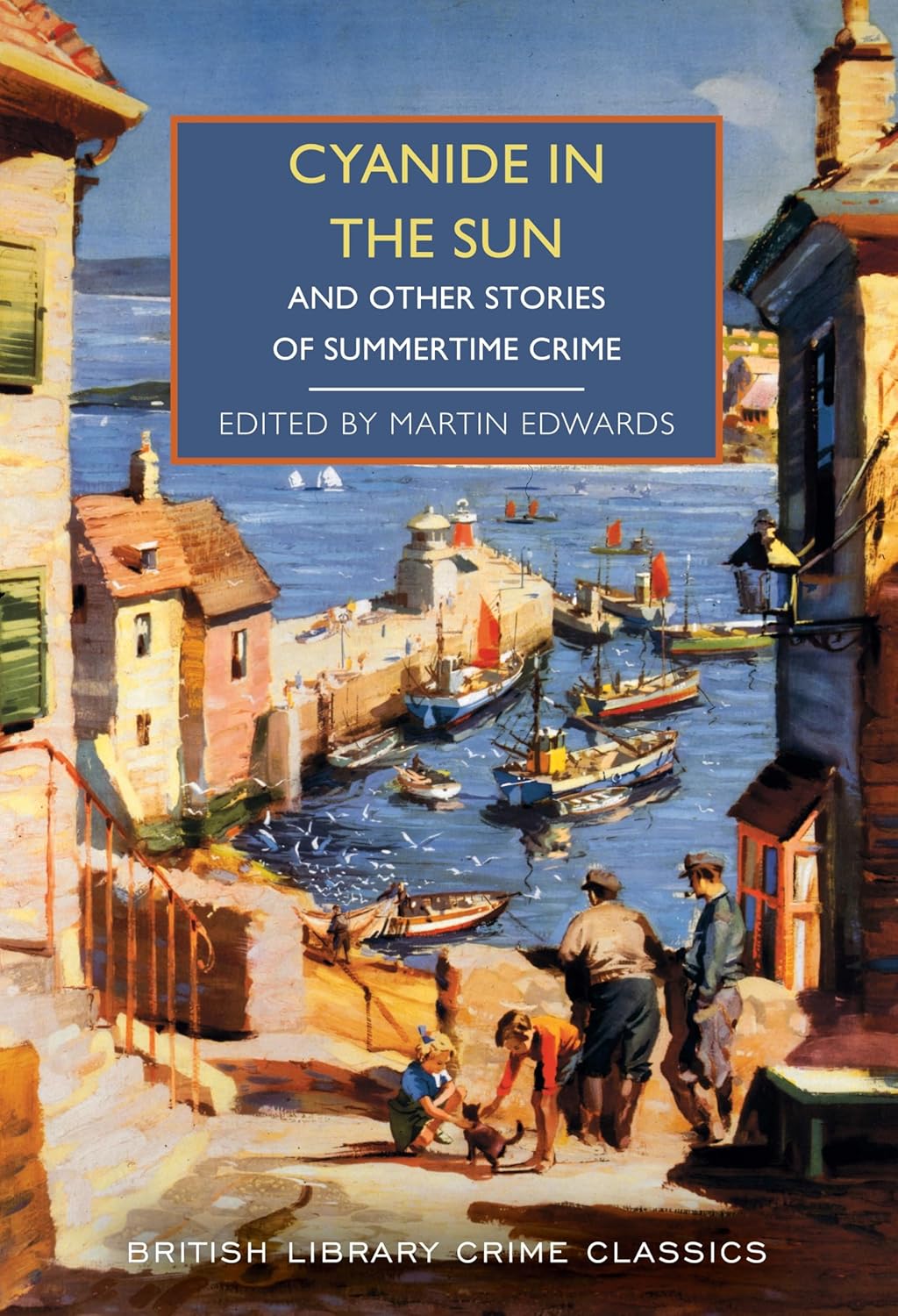
As Northern Hemisphere summers get increasingly sweltering — I wrote this post during the heatwave that the U.K. underwent in late June 2026 — let’s enjoy 18 tales of people murdering, cheating, lying to, and generally mistreating each other, selected for our enjoyment once more by the fabulously knowledgeable Martin Edwards.
Of course, Hercule Poirot famously pointed out that one’s holiday is an ideal time to commit a murder, since one need not account for their presence up the mountain you pushed someone off, on the beach where you stabbed someone, or hanging out in the bar in which you poisoned a drink or five. So how have the great and the good of crime fiction utilised this idea down the years? Let’s look closer at the tales enjoying their day in the sun…

‘Kill and Cure’ (1958) by Guy Cullingford sees writer Rex Burnham reaching burnout and ordered some hotel rest by his doctor, where he can’t help but search for characters and plots among his fellow guests. The eventual direction of this isn’t hard to fathom, but it’s fun, not least the repeatedly catty observations about the elderly Miss Ives and her nurse Miss Bates.
Miss Ives and her companion breasted the top [of the hill], rising like two resurrected ghosts from churchyard mould.
Not Golden Age in style or intent, but plenty of fun.
Crime-solving Chelsea Pensioner Sergeant Pockle is the sleuth in ‘Day Excursion’ (1954) by Wilfred Fienburgh. A coterie of passengers sharing a railway carriage on the trip home from the seaside are alarmed when a young child accuses one of them of theft. This is slight and enjoyable, and lightly and amusingly written enough that it’s to be hoped more Pockle features in future BL collections.
When a recently-wed couple must descend a treacherous hill in heavy fog, it’s only a matter of time until one of them plunges to their death. But how, when the path was so clearly and carefully marked for that exact situation? What is ‘The Secret of the Mountain’ (1927) by C. Bobbett?
Being of a more suspicious nature, I had anticipated a different ending to this. I liked the policeman-narrator Travers and his willingness to deviate from the strict truth in his methods, however; this reminded me of something from The Union Club Mysteries with, perhaps, a slightly less successful ending than was typically experienced in those shorter tales.
In ‘Unlucky Dip’ (1956), Andrew Garve tells a short tale of suspicious death via a nameless insurance investigator. There’s nothing terribly surprising about the eventual answers here, but the final line is a fun soupçon of evidence that lesser authors would possibly have overlooked.
Victor Canning might well have spoiled ‘Quarrel at Sea’ (1956) with its title, and this story of a body found in the holiday cottage the deceased had rented, dead for three days while his business partner brother was out at sea in his yacht, deserves a little better. Another clever small idea here, though core principle which tips the gaff will be unfamiliar to modern audiences (it was to me, at least, and I’m chest-deep in the Golden Age). I wish it had been better seeded, because this is zippy, enjoyable stuff.
Some good, old-fashioned Suspense from Ethel Lina White follows next in ‘The Holiday’ (1938). A man on the run, a serendipitously-open door, an occupant who won’t be missed for the next few weeks…the stuff of domestic nightmares, and White does well to mine the emotional lows (“Her holiday had begun.”).
The resolution of this is clever, too, and if the ending is a little schmaltzy, well, what’s life without a little schmaltz now and then?
Having never been much of a fan of Michael Gilbert, I have to say that I had a grand old time with ‘Even Murderers Take Holidays’ (1950). I love the notion of observing the various periods of professional murderer Croft’s career as if discussing an artist…
…he had had several successes in this medium…
…and while the terminus of this isn’t hard to predict, the ironic fillip that greets us when we arrive made me laugh out loud.
‘“Mr. Bearstowe Says…”’ (1943) by Anthony Berkeley is an expansion of an earlier story, and as such feels a little underdeveloped. When Roger Sheringham learns of the eponymous “literary gigolo” at a party, he soon forgets about the man, but a chance encounter two years later — and a dead body added to the mix — jogs his memory. This has all the hallmarks of Berkeley’s smooth tone and lovely phrasing…
Mrs. Hutton could not escape without rudeness and she lacked the capabilities for that useful gift, which in this country is the prerogative of the Very Upper or the Pretty Well Lower classes.
…but the speculatory nature of this shows in its too-sudden conclusion, which leaves a few question marks unaddressed, I feel. Very little by Berkeley isn’t worth reading, but from a lesser member of the GAD firmament we might be less kind about this one.
Three short newspaper stories follow, the first of which, ‘In the Picture’ (1956) by Nicolas Bentley, concerns a jealous husband, a European driving trip with the man he suspects is having an affair with his blameless wife, and a moment of ‘revenge’ that goes awry. Difficult to object to on sensible grounds, but rather too short to form an opinion on.
‘And the Police Were Not Called’ (1950) by Bernard J. Farmer sees Constable Wardow on holiday with his family, and keen to remain unrecognised as a policeman when a theft is committed. Farmer had a story in the British Library’s Final Acts [ss] (2022) collection which was also short and which also didn’t quite convince, so he’s not striking me as a neglected light on this scant evidence.
‘Consider Your Verdict’ (1956) by Anthony Gilbert concerns a young woman on holiday who meets a wonderful man…and then has good reason to doubt that wonderful man’s bona fides. Much more a crime story than detection, this sets up an interesting question in its final stages, and is very enjoyable for how it manages to turn the situation in on itself. Short and sweet.
An antiques dealer happens upon a man who had conned him by paying with counterfeit notes in ‘Crooked Harvest’ (1947) by Shelley Smith, and seeks to help the beautiful young woman the man is doubtless about to trick out of her difficulty. Another short one, this, but shows how to drop a neat surprise in the final line and sweep out the legs of all that has gone before. Very good, I wonder what other short fiction Smith has written.
Title story ‘Cyanide in the Sun’ (1958) by Christianna Brand was previously included in The Realm of the Impossible [ss] (2017), and it’s lovely to have it brought to a wide audience here. This tale of a serial poisoner finds Brand on typically facetious form, and overflowing with wonderful phrasing:
Miss Jones was a model, it seemed, free-lancing in London, and naturally must keep her figure and couldn’t touch a potato. The bare idea made her go pale.
The borderline-impossible deaths that follow are cleverly contrived, and Brand’s laying on of clues is a masterly as ever. Hot damn, she really was one of the greats.
‘The Fly’ (1953) by John Bingham sees a stolid English policeman, on holiday in Norway, stumbling into a murder case when one of the denizens of his guest house is murdered. You can’t solve this ahead of time — indeed, the murder goes unresolved — and I don’t think the terminal point which gives the story its title makes sense (rot13: gur xvyyre qvqa’g unir gb znxr vg ybbx yvxr gur ivpgvz jnf svfuvat, orpnhfr gur ivpgvz jnf vaqrrq svfuvat). Difficult to dislike, though; the calm dependability of the policeman Wills is a tonic in these hectic days.
Will Scott‘s tramp Giglamps turned up in As If by Magic [ss] (2025), and I hadn’t appreciated at the time that he was also in this earlier collection with ‘A Holiday by the Sea’ (1922). This sees Giglamps and the lugubrious Cheerful stumble over a smuggling plot when a handsome Naval officer gives all indications of being The Admiral, current scourge of several international police forces (“He gets smugglerier an’ smugglerier every day…”).
I thoroughly enjoy both Giglamps’ tendency to veer into the profound (“It’s easier to be a blade o’ grass than a landscape.”) and the politely off-colour (“It’s wonderful what a face’ll do, Cheerful. But p’raps you wouldn’t understand that.”) without warning, and close reading of this very throwaway story is highly recommended to get the most out of it. I remain convinced I read the Giglamps (1924) collection and somehow failed to write it up, so more of these stories in future BL digests would be greatly appreciated.
Disturbingly, I’ve found myself warming to the work of Michael Innes in my recent reading of these BL collections. ‘Two on a Tower’ (1956) doesn’t do anything to set that back, but the story is too minor to really feel anything about. Two people go up a tower, one comes down not via the stairs…I can’t really say much more. It was readable, and it hasn’t put me off re-trying Death at the President’s Lodging (1936) at some point. Heaven help me.
Edwards has made a habit of stepping well beyond the Golden Age in these more recent collections, typically unearthing some wonderful as a result. This trend continues with ‘The Summer Holiday’ by (1983) by Celia Fremlin, in which a widow is finally free of the tyranny of the annual pilgrimage abroad…only for events to intervene and raise the horrible possibility once again.
Fremlin is, of course, magnificent at brittle moments of the human spirit being tried, and captures wonderfully here the agonies our protagonist goes through. And, my god, the way this drew a graveyard chuckle from me at that moment was exquisite. Divine stuff.
We finish with easily the longest story in the collection, ‘The Summer Holiday Murders’, a.k.a. ‘The Crimson Coach Murders’ (1960) by Julian Symons, in which murder sets its sights on the members of a coach tour. Alas, this put me in mind of Murder on the Blackpool Express (2017) and resolves itself about as convincingly; not bad, but far too prolix given the relative paucity of ideas.
“Thanks, Jim; TLDR. What would you pick as the top five stories in this collection?”, you say? Well…
- ‘The Summer Holiday’ (1983) by Celia Fremlin
- ‘Cyanide in the Sun’ (1958) Christianna Brand
- ‘Even Murderers Take Holidays’ (1950) by Michael Gilbert
- ‘Crooked Harvest’ (1947) by Shelley Smith
- ‘Day Excursion’ (1954) by Wilfred Fienburgh
It’s interesting to note just how many of these stories come from the 1950s and later, which means we’re moving beyond the Golden Age a lot of the time. As such, most of what’s here is really crime writing than detection, where the focus seems to be less on cannily-constructed surprise than on conclusions it’s generally easy to anticipate with an occasional tart twist (c.f. the Gilbert story, probably the best example herein).
I mean, nobody promised us detection, it’s just my preferred idiom. Plus, Edwards is clearly going to have to look beyond the previously-expected boundaries in order to continue to fill these enjoyable collections, and is to be commended on finding another good range of explorations of the central theme. I read the collection very quickly indeed, and to have so many stories I’d not previously read brought to my attention was a delight.
Full credit, then, to Martin Edwards, whose job only gets trickier as he puts together two of these collections every year. It’s easy to see why they sell so well, though, so his excellent work in compiling them is certainly appreciated.
~
British Library Crime Classics anthologies on the Invisible Event, edited by Martin Edwards
Capital Crimes: London Mysteries (2015)
Silent Nights: Christmas Mysteries (2015)
Crimson Snow: Winter Mysteries (2016)
Continental Crimes (2017)
Foreign Bodies (2017)
The Long Arm of the Law (2017)
Blood on the Tracks: Railway Mysteries [ss] (2018)
Deep Waters: Mysteries on the Waves (2019)
Settling Scores: Sporting Mysteries (2020)
Guilty Creatures: A Menagerie of Mysteries (2021)
Murder by the Book: Mysteries for Bibliophiles (2021)
Final Acts: Theatrical Mysteries (2022)
Crimes of Cymru: Classic Mystery Tales of Wales (2023)
Who Killed Father Christmas? and Other Seasonal Mysteries (2023)
Lessons in Crime: Academic Mysteries (2024)
Cyanide in the Sun and Other Stories of Summertime Crime (2025)
As If by Magic: Locked Room Mysteries and Other Miraculous Crimes (2025)


Lots of possible choices! i do so like the covers that the British Mystery folk provide for reissues. I hope they reissue more Lorac titles.
LikeLike
What’s the old saying? “Three things in life are certain: death, taxes, and Lorac reissues from the British Library”.
LikeLiked by 1 person
The third is encouraging. The first two are inevitable.
LikeLike