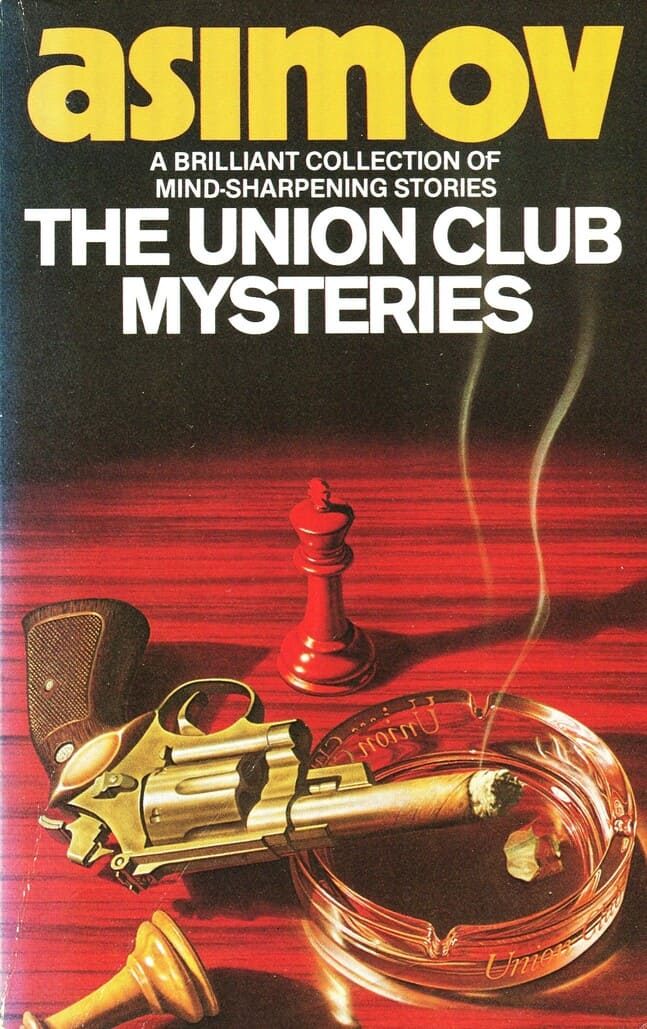
I’ve read, in my general perusal of the crime and mystery genre, some of the Union Club mysteries by Isaac Asimov, but this collection of 30 of them was a chance to diver deeper into the canon, and so I snapped it up.
Originally written for Gallery magazine — as Asimov explains in the Foreword, “what is commonly known as a ‘girlie’ magazine and, like all of that genre, though not as tastelessly as some, it is devoted to the feminine form divine — and unclothed” — these tales are deliberately shorter and simpler than his better-known Black Widowers tales. The structure is fairly well-established…
Each story (without exception) starts with a short exchange among three cronies in the library of the Union Club. The fourth crony is Griswold, who is asleep as the story starts. Something in the exchange stirs him awake and reminds him of a story, which he tells up to the point where the other three ought to be able to solve the mystery. They never do, and Griswold gives them the answer.
…and Asimov is at pains to point out that the issue of fairness in his revelations might be up for grabs:
There may be times when the ending will be obvious to you. There may be times when you’ll decide (with indignation) that no human being could have solved the puzzle given only the information I deigned to hand out. There may be times when you will think, in hindsight, that you ought to have guessed it, and will applaud my cleverness in concealing the answer without being unfair about it. And you may well decide the heck with trying to guess the answer, and just read on to the end.
So, how do these fare, 40 years later? Let’s get chatting…

‘No Refuge Could Save’, a.k.a. ‘To Spot a Spy’ (1980) concerns Griswold’s work in wartime — “My talent was that I could spot phonies”. So, can he tell his superiors whether a new man is a genuine true-blooded American, or a Nazi plant? The fate of the war depends on it…
This is a neat little conceit, and a nice way to adapt to the sorts of tricks Asimov is going to play, but doesn’t the logic of his reasoning somewhat undercut itself, given that all true American’s would have “never even heard of” what Griswold checks…yet Griswold himself knows it? Unless this is a subtle hint that Griswold himself is a turncoat the entire time, but there’s a chance I’m overthinking this.
I have a feeling that ‘The Telephone Number’, a.k.a. ‘The Winning Number’ (1980) might have been the first Union Club story I ever read. Concerning Bulmerson, an intelligence operative with a capacious and flawless memory for telephone numbers, the ante is raised when a number that only he knows is urgently needed, the gentleman in question having croaked out “It’s nine–” and then died.
You can cavil about coincidence where the answer is concerned, but this is a bit of fun, and Asimov makes you believe so fully in the setup that it would be a hard heart which would refuse to appreciate what he achieves in 2,000 words here. I’ve read 80,000-word novels with a less convincing mien than the one he paints in this tale.
How to identify the ringleader in a forthcoming prison riot, and so transfer the man elsewhere? That’s the problem that confronts Griswold in ‘The Men Who Wouldn’t Talk’, a.k.a. ‘Pigeon English’ (1980) — made doubly difficult by the fact that, even if they wanted to, a snitch is unlikely to risk ostracisation and worse in such close proximity to his fellow prisoners.
You wonder how dense the people involved are that they didn’t pick up on the fact that someone was giving them a clue, but also I’d argue that it doesn’t follow that, just because someone likes reading, they like that type of reading. So this is perfectly fine, but would perhaps require more words — words I doubt Asimov was allowed, lest they take away space from the feminine form — to make it more rigorous.
Griswold’s life comes under threat in ‘A Clear Shot’, a.k.a. ‘Big Shot’ (1980), with an anonymous letter to a university threatening his life should he participate in a ceremony to receive an honorary degree.
I can’t believe someone this committed to murder would indulge in such wordplay, and there’s absolutely no way, Dr. Asimov, that anyone would be able to notice the key thing about the culprit, but what the hell. There are 30 of these, and I doubt even I’m going to read what I write about each one.
Although “[t]he august confines of the Union Club were not often the sounding board of amatory reminiscences”, we find ourselves discussing a man who was ‘Irresistible to Women’, a.k.a. ‘Call Me Irresistible’ (1981). Alas, it seems his success with the fairer sex was somewhat balanced out by one of them killing him…
It’s intriguing how Asimov works in the idea that there’s nothing particularly exceptional about the man in question, and the deduction that comes from this…I dunno, it feels a bit wobbly. But, if there’s any truth in it, it’s a great idea, albeit one I have a feeling I’ve seen used elsewhere…though it might be that I’d read this story before, of course.
When you know a man’s name, address, and profession, you would imagine he’d be easy to track down, and yet ‘He Wasn’t There’, a.k.a. ‘The Spy Who Was Out of Focus’ (1981) tells the story of the writer William Smith, who no-one seems to know…
This is one of those stories with a punchline, like ‘The Seven Deadly Virtues’ (1960) by Stanley Ellin, which makes the whole thing feel like a shaggy dog story just to get a wry smile out of you. And, hey, it worked on me, despite my having read it before.
“We’re not going to waste our time finding out who killed one of our men so that we can kill in return. Our work is more important than melodrama of that sort.” Such is the attitude in Griswold’s nameless Department when one of their agents is murdered in ‘The Thin Line’, a.k.a. ‘Taxicab Crackdown’ (1981). More important than the man’s life was access to the information he held. But how to get that now?
The answer is beyond unlikely, and yet contains the nub of a good idea. It feels like this might work with a little more thought behind it…but then you realise how much thought would be required to come up with the necessary setup and clue and make it all work, and that makes the achievement of it here in such a short space even more impressive.
When a low-level gang member is knifed in an alley, he sings a short tune which just might be a clue to the identity of his killer. But how? How to interpret this ‘Mystery Tune’, a.k.a. ‘Death Song’ (1981)?
The idea here is smart, and you can understand why Asimov had to veer into the unfamiliar territory of gangland violence to tell it. It’s sad, too, that the attitude displayed to the deaths of young men and women herein are all too familiar still today. We really haven’t advanced much in 45 years.
How could a package “six feet long and four inches wide” vanish from a watched restaurant with no secret points of egress and no hiding places worth mentioning? This is the problem that confronted Griswold in ‘Hide and Seek’ (1981).
The solution is…fine, and Asimov does good work in selling you the culture of homogeneity and fear that “the agency” operated under (“Jack Winslow came to me…with an ingratiating smile on his face and some tell-tale beads of sweat on his forehead, despite the rule that no agent must perspire.”) which might have resulted in the oversight. But I have a better solution. Remind me to write it up one of these days.
A mole in the German intelligence services has a vital message to communicate to his handlers in the U.S. in ‘Gift’, a.k.a. ‘Decipher Deception’ (1981), but what to make of the single word the man was able to transmit before, presumably, being found out himself? And which of the four men who handled him does it implicate?
I’m sorry, but this is genius. Maybe I’m just finally on the wavelength Asimov needs me to be, maybe I’ve gone full Stockholm, I dunno. If you’re not laughing along with the inspired nature of this solution…I can’t help you.
A scientist on the verge of creating the Fountain of Youth has to mix two unstable solutions as his final step — but at 40 degrees Celsius or 40 degrees Fahrenheit? That’s the problem — should the mixture be ‘Hot or Cold’ (1981)?
This is an odd little scientific principle that you have the information to solve here and which is pleasingly straightforward and one of those little nuggets worth storing away for future reference. I mean, I doubt you’ll ever need it…but if you do, wow are people going to think you’re a genius.
‘The Thirteenth Page’ (1981) sets up the situation that a coded message received from a double agent during the Vietnam War is, when decided, a jumble of nonsense. But the man is reliable, so how to explain this, and how to decode the message correctly?
I get the wider point about ambiguity here, but surely this wasn’t the first message they’d received from this agent, and so the misunderstanding that results here wouldn’t occur. There’s a good way to make this point, but I think Asimov missed a trick here by making his milieu so well-considered.
“Surely there can’t be any one person in the world to whom so many impossible problems are posed! I don’t believe it! I don’t believe it.” With such sentiments does ‘1 to 999’, a.k.a. ‘One in a Thousand’ (1981) begin, our narrator doubting the veracity of all Griswold’s claims.
When an eccentric man dies, leaving only an ordered list of the integers from 1 to 999 behind him, how can it possibly be a clue to his intended successor? I’m pleased to say I solved this one ahead of Griswold telling us, but only because of the obscure knowledge required already being in my archives. But it’s a good one, I don’t deny
While ‘Twelve Years Old’, a.k.a. ‘The 12-Year-Old Problem’ (1981) might not display the most laudable attitudes to getting a young witness to an assassination to talk (“[S]lam him around…knock the crap out of him.”), there’s a good idea here that is very familiar and still catches you out.
I had wondered if the “short, very familiar word” that is impossible to pronounce might rely on the whole ‘verbs that are nouns’ thing, but Asimov’s solution is better than that. It’s also part of the punchline to a joke that I’ve never worked out how to tell verbally for this exact reason.
We learn about Griswold’s first encounter with whichever mysterious agency employed him for all those years in ‘Testing, Testing!’, a.k.a. ‘Cloak and Dagger Duel’ (1981). Summoned to HQ to see if he’s got the Right Stuff, he irritates a powerful man and so it put on the spot with a poser that he, of course, aces.
This is one of those solutions that I don’t believe, but which I don’t hate. There’s a linguistic element to this that I quite enjoyed, too — it’s a canny idea, and probably took bleedin’ ages to come up with. But then, I’m an idiot, so maybe it would just take me ages were I ever to think of this sort of thing.
A murder mystery rears its head in ‘The Appleby Story’, a.k.a. ‘The Last Laugh’ (1981): how could an innocent visit to a coffee shop result in the death of the extraverted, garrulous Thomas Appleby?
I figured out the essential idea here, even if I got the details wrong, but that’s more to there being less than usual in this story in terms of relevant, innocent-seeming plot points. But at least I got a good joke out of it.
‘Dollars and Cents’, a.k.a. ‘Countdown to Disaster’ (1982) sees a newspaper reporter warned of a series of bombings in hotels, but every bomb turns out to be fake. The bomber promises that this is all practice and that one day the bomb will be real…and they’ll know because he won’t tell them which room it’s in this time.
This relies on one of those principles which is now largely out of date, so I don’t expect many people will solve it. But the idea is a good one, and Asimov is again to be commended for the clarity of the world he draws up in such little space.
I don’t really know what the plot of ‘Friends and Allies’, a.k.a. ‘Mirror Image’ (1982) is, but I’m inclined to believe this was written when our author had a lot on, because it’s an old trick and all the more frustrating because it relies on people whose behaviour should be known doing things that are apparently unprecedented.
‘Which is Which?’, a.k.a. ‘The Perfect Alibi’ (1982) sees two men who are unrelated but virtually identical in appearance engage in a series of petty crimes knowing that any witness will struggle to definitely know which one of them is actually guilty.
When one of them gets caught up in a shooting and Griswold and a police officer follow the man to where his near-twin is waiting for deniability, well, you better have been paying attention. This is a neat little idea, but a minor story overall.
A military officer is approached to see if he would be willing to spy for the other side, and is murdered before he can pass on the name of the recruiter. What was ‘The Sign’, a.k.a. ‘The Telltale Sign’ (1982) that will give his murderer away?.
Another story where I learned something, and that’s always nice. I’ll probably trot this out at random at some point in the future and people will once again wonder what the hell’s wrong with me that my head is full of useless information like this.
How to capture a man who is the keystone in a massive drug distribution network? That’s the problem at the heart of ‘Catching the Fox’, a.k.a. ‘Stopping the Fox’ (1982) — not least because the the man in question has a genius for going unnoticed.
I can understand the essential idea of this, but it’s undermined somewhat by the exact ruse they use being discredited by a character within the story. Like, okay, I know there are subtleties, but it seems weird to me that you’d take the time to go “Yeah, nah, that won’t work” and then the solution is “Oh, we did that thing we established wouldn’t work earlier”.
Something apart from international spies and frantic global importance in ‘Getting the Combination’, a.k.a. ‘Playing it by the Numbers’ (1982): Griswold’s neighbour’s wife needs the combination to the safe her husband bought in order to get a chequebook out of it.
This is again a little curiosity, one of those pieces of ‘Huh, how about that?’ information that doubtless scatter the internet these days and which are still cool. A fun little principle, though minor as a story.
The concept at the core of ‘The Library Book’, a.k.a. ‘Mystery Book’ (1982) is one of those ‘We’ve looked everywhere!‘ ideas that, frustratingly, is resolved because they hadn’t looked everywhere. So on that basis alone, it’s a little irritating.
Interesting to reflect, though, that I’m old enough to remember the conceit at the heart of this, but to certain generations this will be gobbledegook — some people don’t remember Magic Eye pictures, after all, so this is practically arcane knowledge.
‘The Three Goblets., a.k.a. ‘A Flash of Brilliance’ (1982) should be brilliant and isn’t. Untraceable diamond smuggling, ‘We’ve looked everywhere!‘, and a tame solution. Stands to reason; no-one scores every time.
‘Spell It!’, a.k.a. ‘Book Smart’ (1982) is one of those setups where “no crime of any sort seemed involved”: a famous author trying to buy a book is asked to spell his name by the clerk in the bookstore…that’s it.
I…don’t buy this in the least. Asimov has done some good work to spin thin tales out of strong ideas, or turning slight ideas into believable little dramas, but this is nonsense. Why can’t the clerk simply be dyslexic, or presuming that not everyone with that name — whatever it is — spells it the same? Hell, I knew a Jon Smyth once, so have learned never to assume anything. Thin stuff.
Consulted by the mother of a young lady who has been missing for an indeterminate amount of time — she might have gone to Europe, she might have come back — Griswold goes to the police only to be told that they’re looking into the disappearance of a suspected terrorist in ‘Two Women’, a.k.a. ‘Cherchez la Femme: The Case of the Disappearing Woman’ (1982).
I solved this, but mainly because the discussion of the sort of thing not normally discussed in the sorts of books I read — due to their era — stood out to me like a sore thumb. Interesting to see it utilised as a clue in this setting, though.
Good grief, the absolute horse shit that is ‘Sending a Signal’, a.k.a. ‘A Piece of the Rock’ (1982). Back with spies and double agents — in an era when “the United States had to be very careful in its support of Israel”, if you please — can Griswold identify a quisling knowing only their code name?
This is…what is this? “Logic is logic” we’re told in the final line of this story, and you can’t argue with that, but it hasn’t been applied in this situation in the least. It’s at times like this I remember that, for all he achieved in the huge amount of writing he did, Asimov is also responsible for A Whiff of Death (1958), which might be the worst mystery novel I’ve ever read.
When an overheard piece of dialogue between two killers might be a slim clue to the location of a killing, Griswold is consulted in ‘The Favorite Piece’, a.k.a. ‘Face the Music’ (1982). Except, since Gilbert and Sullivan are heavily indicated, which of the nineteen upcoming performances to scope out?
I like the midirection here, even if the second line of dialogue is a little speculative. Griswold — and so Asimov — admits it’s a slim chance, but the idea is a good one, and folding those two conceits together is very savvy indeed.
Back to gangs and ghosts with ‘Half a Ghost’, a.k.a. ‘A Ghost of a Chance’ (1983), in which a nickname of a gang member might help point the forces of law and order towards something something the usual framing, etc.
I don’t mind this, though ‘Ghost’ is a bit of a leap. I don’t care if you’ve been in a library, I’m not sure gangs are that big on etymology. This is a brief summary, sorry, but we’re near the end and some of these have been difficult to say much about.
It’s interesting how Asimov sometimes veers into current events in these tales, such as acknowledging the fundraising done in American for the IRA in ‘There Was a Young Lady’, a.k.a. ‘Poetic License’ (1983). There’s no need for it, and I like the stories that do this sort of thing more purely because there’s no need for it.
Plus, the core idea here s very good: a nifty misdirection that ties into the framing well. It didn’t need to be about the IRA, but I can see why that gave events a certain urgency. A good one to finish on.
A top five? I mean, I’ll do my best, but I read these over an extended period and my memories fade…
- ‘Gift’, a.k.a. ‘Decipher Deception’ (1981)
- ‘Twelve Years Old’, a.k.a. ‘The 12-Year-Old Problem’ (1981)
- ‘Hot or Cold’ (1981)
- ‘There Was a Young Lady’, a.k.a. ‘Poetic License’ (1983)
- ‘1 to 999’, a.k.a. ‘One in a Thousand’ (1981)
While there’s little here that will get the lover of truly brilliant mysteries too excited, they paint a picture of a wonderfully fertile imagination, and it’s pretty incredible to think that — amidst all his other writing — the Good Doctor had time to sit down and try an Encyclopedia Brown-style mystery once a month, too. I know Asimov wrote another 20-some additional Union Club mysteries, but they’ve never been collected as far as I can tell. Plus, he implies in the foreword that the very first one wasn’t included in this collection, and I wonder whatever happened to that.
Bottom line, as disposable mini-mysteries you could do a damn sight worse than these, and should to opportunity to read more than a couple of the remainder present itself I’d be very interested to examine the rest of the canon. Equally, if you’ve enjoyed these and haven’t read the Leonard Strang mysteries by William Brittain, well, hop to it. In the meantime, this post has gone on long enough; congratulations to anyone who read every on of these 3,500+ words. Now go and have a lie down — you’ve earned it.


Damn what’s so bad about A Whiff of Death? I found it fine. In any case, I quite like Asimov’s short armchair mysteries, Black Widowers especially. I hope Crippen & Landru collect the other missing stories from this series eventually.
LikeLike
And speaking of Asimov and Encyclopedia Brown…
https://asimov.fandom.com/wiki/Larry_Mysteries_series
LikeLike
The baffling case of who could possibly have entered the lab is resolved when it’s discovered that someone has a master key. As payoffs go, that’s about as annoying a one as I can think of.
And, yes, another collection of the Union Club mysteries would be very welcome.
LikeLike
Not sure I have read these short stories but I loved his Black Widower collections and have some worn paperbacks somewhere on my shelves. Perhaps it’s time to find one of them.
LikeLike
I bought this and the second BW collection at the same time, and I’m looking forward to getting back to Henry & Co. Watch this space!
LikeLike