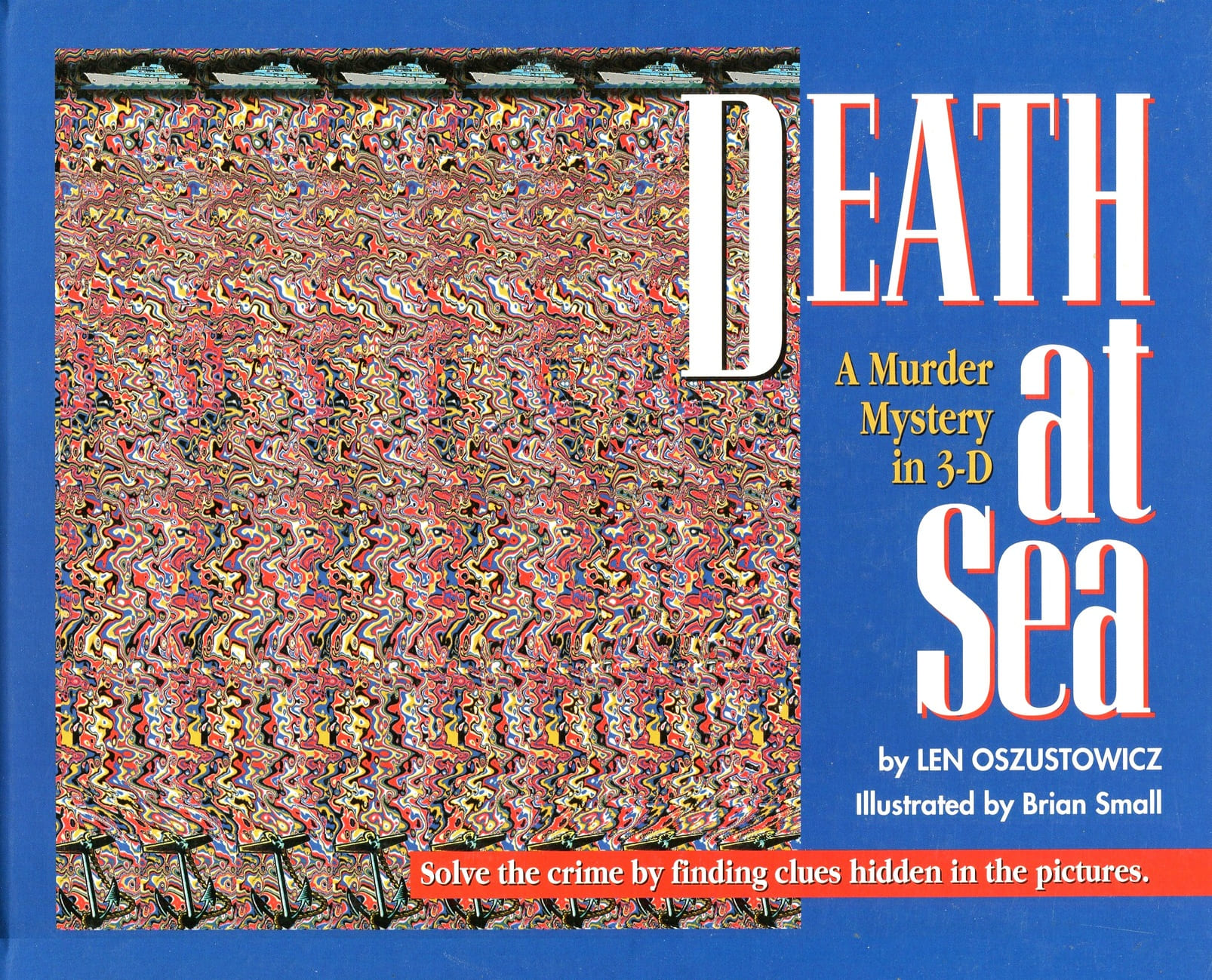
Either one of the greatest innovations in the genre’s history or one of it’s most misguided attempts at latching onto a passing phase, you can bet that I snapped up a copy of this murder mystery containing what my youthful 1990s self knew as magic eye pictures — more formally called stereograms or autostereograms — the second I learned of its existence.
I also made the mistake of showing this book to a friend of mine who is not yet 30, and their complete bafflement made forty-seven grey hairs sprout from my head and part of my face crumble off like the decaying wing of a long-neglected manor house. So, was it worth all this? Let’s investigate…
Death at Sea (1994) by Len Oszustowicz begins with 72 year-old London socialite Millicent Prestwood having died while out cruising on her private yacht Queen’s Speed. Unconventional Detective Inspector H. Parkington ‘Park’ Bowles is assigned to the case and makes it clear he’s none too happy about it: the Prestwoods and their kin being “a class of people he had very little time for in the first place”. Upon meeting his assistant Henry Colf on the boat (“Let’s go see the dead lady who’s going to waste the next two weeks of our lives.”), Park makes the acquaintance of the five other passengers who will, one presumes, become the suspects once murder is suspected: Millicent’s society daughter Bethany, her fiancé Charles Collett, Dr. Jonas Steed, “[p]ractitioner of internal medicine and chaser of dolly birds”, ship’s captain Harvey Clark, and chef Gerald Blume.
A (ahem) raft of motives soon present themselves: Millicent considered Charles Collett a “cheap hoodlum” who wasn’t good enough for her daughter, while Bethany herself blames her mother for her father’s death. Elsewhere, Captain Clark is losing heavily on the horses, stands to gain a lot of money under the deceased’s will, and claims that he and the dead woman were becoming emotionally close…but how much of that is true?
The listing of the passengers’ personal belongings makes it clear this is an historical mystery — their ready money is all pounds, shillings, and pence — but the characterisation here feels rather more in the idiom of its 1994 writing: Park has been passed over for promotion, is cynical about his job (he “detest[s]” writing reports), and yet is understood by the One Good Woman who sees through the veil of sarcasm and irreverence to understand that he’s the best cop on the Force, dammit! Oh, and his wife died nine years ago in a bombing meant for him, meaning he “turn[s] to a bottle for therapy” on a regular basis. See what I mean? It’s very nineties, but with an unapologeticness that’s honestly hard to dislike.
The writing is pretty functional, though occasionally quite witty…
Bowles browsed through the most recent news reports of the death of Millicent Prestwood, which had her dying of everything from the throes of passion with a twenty-three-year-old male prostitute, to her suicide resulting from her involvement with an international spy ring.
…but a few little hiccups interrupt the flow at times. I’m willing to bet that Len Oszustowicz is American, despite the British setting of this, if only because one character has the address 3232 Abshire Common, a number that has never existed in any address anywhere in the British Isles. Equally, given the aforementioned historical setting of this, I find it difficult to believe that any still camera would at this time have been able to imprint the time and date that a photo was taken upon the photo itself (this was, though, definitely a thing in the 1990s — I had a camera which did exactly that, and I hated it as a feature). Also, one does not “reign [a habit] in”.
Round and round we go, with a variety of interviews and Bowles clashing with his colleagues — weirdly, at one point he asks a policeman whose job it is to work on, like, crime things for help and the guy turns him down because…conflict? — and 25 magic eye pictures littered among the story’s 75 pages to inform scenes and add a little context (we’re told someone sent a fax, and the accompanying picture is a fax machine with a piece of paper bearing the word FAX on it, etc.). This is obviously the key interest here, both for the nostalgia value and the fact that the cover tells you to “Solve the crime by finding clues hidden in the pictures” — a bold assertion given that this manner of image doesn’t exactly excel in fine detail.
And, look, I know the science it pretty well catalogued now, but the simple fact of stereograms will never cease to amaze me. I picked up the knack for it pretty quickly once more as a zipped through this book, and I still remember the sense of awe that overcame me when I first experienced that shifting of perspective and the sudden melting of a 2D jumble into a genuine three-dimensional rendering on the page. Technology has moved on, and we’re even harder to impress these days with even more magnificent things readily available to us, and I think it’s a little sad that something as simple and joyous as this has been swept aside so easily.
However.
There is not a single clue in any of the stereograms in this book. Not one. They comprise lots of pictures of people sitting in offices or close-ups of teacups and the like, but there’s nothing in any of these pictures that contributes to the plot, the solution, or understanding why the solution is what it is. And, I’m sorry to say, there’s very little clewing in the text, either, or much in the way of the investigation that warrants merit (after poison is confirmed as the cause of death, it still takes two days to test the cup found in the deceased’s cabin…). I guess you could argue that we’re given the information which allows the solution to come about, but, just for the fun of it, I did a Poisoned Chocolates Case (1929) on this and was able to come up with another two solutions that allow for the exact same circumstances and could equally be true, so it’s not even like this is an especially tight piece of writing.
Oh, and it seems to take place in 1990, nineteen and a half years after the currency was decimalised.
And so, well, Death at Sea is a curiosity that tickled a dreamy nostalgia in me, but, the odd turn of phrase aside, doesn’t exactly compel as the crossover it could have been. One of the clues is a photograph, for instance, and we’re not shown that as a stereogram for the reason that it would be difficult to render…but why have the detective rely on a visual principle in a book that’s supposed to be sharing visual information with the reader which can’t then share that visual information? And when the picture is interpreted, we’re not told how that interpretation is reached, just that it is. I guess we knew it wasn’t going to be completely successful, since it appears to be the only one of its kind, but I had hoped that it had simply done an amazing job in a way that was just bloody hard to replicate.

It is easy to poach from the sidelines, however, and as something of an author myself I suppose the question turns to how this could have used the stereograms more effectively. Here, then, are three ideas off the top of my head:
We are shown a stereogram of the dead body in its cabin, with a bedside table beside the, er, bed, on top of which is the cup used to poison Mrs. Prestwood, an alarm clock, and a tub of some sort, presumably containing her medication — all shapes easily-rendered in stereogram form. Then we’re shown a close up of the bedside cabinet a few pictures later and the tub is a different shape or has been removed entirely. Even better if only one person has gone into the room since then and so might be involved in the removal.
The motive concerns a will, so we could have two people meeting in a room, having mentioned that this all takes place in August, and there’s a fire burning in the background — a subtle nod to that person having just stolen the new will and destroyed it. The text could mention that the room was warm, but the image itself would show why…and obviously raise the question in the observer’s mind about what the fire is doing burning in the first place.
Someone hands someone a cup of tea, say, and we’re shown a stereogram of the hand passing it over. On one finger is a distinctively-shaped ring. The image on the cover is someone tipping poison into a cup (it actually is, I mean). That hand could also bear the distinctive ring, so that anyone who is paying attention to everything notices the commonality. That would be a nice way for the principles of detective fiction to be observed: even the cover is a clue.
Okay, none of those are great, but I did just make them up right now, and they still deploy more of the subtle arts than any of the pictures in here. I like the idea of doing something this way…maybe I should put stereograms in the sequel to my own book…?! Or, hey, if someone wants to plot something along these lines, let’s chat.
For now, though, this is a bit of a missed opportunity. A little more thought would have gone a long way — hell, there could even be floorplans, sort of like what Dennis Wheatley did — but I can’t deny enjoying the nostalgia rush of this. Difficult to recommend if you’re not a child of the 1990s, however. And even then…


If it helps recolor your hair a little, I’m below 30 and gasped a little when I saw this cover. When I was a kid I had two of these books from somewhere and would flip through them over and over again. A shame this book wasn’t more interesting, as I would have seeked it out
Now that I think about it, there was a joke about them in Phineas & Ferb. I wonder how many people understood it
LikeLike
Well, you’re one of the cool twentysomethings, then, but we already knew that — anyone who blogs about classic mysteries is instantly cool.
And, yes, it’s a shame more wasn’t done with this; there’s potential, and the writing has a sort of rough charm…but I guess the properly-clued mystery really wasn’t in vogue in 1994 and so there’s a good chance no-one involved had any idea what they were aiming for.
LikeLike
This is one of the greatest things I’ve ever seen. How perfectly 90s. It looks like something you would see in a thrift store, and I mean that positively. I couldn’t see anything in the images, which I’m willing to grant to not knowing how these magic eye pictures worked. I only remembered the ones where you used special glasses to see them. I’m really glad to see something like this on here; I love this kind of obscure stuff.
LikeLike
I was very excited when I stumbled over it on an online bookshop for a secondhand store. Couldn’t have clicked BUY any faster.
And its weird how these cultural things die out: if you could find someone my age who didn’t know how these work — not everyone can make it work for them, fine, but I reckon the knowledge is pretty well disseminated — I’d be pretty shocked. But one of my colleagues is four years younger than me and had no idea what this was.
LikeLike
If you love this kind of thing, there’s actually a case in the Ace Attorney game Terng Npr Nggbearl Puebavpyrf that uses a stereoscopic image as a clue. Admittedly, it made more sense when the game was first released in Japan on the 3DS, a handheld console that was able to generate a stereoscopic affect.
LikeLike
I hear lots about Ace Attorney; I really should check these out at some point. Thanks for the reminder.
LikeLike
For an idea like this, it would have to be diagetic to make it fun! Even your ideas aren’t that compelling because it is not what’s happening to the detective.
Make the victim herself a maker of these puzzles. Then she could be afraid for her life and putting clues into the puzzles in case she is murdered. Alternatively, she could be a secret agent or a blackmailer or a criminal, communicating with her handlers/victims/gang via messages in here. And the twist can be — she isn’t the one putting messages but someone in the chain of manufacturing these (maybe her editor? I have no idea how these things are made) is putting addition info into them for his own nefarious purposes (either he can be the killer because she found out or he can be the intended target, and she was mistakenly killed)
At any rate, one clue can be two almost identical magic eye pictures, with second one tampered by the editor. Now you have a spot-the-difference element within magic eye picture. Fun!
LikeLike
In fairness to the authors, the meta mystery wasn’t exactly big at the time. But, yes, I like the idea of the stereograms existing in the universe. Maybe you should write one like this….
LikeLike