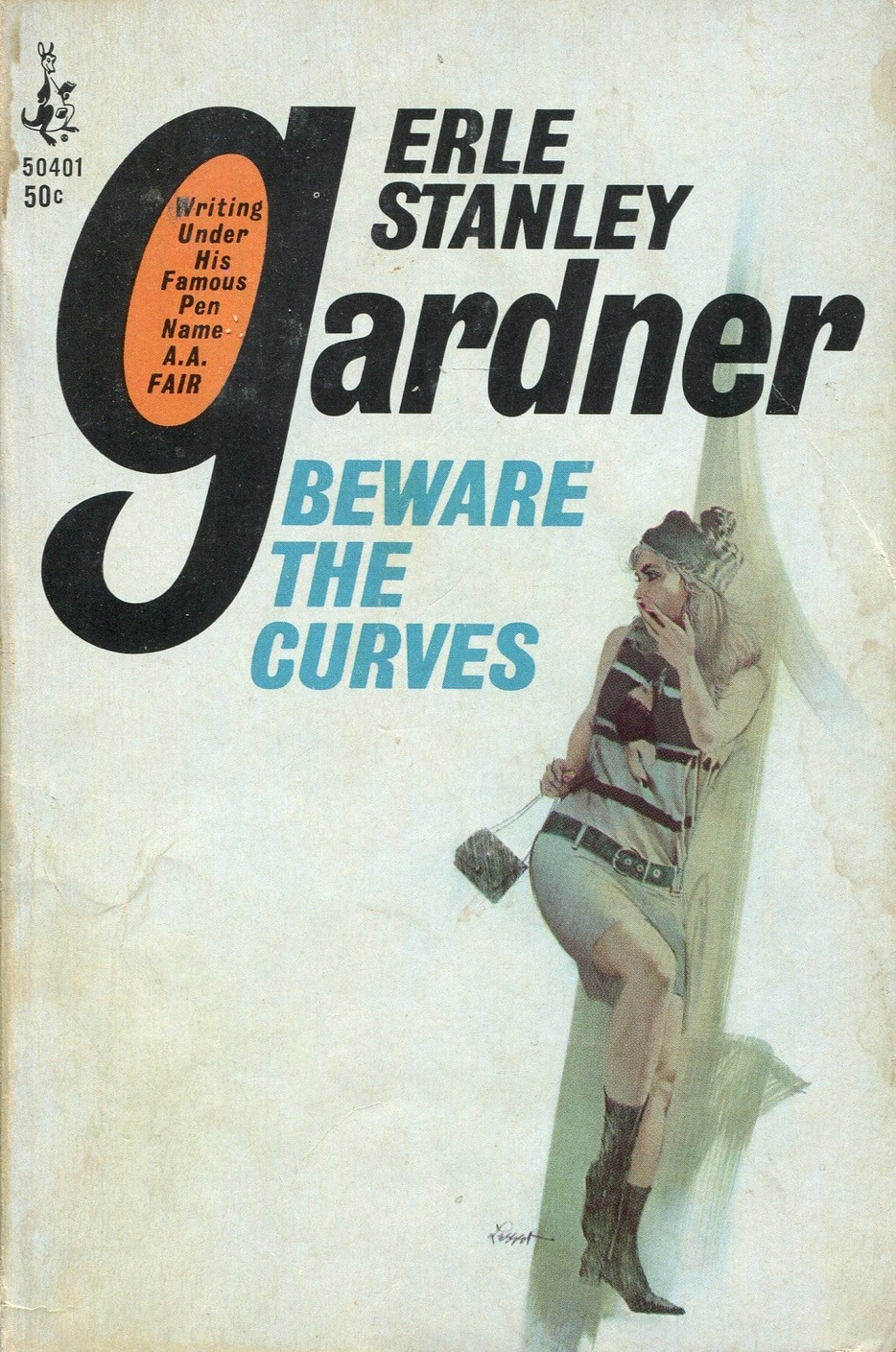


Given that A.A. Fair was a nom de plume adopted by Erle Stanley Gardner, a trained lawyer who would write over 80 legal thrillers featuring Perry Mason, it was inevitable that the Cool and lam books Fair wrote would veer into legalistic territory at times. The first in the series, The Bigger They Come (1939), relied on an obscure state law loophole, after all, and got things off to an ingenious start. What’s perhaps surprising is that it wasn’t until fifteenth title Beware the Curves (1956) that Gardner would venture once more into the courtroom with his L.A. P.I.s…though, I suppose he had written 36 Masons and nine novels featuring D.A. Doug Selby in the meantime…so I guess he was getting his fix elsewhere.
Hired by John Dittmar Ansel to track down a man he has met some six years ago on holiday, Donald Lam is able to complete the task very quickly indeed, but being what Bertha Cool likes to call a “brainy sonofabitch” is wise to the holes in the story they’re sold.
“Someone gave him an idea for a plot in Paris six years ago. He doesn’t make much money. It was a factual story the man gave him, but he’s going to turn it into fiction and make a novel out of it. So he wants to find the guy, and quite naturally he employs a detective agency to locate this bird. It’s just routine.”
Bertha shook her head as the full implications of what I was saying dawned on her.
“Fry me for an oyster!” she exclaimed.
“Exactly,” I told her.
The plot from here, well, it acquires the thickness, as motivations become suspect, an old murder rears its head, and it is increasingly apparent that something is going on behind the enquiries Ansel set running which hints at a bigger picture in play. The Fair books are to be noted for the clever switchbacks employed within, and this might just be the most dense in terms of plotting to date: keeping up with exactly who is suspected of what is half the fun, and the nature and timbre of the book changes probably half a dozen times in its short duration. As a result, it’s perhaps not the most successful book in the C&L canon, but it’s fun watching Fair pull rug after rug from beneath you, and the characters are superb:
Whenever a client was making out a check Bertha considered the moment sacred. The slightest sound, the intrusion of a comment might be an interruption.
Given Gardner’s undoubted excellence in all things legal, it’s a shame that the eventual courtroom direction of this feels a little tame. I could have done without Donald — who, yes, was a qualified lawyer before he was disbarred — essentially mansplaining how to behave during a trial to Barney Quinn, the lawyer they get working for them and, if I’m completely honest, I don’t see how the various, apparently-bizarre instructions given to Quinn form part of Lam’s masterplan. And therein lies the main rubs I have with this book: for all its slick plotting and commendable attitude of dismissing the notion that women are ‘past it’ once they hit 30, Gardner’s evident and understandable reverence for the law takes two big hits in the closing stages which leave a weird taste in the mouth.
The first of these is that I simply don’t understand how a judge and a District Attorney could be unaware of…the thing…that Donald draws on as his final sucker-punch. This is the problem when plotting in a way that requires the esoterica of a specialism (and one of the reasons I’ll never understand the popularity of House (2004-12)): the general observer has no notion of how clever these deductions are, and I just don’t believe that this one would be unknown. Far worse, however, is the postscript, in which it is heavily hinted that a man is jailed on false charges after what must have been false evidence being given against him…this following passages in the novel in which a prosecutor is reprimanded for trying to bring in evidence without foundation against the accused. Is it just me? This is…uncomfortable, right?
And so for all the cleverness here, the lingering sense of hypocrisy and the horrible implications of the much-vaunted legal processes being used to achieve what might loosely be termed justice on false grounds feels more like the sort of thing Gardner would rally against (he has established the Court of Last Resort by this point, after all) than the sort of crowning fillip he’d allow his long-running heroic characters to stoop to. It leaves an amoral stain on the surface of what had been some fairly breezy books to this point, but let’s not pretend that we take out literature so seriously that I won’t be able to read further.
~
The Cool & Lam series by Erle Stanley Gardner writing as A.A. Fair:
1. The Bigger They Come, a.k.a. Lam to the Slaughter (1939)
2. Turn on the Heat (1940)
3. Gold Comes in Bricks (1940)
4. Spill the Jackpot (1941)
5. Double or Quits (1941)
6. Owls Don’t Blink (1942)
7. Bats Fly at Dusk (1942)
8. Cats Prowl at Night (1943)
9. Give ‘Em the Ax, a.k.a. An Axe to Grind (1944)
10. Crows Can’t Count (1946)
11. Fools Die on Friday (1947)
12. Bedrooms Have Windows (1949)
13. Top of the Heap (1952)
14. Some Women Won’t Wait (1953)
15. Beware the Curves (1956)
16. You Can Die Laughing (1957)
17. Some Slips Don’t Show (1957)
18. The Count of Nine (1958)
19. Pass the Gravy (1959)
20. Kept Women Can’t Quit (1960)
21. Bachelors Get Lonely (1961)
22. Shills Can’t Cash Chips, a.k.a. Stop at the Red Light (1961)
23. Try Anything Once (1962)
24. Fish or Cut Bait (1963)
25. Up for Grabs (1964)
26. Cut Thin to Win (1965)
27. Widows Wear Weeds (1966)
28. Traps Need Fresh Bait (1967)
29. All Grass Isn’t Green (1970)
30. The Knife Slipped (2016)


My main reaction after reading my first Perry Mason novel was “Okay, you clearly don’t respect the police or their integrity at all, so you continuing to insist that you do just sounds like the author being too cowardly to call the police out for being corrupt and lazy.”
LikeLike
Yeah, it’s an interesting line that Gardner takes with regard to the law. I mean, clearly he needs the police not to be up to the mark so that gaps exist for Mason to cram his case through, but he really does sail close to the wind in terms of criticism at times.
I mean, it’s not even as if there’s one tame policeman who likes and respects Mason, as other series sleuths get: a Humbleby or a Masters or a Japp, etc. They’re still ineffective, but at least they’re on the side of good overall.
LikeLike
I don’t mean to butt into this conversation, but it’s a little more complicated than that! Gardner had complicated feelings about the police that were based on his own career as an attorney, particularly when he defended immigrants whom he felt were being railroaded by a combination of shoddy police work and prejudice. But he also had a respect for good police work, and it shows in two major characters: in the Perry Mason books, Lieutenant Tragg is one of the good ones, and we see time and again how he will not merely back Hamilton Burger because he’s the D.A. but will report the truth even if it helps Mason’s client. Tragg isn’t inept or corrupt, like Sergeant Holcomb. He and Mason have respect for each other, even if they play an adversarial game most of the time.
The other fine cop is Sheriff Rex Brandon, who works with D.A. Doug Selby in that series. Again, Gardner’s plots revolve around the adversarial relationships between prosecution and defense, and in this series, the defense lawyers are the bad guys. So while I accept that Gardner’s relationship with the police problematic, based on his perceived experience of their methods and attitudes, I also agree with JJ that this is Fiction 101, and the bad guys have to be inept or corrupt so that the good guys can ultimately win.
LikeLike
I failed to think of Rex Brandon — I’m an idiot. See also Bill Eldon in the Two Clues collection.
LikeLiked by 1 person
That negative view of the police stood out to me as well. Even Tragg comes under Mason’s scrutiny a few times. There’s a bit at the end of Counterfeit Eye where the main officer of the book (who I thought was Tragg) has a dramatic confrontation with the killer where he walks on like the Terminator after getting shot, and Della is really impressed while Mason snarks “Yeah, maybe if he had been smarter about it he wouldn’t have been shot.”
Like you said, part of it is just that the police have to be wrong for the story to function, but there is some genuine criticism there. Gardner was very aware of how stacked the deck was against the average person and that even a well-intentioned investigator can easily railroad an innocent without even meaning to. Mason comments in a few books that the full force of the State is against him, and that motivates his borderline-shady tactics. Trant is the ideal cop, Holcomb is the reality. (But even Holcomb gets Mason’s respect sometimes, like in Baited Hook.)
Part of me suspects it’s the pulp/noir influence of American mystery fiction. You really don’t see this very negative view of the police in British GAD fiction, outside of a couple of exceptions like Henry Wade, until around WWII/post-war.
LikeLike
I also feel that dismissal of the police has been baked into the genre since Holmes was mocking of Lestrade and Badger, picked up and made gentler by the likes of Poirot/Japp, etc. The Americans made it more of a dichotomy, but the disdain for the professional police has been there since their inception.
LikeLike
Yes, that’s true. British GAD fiction–broadly–tends to treat the police as misguided at worst, still caring about the truth. American fiction from that same period–again, broadly–is much more likely to portray them as incompetent, useless, or antagonistic with a little more bite. But I haven’t read enough to say how accurate that is. I’m sure someone smarter than me could write something interesting about that disdain.
LikeLike
I’m sure there are plenty of corrupt and/or incompetent cops in crime fiction on both sides of the Atlantic, but I think we need to give credit to the following:
Ellery Queen assists his father and an entire police department full of competent officers and detectives – EQ is there to deal with the more “bizarre” cases
EQ is modeled after S.S. Van Dine, whose police were no match for Philo Vance but were still not incompetent
Anthony Abbott’s Thatcher Colt worked with a great team of police
Nero Wolfe had a complex relationship with the cops but they were still good policemen – another example of conflict fueling the plot
Ed McBain’s 87th Squad is a brilliant and mostly realistic depiction of a police department.
In short, there were plenty of GOOD cops on the U.S. side. And I would say there are even more today, now that the “eccentric detective” is less prevalent.
LikeLike
True true! Thank you for the counterexamples!
LikeLike
I wonder who the first Killer Policeman was, though…
LikeLike