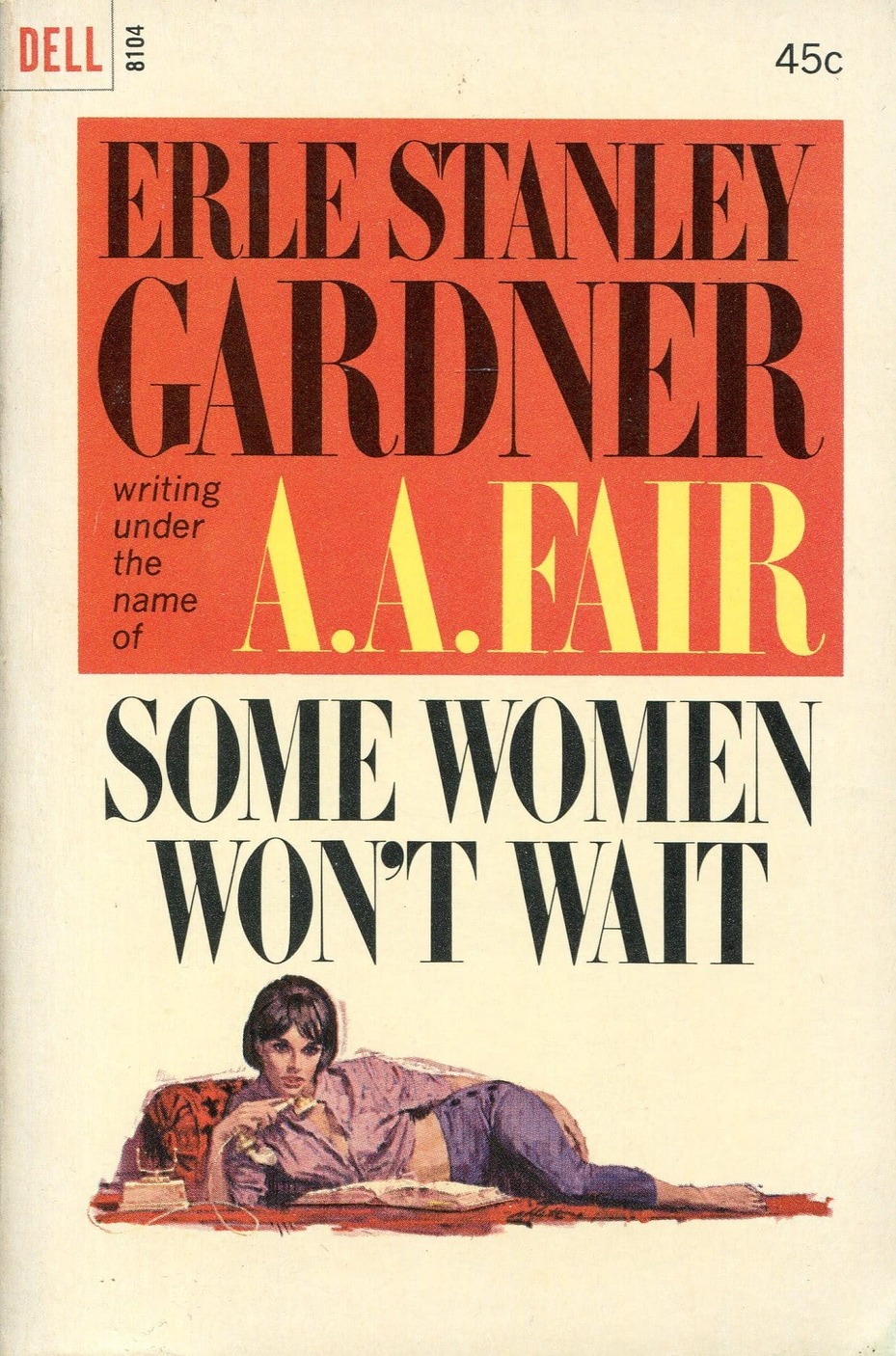


The fourteenth published tale by Erle Stanley Gardner about L.A. P.I.s Bertha Cool and Donald Lam, Some Women Won’t Wait (1953) marks the halfway point of my reading all thirty titles for the blog — ‘cos, y’know, there’s that unpublished one — very nearly five years after I started. And while I won’t say that the machine is starting to bleed to death here, it’s probably the simplest Cool and Lam case put on paper to date: relying essentially on a moment of misdirection akin to a classic novel of Golden Age detection rather than the imbrication of a variety of switchbacks that have been the hallmark of the series thus far.
Stephenson D. Bicknell calls on Bertha Cool with a problem: his ex-partner’s much younger second wife — now widow — seems to be in a bind, having asked the wealthy Bicknell for a $20,000 advance on the money he is overseeing for her ahead of her inheritance under her husband’s will. Unsure what to make of the request, Bicknell wants Bertha to join him on a trip to Hawaii, where she will make seemingly accidental contact with Mira Woodford, the lady in question, and see if some confidences cannot be exchanged. Money is no object, and money is the lingua franca of Cool and Lam, Investigators.
Of the plot from here, it’s probably best that I say not too much more. My concerns were naturally aroused when foreign travel appear on the menu — yes, okay, not foreign travel, as they’re remaining within the fifty states — since the last time Gardner attempted such a plot with these two we got Crows Can’t Count (1946), which remains the nadir of the series to date. And while there’s nothing to get too excited about here — most of the prose is pretty functional, and only a handful of characters beyond Bicknell, Mira, and Mira’s close friend Norma Radcliff really feature — there’s the odd stir of life, like Sidney Selma being casually dismissed as “a complete phony, three-dollar-bill type of individual who obviously assayed fourteen carat brass”, or the wonderful moment Berth and Bicknell are questioned by Donald in a room that our P.I.s know is bugged — a fact Bicknell seems completely oblivious to.
If you’ve read Fair before, you can tell this isn’t going to be the most plot-dense undertaking by the sheer amount of time given over to Donald trying to convince Bertha into adopting Hawaiian fashions. Occasional ideas bob into view in a manner that threatens to develop into something with the complexity we’ve come to expect, such as who it is actually putting the screw on Mira and how that first contact might have been established, but nothing quite takes off in the manner that Gardner would have previously exploited such ideas. And so it develops into a merely very enjoyable time, with Donald commanding much attention from the sultry and alluring Mira and Norma, and Bicknell railing against employing two detectives who seem to be achieving nothing:
Stephenson Bicknell was sitting on the edge of his chair, holding his cane in his hands, looking mad enough to put cream and sugar on ten-penny nails and chew them up for breakfast food.
Interestingly, Gardner takes time to look a little closer at the monied world of these men and women who know they’re only drawn together because of money and sex appeal on either side, stirring in a cynical edge to the lightness on display.
“You know, Lam, a girl like Norma would never have noticed me until I got too old to care. After I’d acquired jowls and a pot belly and a bank account I could take a cruise, and of course, by that time Norma would be out of the running, but there’d be some other little girl just like Norma on the ship, some girl who had a good figure and watchful eyes, some girl who would smile at just the right people, some girl who would be available under the proper circumstances.”
There’s a moment of commentary, too, about the delusion of anyone involved in such transaction who thinks that there might be genuine love behind it, too, with the idea of someone simply being in love with being in love rather than actually experiencing the emotion. And while this could be expressed more delicately at times, it’s an interesting side note to the sexual undercurrent that is very much not under when Mira and Norma are on the page — adding a degree of intrigue as to exactly what their game might be. And what does the title of the book even mean? It might be a clue or, as with a lot of Cool and Lam titles, it might just sound snarky and that’s enough.
Some Women Won’t Wait is, then, almost a reboot for Cool and Lam, perhaps a chance to invite new passengers onto the ride and see if they like what they encounter. It remains slickly written, with scenes like Donald taking a beating late on really making you wince, and perhaps indicates something of the variety possible in this series by not coiling as tightly as the plots have elsewhere — occasionally, it must be said, to the detriment of those books overall. To come away from this with a very clear idea of what actually happened and why is a lovely feeling, and if this is Cool and Lam going forward, well, I could certainly live with that.
~
The Cool & Lam series by Erle Stanley Gardner writing as A.A. Fair:
1. The Bigger They Come, a.k.a. Lam to the Slaughter (1939)
2. Turn on the Heat (1940)
3. Gold Comes in Bricks (1940)
4. Spill the Jackpot (1941)
5. Double or Quits (1941)
6. Owls Don’t Blink (1942)
7. Bats Fly at Dusk (1942)
8. Cats Prowl at Night (1943)
9. Give ‘Em the Ax, a.k.a. An Axe to Grind (1944)
10. Crows Can’t Count (1946)
11. Fools Die on Friday (1947)
12. Bedrooms Have Windows (1949)
13. Top of the Heap (1952)
14. Some Women Won’t Wait (1953)
15. Beware the Curves (1956)
16. You Can Die Laughing (1957)
17. Some Slips Don’t Show (1957)
18. The Count of Nine (1958)
19. Pass the Gravy (1959)
20. Kept Women Can’t Quit (1960)
21. Bachelors Get Lonely (1961)
22. Shills Can’t Cash Chips, a.k.a. Stop at the Red Light (1961)
23. Try Anything Once (1962)
24. Fish or Cut Bait (1963)
25. Up for Grabs (1964)
26. Cut Thin to Win (1965)
27. Widows Wear Weeds (1966)
28. Traps Need Fresh Bait (1967)
29. All Grass Isn’t Green (1970)
30. The Knife Slipped (2016)

