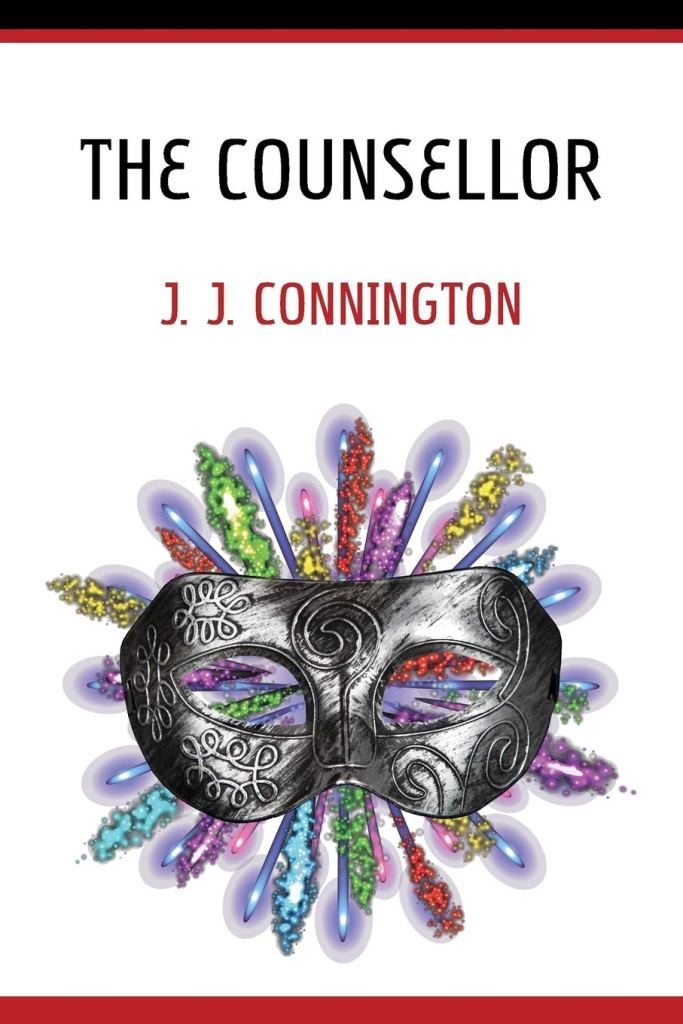


J.J. Connington would, from time to time, fancy a bit of a break from his usual sleuth, Sir Clinton Driffield, and the outcome of these meanderings leave something to be desired. The bland Supt. Ross got a brace of novels to himself — the awful The Eye in the Museum (1929) and The Two Tickets Puzzle (1930), which is better because anything would be — and radio host Mark Brand similarly got two books of his own: the execrable The Four Defences (1940) and today’s read, his debut appearance, The Counsellor (1939) which is better than his sophomore case, but, well, no wonder Brand has a short career; Driffield would have solved this in a third of the time.
Seemingly running a radio programme through which he dispenses advice for the lovelorn, the generally upset, the medically unfit, and possibly anyone who has any sort of problem at all, Brand — referred to as The Counsellor throughout, which is oddly vexing — receives a request to help track a young lady who drove away from home a week ago and hasn’t been seen since. Moved perhaps by his interest in detective fiction — Reggie Fortune, John Thorndyke, Hercule Poirot, Peter Wimsey, and Clinton Driffield are all referenced in jocular fashion — Brand decides to take a keen interest in finding Helen Treverton, and begins to involve himself personally in the hunt.
In essence, this is not a bad book. The pure, unadulterated Humdrummery of it all is very likeable, and the opening stages of the investigation in which Brand and his associates painstakingly chart the car journey taken by Miss Treverton, up to the discovery of the hidden car itself, bristle with intelligence. There’s even some arch wit in here, with the forever-in-debt printing press to which Miss Treverton might be heir described as “a philanthropic institution for supplying the public with something it won’t pay for”, turning out reproductions for a customer base who want “something by an Old Master to hang up and make him feel he’s cultured”.
Some of the characters are good, too, with the missing woman’s miserly uncle, running the press on tight reins and ruining the business in the process, an especially vinegary presence, and Sandra Rainham, The Counsellor’s right-hand woman, being a pleasingly cool head as Brand spends more and more time on this apparently fruitless errand. Some people don’t come out well — one character is roundly dismissed as “that repressed virgin” — but Brand is on the whole peppy enough to keep things rolling and keep developments, er, developing (the observation about small hotels, say) without ever really seeming to know what he’s up to.
What practically flatlines the book is how damn sedulous it is about every detail. And, yes, you’ll be all “Haha, but you like Freeman Wills Crofts, Jim…”, but Crofts at least understood when you needed detail and when you didn’t. Connington, who has normally displayed stronger judgement than this, hits the nail on the head when he has Brand “laboriously ticking off his points on his fingers” late on. Maybe it’s a testament to The Counsellor not knowing any better and so going about it all the long way round, but, yeesh, do we have to be told so damn much about it all? Couldn’t you, like, précis a paragraph now and again, Alfred?
The plotting, too, is rather ill-formed, which sticks out at moments like when an attempt is made on The Counsellor’s life about halfway through…yet the person trying to kill him would have needed time to set things up, which they definitely don’t have, and would have needed to know in advance about the events which lead to the attempt, which they definitely couldn’t have. And this is yet another Connington in which the guilty party could hardly be more obvious — Connington stopped merely playing fair at some point and instead just tells you everything without any adornments, meaning that every occurrence is obvious in its intent — so the slow trudge to the inevitable realisation feels even longer.
A throwaway comment about cheap foreign labour seems oddly prescient given the era of this, but that’s perhaps the only real point of interest left to mention. I know Connington wrote a late-career belter with Jack-in-the-Box (1944), and I’m hoping the three books of his remaining to me provide a little more interest and intrigue than is gathered here; he’s very enjoyable when on form, but this experience was not one to get excited about.
~
See also
Martin Edwards: I found the mystery only average by Connington’s standards. Never mind. I like the way he kept trying to do something different with the traditional detective story, and also his passionate commitment to “playing fair” with the reader. Brand’s second case was a definite improvement on this one, with a stronger plot, and I’m rather sorry that the series didn’t continue.
~
J.J. Connington on The Invisible Event
Standalones:
Featuring Sir Clinton Driffield:
Murder in the Maze (1927)
Tragedy at Ravensthorpe (1927)
The Case with Nine Solutions (1928)
Mystery at Lynden Sands (1928)
Nemesis at Raynham Parva, a.k.a. Grim Vengeance (1929)
The Boathouse Riddle (1931)
The Sweepstake Murders (1931)
The Castleford Conundrum (1932)
The Brandon Case, a.k.a. The Ha-Ha Case (1934)
In Whose Dim Shadow, a.k.a. The Tau Cross Mystery (1935)
A Minor Operation (1937)
Truth Comes Limping (1938)
Murder Will Speak, a.k.a. For Murder Will Speak (1938)
Jack-in-the-Box (1944)
Featuring Superintendent Ross:
Featuring Mark Brandon:
The Counsellor (1939)
The Four Defences (1940)


You’ll enjoy No Past Is Dead. I predict four, possibly five, stars.
LikeLike
Excellent news, I’m delighted that there’s another good late title 🙂
LikeLike