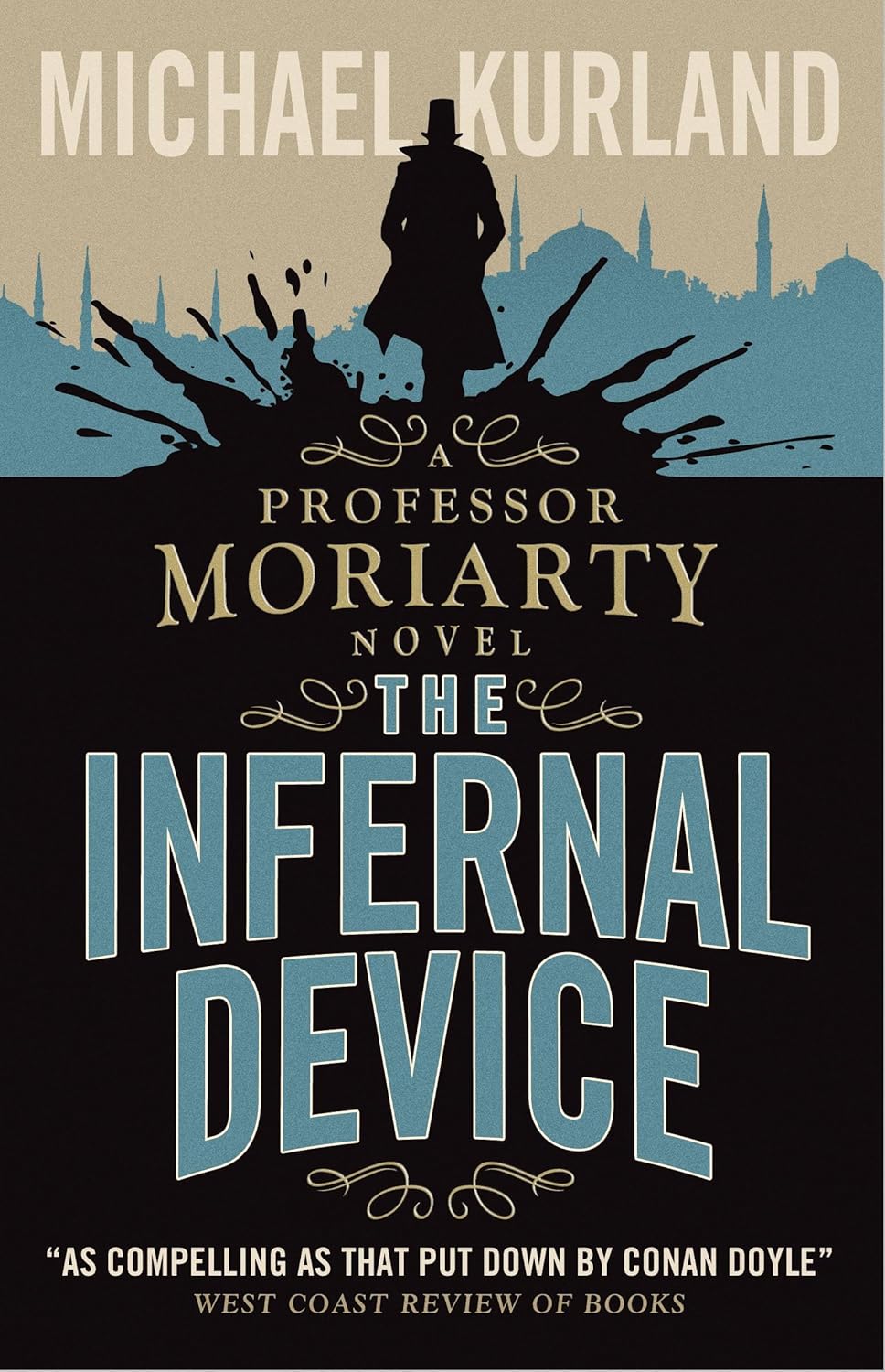
Hand on heart, I honestly believed I had read The Infernal Device (1978), the first of five books about Professor James Moriarty written by Michael Kurland, before now. Hell, I have talked about this book at length with various people, recommending it to them in very strong terms. So to pick it up and discover that, nope, I have never encountered this particular story — and that it’s so dull I was forgetting swathes of it as I read it, not that it mattered — was something of a shock.
In Constantinople for…reasons, journalist Benjamin Barnett is framed for murder, jailed, and then liberated from jail thanks to one Professor James Moriarty. This takes about a third of a book. Then he’s taken into Moriarty’s employ and shown around the Professor’s organisation, which takes about another third. The Kurland remembers that there’s supposed to be a plot of some sort and they chase an archvillain who hides behind a mask and so is clearly going to be a surprise reveal in the final stretch. Sherlock Holmes is in this, too. You remember him?
The back of my Titan Books edition carries a quote from Isaac Asimov — “Kurland has made Moriarty more interesting than Doyle ever made Holmes.” — which implies that we’re in for a cannon-testing upending of some expectations, much as Jack Anderson achieved recently in the utterly superb The Return of Moriarty (2025) (buy a copy; buy three!). And, honestly, my main takeaway from this book is ‘Huh, I didn’t know Isaac Asimov and Michael Kurland were friends,’ because Kurland in no way makes Moriarty more interesting than Holmes — instead, his Moriarty simply is Holmes.
Here, Moriarty lives in Russell Square — a fancy London address if ever there was one — in a house full of scientific equipment to enable experiments, has on hand a loyal lackey in the shape of butler Mr. Maws who is willing to go into any sort of melee requested of him armed and with a minimum of questions, has a housekeeper in the form of Mrs. H who is able to tend to his every need…
“What sort of a name is that — just the initial?” Barnett asked.
“Short,” she replied.
Moriarty is a consultant for hire, an observational genius…
From a superficial examination of the man who sat opposite him in a railroad carriage, Moriarty could state the man’s profession, marital status, interests, and possibly even add a few intimate details of his private life. When pressed to explain his methods, Moriarty drew an inductive path leading from his observations to his conclusions that made you feel foolish for not having seen it yourself. And he was usually, if not invariably, correct.
…employs mendicants to be his eyes and ears on the street as Holmes uses the children of the Baker Street Irregulars; Moriarty is waspish and irritable when his experiments or undertakings don’t go to plan, and he even does the whole ‘I can make a comment about what you were thinking even though you didn’t say anything’ shtick which Doyle repurposed from Edgar Allan Poe. Honestly, he’s not even really a criminal as such in this, since he’s hired to stop someone doing a crime and ends up teaming up with Holmes and Watson in order to make that crime not happen. And he doesn’t even betray Holmes in some way at the end, which seems the very least we could expect.
Barnett has to mildly wrestle with how he feels about working for a criminal for one short paragraph, then shrugs and decides he’s fine with it, and it’s never really an issue anyway. I’ll be honest, I don’t even know why Barnett is in the book, since he’s hardly the only morally flexible journalist in existence, and the few things he does contribute largely seem to be setting up a future opportunity for him to get his leg over with the secretary he employs, a woman with whom he shares this exchange at their first meeting:
“You will have to learn to control your emotions,” Barnett said gently.
“You’re right, of course,” Miss Perrine said, taking a deep breath and standing up. “Thank you for your time.”
Honestly, the book is hard to recommend, and I only made it through because Kurland has a light touch with prose and keen eye on the humour in some of his situations. Take for instance this exchange, when Moriarty first careens into view of Barnett in Constantinople, pursued by a gang of street Arabs:
“I say,” Lieutenant Sefton said, “an Englishman seems to be in trouble. We’d better come to his aid.”
Barnett put his notebook away and took off his jacket. “He might be French,” he said.
“Nonsense, man — look at the cut of those trousers!”
Elsewhere, see Moriarty’s wry aside when he, Barnett, and Maws are about to storm what they think is a meeting of the enemy allied against them (“Assuming our conclusions are correct, and this doesn’t turn out to be a gathering of the Lithuanian branch of the Young Men’s Christian Association.”), or canon-accurate references to the likes of James Philimore and the error in Doyle’s own writing which gave James Moriarty a brother called…James Moriarty. I also quite enjoyed that when Holmes first shows up he’s referred to by our third-person narrator as “a private inquiry agent who lived in Baker Street” — these little glimmers do a lot, but the book around them does not deserve it.
When Kurland challenges the canon — giving us the backstory that Moriarty was Holmes’s Mathematics professor at university, say — he’s on less certain ground again, and his characterisation of Holmes as being obsessed that every crime in London has Moriarty behind it somewhere (“Why so limiting? Say rather, in the world, Professor. In the world!”) doesn’t feel true. Additionally, I can’t believe that Professor Moriarty would ever need to have a grandstanding speech about how he’s viewed as a criminal when in fact what he does is so minor in comparison to the acts other men are glorified for. It feels self-pitying rather than energising, like a child complaining that it’s not fair some bigger boys are allowed to do what he’s not. I’ve never felt more sorry for a character reading a book within a story before…
What else? I learned that there was a submersible used during the American Civil War, so that was fun. Oh, and we never find out who the masked mastermind is, or even if he dies at the end, so I’m guessing he comes back in future books and it’ll all be a Big Surprise at some point. Or maybe not, I don’t really care. Okay, I’ve just looked up the plot of the second novel Death by Gaslight (1982) and it sounds like it might contain some impossible crimes — and, yup, it’s in Skupin. Goddammit, do I have to read another one of these?
~
The checklist of extra-canonical Sherlock Holmes works on The Invisible Event can be found here.

