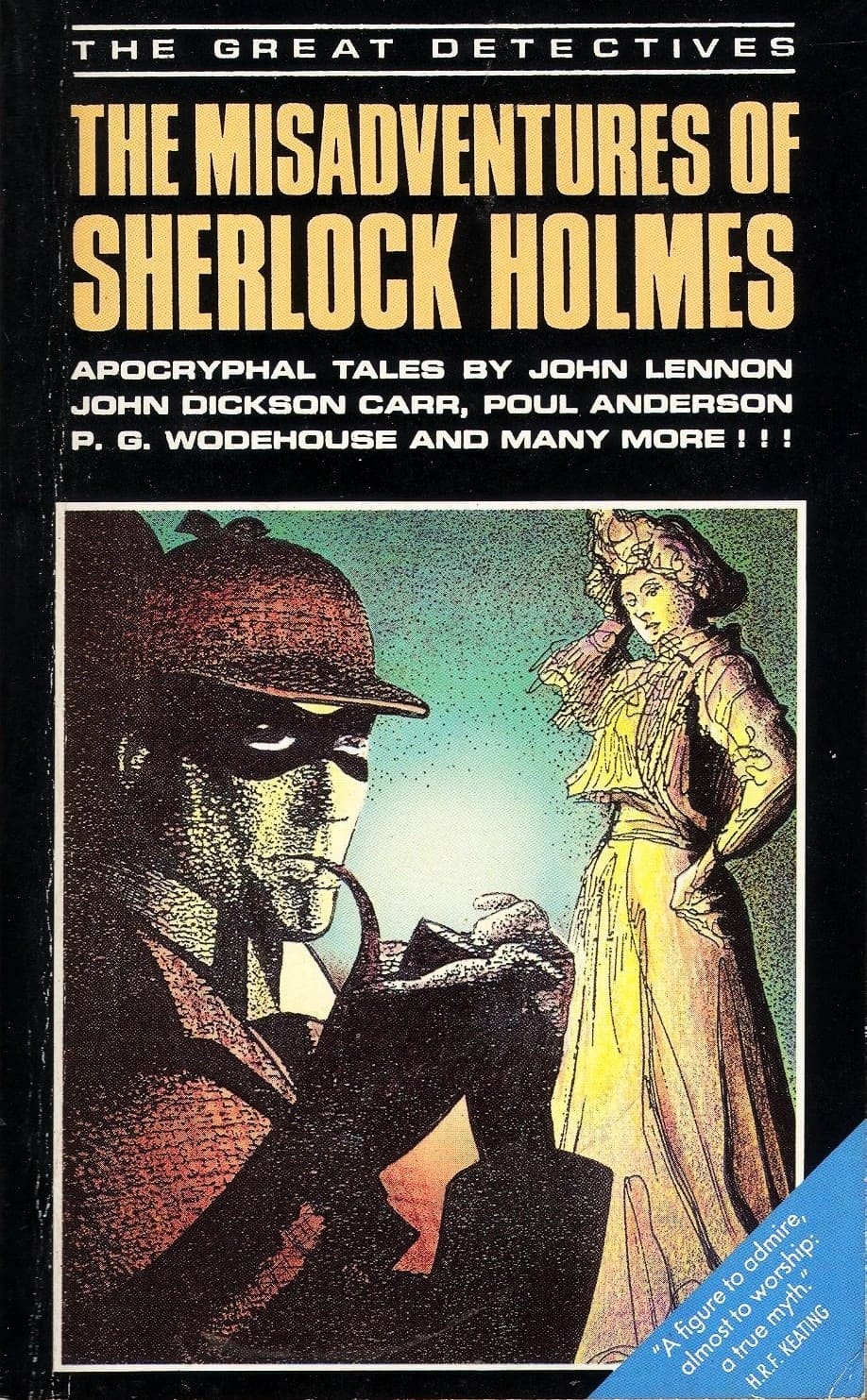
Fourteen alternative takes on the Great Detective — editor Sebastian Wolfe is unable to distinguish “parodies, pastiches and burlesques” from each other — fill out The Misadventures of Sherlock Holmes [ss] (1989). No, not the Ellery Queen one. This is different.
Wolfe’s stated intention is to draw on “less familiar” takes on Holmes, and I suppose there must — even in 1989 — have been plenty of those. Thus the famous rub shoulders with authors and stories you’ve never heard of, which is a policy I fully favour. So, deerstalker on — no, it’s not canonical, but neither are these stories — and magnifying glass at the ready…

I first read ‘The Martian Crown Jewels’ (1958) by Poul Anderson in The Realm of the Impossible [ss] (2017) and had forgotten that it was a Sherlock Holmes homage. So starting this collection with it is a bold strategy, though upon reflection there are enough parallels — the detective Syaloch plays a stringed instrument, has a chemical laboratory, and has spelled out the initials of “the reigning Nest-Mother” in his wall in bullets — to justify its inclusion on those grounds.
The impossible vanishing of the eponymous priceless jewels from an unmanned ship that would have been a practical impossibility to track down in the infinity of space, not to mention that simple laws of Physics ensure it hasn’t been boarded, make for interesting precepts, and the explanation is far cleverer than I gave it credit for first time around. I enjoy, too, Anderson’s commitment to the weirdness of SF (“The detective folded the letter carefully, sprinkled it with salt, and ate it.”). A good time.
‘From the Diary of Sherlock Holmes’ (1911) by Maurice Baring is a parody of sorts, with short diary entries making note of a few odd cases that came Holmes’s way in Watson’s absence. Maybe the era of this makes Baring a little wary of pushing his fun too far, but this feels rather muted when it could have taken lot more licence poking fun at the Great Detective. As it is, I’m not even sure if it’s supposed to be funny.
I was pretty sure that I didn’t care for impossible crime tale ‘The Anomaly of the Empty Man’ (1952) Anthony Boucher when I first read it, and upon this second visit I come away confused at its apparent Sherlockian credentials. Boucher was a staunch admirer of the Holmes canon, we know, but this is mostly about weird LPs, with its central mystery of a man apparently evaporating from his clothes “as though some hyperspatial suction had drawn [him] out of his wardrobe, leaving his sartorial shell behind him” feeling minor by comparison. It’s not Holmesian, and I’ll fight anyone who insists otherwise. [Legal notice: Jim will not fight anyone who insists otherwise]
One of two short Sherlockian plays by John Dickson Carr, ‘The Adventure of the Paradol Chamber’ (1949) is I guess supposed to be funny, but mostly derives its humour from the concept of — or maybe just the word — trousers. Carr at his best is spectacular. This is not Carr at his best.
If I understand my reading correctly, ‘The Adventure of the Conk-Singleton Papers’ (1948) was the first of the two John Dickson Carr parodies, but is published second here. That this is funnier than the other play is almost a given…
HOLMES:
Her Majesty, I perceive, was not amused.VISITOR:
She was indeed (hesitates) somewhat vexed. (Then suddenly amazed) But how could you possibly know —HOLMES:
Her Majesty has twice underlined the word ‘bastard’.
…but anyone who was excited when they heard that Carr had written two Holmes parodies is going to come away wondering what the point of these was. Maybe you had to be there.
I’ve long had a dim awareness of the Solar Pons stories by August Derleth, though ‘The Adventure of the Snitch in Time’ (1953) written by Derleth with SF author Mack Reynolds is my first encounter with the character. I don’t know quite what to make of it, if I’m honest. It appears to be a fairly straight-faced pastiche, yet from reference to “my distinguished predecessor” it seems that Holmes already existed in this universe…so Pons knows that he’s aping Holmes in every regard?
When an interdimensional traveller seeks to engage Pons’ services — Pons would appear to be a fictional character in that being’s universe — there’s some small fun to be had with how to prevent interdimensional crime, mainly from the notion of lawful criminals (“The criminals of our day are advanced, Mr. Pons. They pay their taxes.”). The “Industrial Feudalism” that rules in Mr. Athelney’s reality feels oddly prescient given the way the wealthy hold increasing sway in this tyimeline, but it’s difficult to tell on this evidence how much is commentary and how much is accidental.
All told, I do not know what to make of this one. Instruction from others with more experience of Pons and his ways would be appreciated.
I’m aware of Robert L. Fish‘s work through his Kek Huuygens stories, and I know he wrote several parodies featuring Schlock Homes, but ‘The Adventure of the Dog in the Knight’ (1969) is the first one I’ve read. The plot concerns an attempt on the life of Sir Francis Gibbon, and is clearly going for ‘Homes is an idiot and convinces himself of the wrong answer’ vibes.
It’s largely successful, too, with every tortuous pun (the “Boxing-Day” one requires so much effort you wonder why Fish bothered) made up for by some lovely wordplay (“…the floe of ideas?”). It actually does a pretty good job of Homes being wrong while convinced he’s correct, and the solution the reader intuits beneath all this fun-and-games is neatly drawn without overplaying its hand. I’d read more Schlock Homes on this evidence, so let’s see what happens.
Incidentally, this see us halfway through the number of stories but only a third of the way through the pages in the book, so maybe the latter half has a little more content to it…
Oh, now that disparity in pages makes sense: ‘The Adventure of the Three Madmen’ (1984) by Philip Jose Farmer accounts for over a third of this volume on its own.
Again, one gets the impression that this is meant to be funny…
“Lord Greyminster lives in a tree house?” I said
“Ah, yes,” Mycroft said. “Greyminster is living in a tree house with an ape.”
“Lord Greyminster is living with an ape?” I said. “A female ape, I trust.”
“Oh, yes,” Mycroft said. “There’s nothing queer about Lord Greyminster, you know.”
…but for all the freneticism and starred-out expletives on display it’s just…not. The effect becomes rather like an old bore telling you a story that they find hilarious but you simply want to escape from. I must confess, I opted for escape and did not finish it.
The closest this gets to a joke is the opening section which mentions Watson working in a hospital with an overweight colleague called Dr. Fell, and an early meeting at the Foreign Office with a certain “young Merrivale”. I mean, he’s not saying Gideon Fell is a medical doctor, surely? Archons of Athens, man!
Having previously read H.F. Heard‘s A Taste for Honey (1941), my expectations were not high for ‘Mr Montalba, Obsequist’ (1945). It starts with a two-page rambling soliloquy, turns on an idea too obvious for words, and ends up being about as disappointing as I’d anticipated.
I’m starting to suspect that this collection isn’t very good.
A straight-faced pastiche, ‘A Trifling Affair’ (1980) by H.R.F. Keating does well in its Watsonian voice, and plays up the intrigue of why Holmes would investigate, of all things, the spilling of ink on a valuable book in a boarding school that sees the headmaster cancel a public holiday.
There’s intrigue in the book being locked in a case that only two people — the headmaster and his trustworthy son — have keys to, and then the solution completely throws this over in a way that makes me wonder why Keating bothered to write this.
A somewhat madcap parody, ‘The Great Detective’, a.k.a. ‘Maddened by Mystery’ (1911) by Stephen Leacock wears its air of farce on its sleeve. That said, I’m not sure what any of the jokes are — though they may best be understood by the Great Detective (as he is referred to in the text) being exhorted to find the kidnapped Prince of Wurttemberg and being confounded by telegrams which by turns describe the prince’s “long, wet snout, broad ears, very long body, and short hind legs” and his “deep bark”.
There is, though, an utterly magnificent joke in the final paragraph which made me laugh out loud. The story deserved more of that sort of thing. If, however, you enjoy this sort of nonsense done well — and I very much do — then you should read The Pirates! In an Adventure with Scientists! (2004) by Gideon Defoe and its sequels.
‘The Singularge Experience of Miss Anne Duffield’ (1965) by the third-best Beatle — I refer of course to John Lennon1 — is a short piece written in a sort of comedy nonsense style:
He made no remark but the matter ran down his head, for he stud in front of the fire with a thoughtfowl face, smirking his pile, and casting an occasional gland at the massage. Quite sydney without warping he turd upod me with a miscarriage twinkle in his isle.
It manages to be more annoying than ‘I’m So Tired’, so that’s something, I guess.
Newly-commissioned for this volume (yay…?), ‘The Affair of the Midnight Midget’ (1989) by Ardath Mayhar is told in the form of letters from Mrs. Hudson to Watson, first airing her concern at Holmes’s health and then telling more of the details of a case in which she becomes involved.
It’s…perfectly fine. Mayhar seems to have no connection with any Holmes pastichery before or after this, so clearly had a hankering to write one from this perspective and then split. And it’s…yeah, I can only repeat “perfectly fine”. I don’t know why the midget needs to be a midget, and I don’t understand how a bomb can go off in your hand and not hurt you, but let’s just move on, eh?
Finally, ‘From a Detective’s Notebook’ by (1959) P.G. Wodehouse concerns a detective telling the various people in his club’s lounge about how Holmes isn’t really a detective and so must therefore be a criminal. As he talks, people make their excuses and leave one by one. I understood how they felt.
I typically do a top five at the end of any short story collection, and so, despite feeling disinclined in this regard, I suppose we have our traditions for a reason:
- ‘The Adventure of the Dog in the Knight’ (1969) by Robert L. Fish
- ‘The Great Detective’, a.k.a. ‘Maddened by Mystery’ (1911) by Stephen Leacock
- ‘The Adventure of the Snitch in Time’ (1953) by August Derleth and Mack Reynolds
- ‘The Martian Crown Jewels’ (1958) by Poul Anderson
- ‘From the Diary of Sherlock Holmes’ (1911) by Maurice Baring
Admittedly, some of these stories don’t work for me because their humour is not my humour, but increasingly they just feel like something someone trotted out for fun and never expected to do anything with, and Wolfe has hunted them to the ends of the earth and presented them here as if they’re something special.
I look forward to more Schlock Holmes stories by Robert L. Fish, so I suppose reading this collection has at least hastened those into my life, but all told this is really a collection of the sort of extra-canonical tales that would put a curious-but-not-fanatical reader unlike me off hunting down any more. Having read this, I’m torn between a) immediately reading more pastiches to get the taste of this lot out of my head and b) never doing another No Police Like Holmes post ever again. So it’s been an odd experience.
Thankfully this is the last one for this month, so I don’t have to make a decision any time soon. Onwards and elseward.
~
The checklist of extra-canonical Sherlock Holmes works on The Invisible Event can be found here.
- 1. George Harrison
2. Pete Best
3. John Lennon
4. Paul McCartney
I will be taking no questions. ↩︎


This sounds like a bit of a turkey all over. Thank you for enduring it and reporting back tour experiences!
LikeLike
The particularly disappointing thing is how underwhelming the Carr plays are. I know not everything he turned out was gold, but given his fondness for Doyle and his affinity with Holmes I’d hoped for something a little more…meaty, even if only in passing.
LikeLike
As the Carrs were just joke skits for an evening’s bit of fun among knowing friends. As we know he wrote very good traditional pastiches, seems pointless to be too hard on such a minor frivolity on Carr’s part.
LikeLike
As I said above: maybe you had to be there 🙂
LikeLike
No maybe about it, I would have thought 🤣
LikeLike
Well you’re definitely right about George Harrison! The Solar Pons story here with its sci-fi/fantasy trappings is atypical. Those in the first volume “The Adventures of Solar Pons” are just straight pastiches. Apparently on being told Doyle was not writing any more Holmes stories, Derleth asked whether he could take over the mantle, and on being told “no” he created Pons instead.
LikeLike
Excellent news, thank-you. And didn’t someone else take on the Pons mantle when Derleth died? What a weird sort of hand-me-down existence that is for a character.
LikeLike
Yes, Basil Copper took it on, and wrote a series of longer short stories. I picked all those up in nice editions recently (could have had them years ago much cheaper from a local charity shop but my TBR pile was so much bigger then) and then thought I should try Derleth’s originals as well. And now there are further Pons pastiches collected by David Marcum among others.
LikeLike
I have a feeling I might have tried one of Cooper’s stories…or I could be thinking of someone else doing a continuation of someone else. It might have been one of the Raffles continuation stories, now I think about it. Or maybe not. Hmmm.
LikeLike
I first read The Martian Crown Jewels as a teenager LONG ago. I very much liked the idea of the mystery puzzle hinging on the physics of how a space ship would operate. The story didn’t work that well for me but it always stuck with me, so that much later when I started writing science fiction of my own I decided I had to do the spaceship-physics-based mystery puzzle the “right” way. By that time I had read enough GAD stuff to want to do not just a mystery but a locked room mystery.
I’ve always been a fan of the Fish stories of Schlock Homes. I’m also a fan of the Solar Pons stories by Derleth, but haven’t read any of the Basil Copper ones. I think the Derleths are probably some of the best pastiches I know, at least when they are taken seriously and not trying to be cute. The science fictiony one in the anthology just sounds weird; don’t judge the series based on it.
If this poor book introduces you to Schlock Homes and Solar Pons, it may all be worth it…
LikeLike
I’m about six stories deep on Schlock Homes and inclined to agree with you 🙂
LikeLike
You know I clicked on this because I have a magazine with a story by Carolyn Wells originally printed in The Misadventures of Sherlock Holmes. I was confused when I scrolled all the way down and didn’t see it. Well, apparently it was in the 1944 collection with the same name, edited by Ellery Queen.
At least it was a funny review. I would hate to miss out on your suffering.
LikeLike
I had already given up on one Holmes pastiche for this post, and time was running a little short. So I had to persevere with this so that there was something to write about. Honestly, those conditions were kind of perfect, and I’m always delighted to pass on my suffering to a receptive audience 🙂
I see the EQ volume under this title is hard to come by. Seems to have some interesting stories in it, though. Wonder if I’ll ever acquire a copy.
LikeLike
Well, I just read the Wells story (“The Adventure of the Clothes-Line”) and it was…okay. Basically a crossover with a bunch of Edwardian sleuths trying to explain why a woman was spotted moving hand over hand across a clothesline, but none of their solutions were particularly funny or good. It actually sounded somewhat like the stories here. So maybe don’t break the bank for that EQ volume.
LikeLike
Quite a few of the parodies in that EQ volume — including the Wells story you mention — seem to be available online here for the curious. And the John Lennon story is there, as well, if anyone wants to waste time on it.
LikeLike
Incidentally, I’ve done the work to find the list of what’s in that Ellery Queen collection and now don’t know what to do with the information, so I’ll post it here in case anyone is interested:
The Great Pegram Mystery (1892) by Robert Barr
Holmlock Shears Arrives Too Late (1907) by Maurice Leblanc
The Adventure of the Clothes-Line (1915) by Carolyn Wells
The Unique Hamlet (1920) by Vincent Starrett
Holmes and the Dasher (1925) by Anthony Berkeley
The Case of the Missing Lady (1929) by Agatha Christie
The Adventure of the Illustrious Impostor (1942) by Anthony Boucher
The Disappearance of Mr. James Phillimore (1943) by Ellery Queen
The Adventure of the Remarkable Worm (1943) by August Derleth
The Adventure of the Two Collaborators (1893) by Sir James M. Barrie
A Double-Barrelled Detective Story (1902) by Mark Twain
The Stolen Cigar Case (1902_ by Bret Harte
The Adventures of Shamrock Jolnes (1911) by O. Henry
The Umbrosa Burglary (1893) by R. C. Lehmann
The Stranger Unravels a Mystery (1897) by John Kendrick Bangs
Shylock Homes: His Posthumous Memoirs (1903) by John Kendrick Bangs
Maddened by Mystery or, The Defective Detective (1911) by Stephen Leacock
An Irreducible Detective Story (1916) by Stephen Leacock
The Adventure of the Table Foot (1894) by Zero, a.k.a. Allan Ramsay
The Sign of the “400” (1894) by R. K. Munkittrick
Our Mr. Smith (1907) by Oswald Crawjurd
The Footprints on the Ceiling (1920) by Jules Castier
The End of Sherlock Holmes (1927) by A. E. P.
The Adventure of the Norcross Riddle (1928) by August Derleth
The Mary Queen of Scots Jewel (1929) by William O. Fuller
The Ruby of Khitmandu (1932) by Hugh Kingsmill
His Last Scrape or, Holmes, Sweet Holmes! (1932) by Rachel Ferguson
The Adventure of the Murdered Art Editor (1933) by Frederic Dorr Steele
The Canterbury Cathedral Murder (1933) by Frederic Arnold Kummer and Basil Mitchell
The Adventure of the Queen Bee (1932) by Frederic Arnold Kummer and Basil Mitchell
The Case of the Missing Patriarchs (1934) by Logan Clendening, M.D.
The Case of the Diabolical Plot (1935) by Richard Mallett
Christmas Eve (1936) by S. C. Roberts
The Man Who Was Not Dead (1941) by Manly Wade Wellman
LikeLike