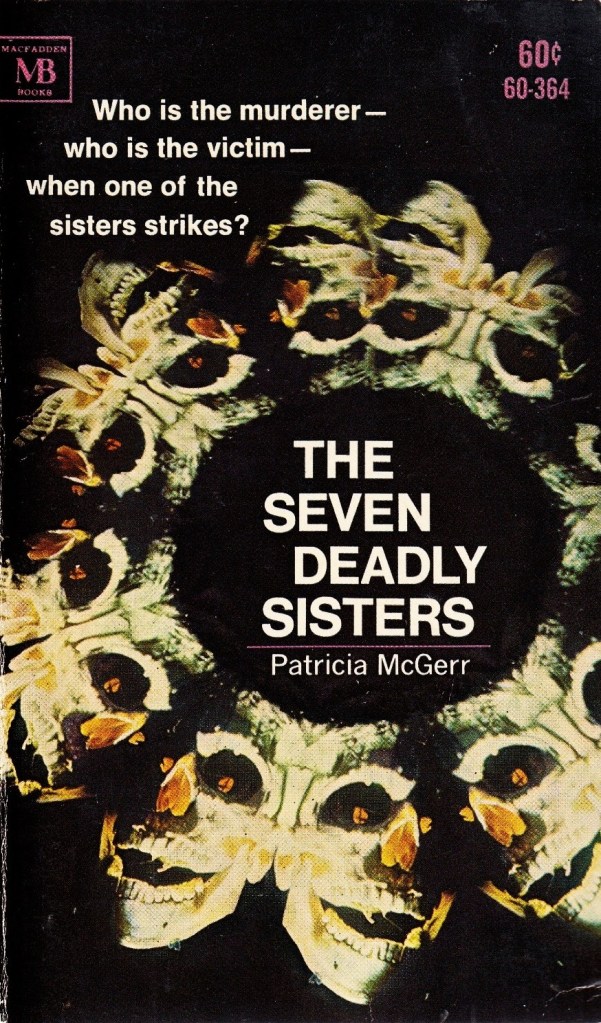


Newly-married and living in England, young American Sally Bowen receives a letter from a friend in the U.S. expressing concern for surprising recent developments: “It must be dreadful to be so far away from home and have your aunt confess that she poisoned her husband“. The only problem is, the letter fails to mention which of Sally’s seven aunts is the poisoner — and with no news agencies open until the following day, Sally doesn’t know who to contact for details…suppose, after all, she asks the poisoner themself? So her husband Peter convinces her to tell him to story of the family, suggesting that he will be able to truffle out the solution and put his wife’s mind at ease.
That, then, accounts for 98% of The Seven Deadly Sisters (1947) by Patricia McGerr, another example of this author’s Whowasdunin subgenre where we know someone’s dead but have to find out, well, who. Alas, where the likes of Leo Bruce mined this idea for good comedy and compelling plot dynamics a decade earlier, McGerr’s take is rather longer on Family Saga, with most of what follows this clever opening concerning the relationships, in-fighting, jealousies, and disappointments of one generation of the Martin family.
At first, the concept of dropping seven sisters, their husbands, and the various family setups — eldest Clara is actually half-sister to the rest, for one — seemed rather too crowded, with too many people possessing too many personalities to keep straight. It’s to McGerr’s credit that she soon settles down and focuses on the mini-dramas within each tranche of the family’s history: usually betokened by the no-good men who come into the family, marry someone, and then cause havoc by either proving thoroughly unsuitable or, in one case, disappearing altogether.
Similar to Enemy Unseen (1945) by Freeman Wills Crofts there’s a fascinating story here for those of you who just want to watch a spread out generation of women (27 years separates eldest Clara and youngest Doris) bicker and support each other through tough times. Clara is intent that everyone make a good marriage so that she is able to hold her head up in society, Tessie is colourless and unappealing to seemingly everyone, Molly gets a fit of undetermined illness every time an outsider comes near here, Agnes — we know from the off — is already having trouble with one husband, and he might not be the first. And through Sally and Peter’s conversation some traps are laid that you know have already sprung at some future point in the narrative (“Did Bert and Doris meet at all during Christmas vacation?”).
Some humour peppers the text…
Occasionally Agnes shouted back at [her unruly children], or slapped whichever one came in reach, but otherwise she made no attempt to control them. The rest of the household could only clench their teeth and try to conceal their homicidal thoughts.
…but this is for the most part an earnest and slow series of car crashes which you feel the inexorable build toward, over and over. In the back of your head is the idea that a murderer and victim must result from this well-drawn domicile, but it never really comes to fruition until almost the last possible moment. And, really, that for me is where the book falls down. About one-and-a-half of the final three pages of my Macfadden edition are concerned with the solution, and, while it can’t be denied that a few pointers were laid along the way, there’s not much to engage the reader who wants more than just catty women making bad decisions and putting hackles up as they get treated poorly by both their kin and the occasional people they invite in.
This is, of course, more of a novel of psychology, the direction the genre started to head in after the Golden Age, and you can draw a clean line from here to the likes of Patricia Highsmith with ease, which is a fascinating prospect for anyone interested in that later school. For GAD devotees like myself, however, this comes as a disappointment for how fully it shrugs off the trappings of the genre which birthed it — a series of well-drawn characters is always lovely, but it takes a little more than that to compel. Hell, in the genre’s heyday, authors managed that and a compelling plot alongside, and it’s difficult not to feel like this represents more of a step backwards than anything else.
 The Invisible Event