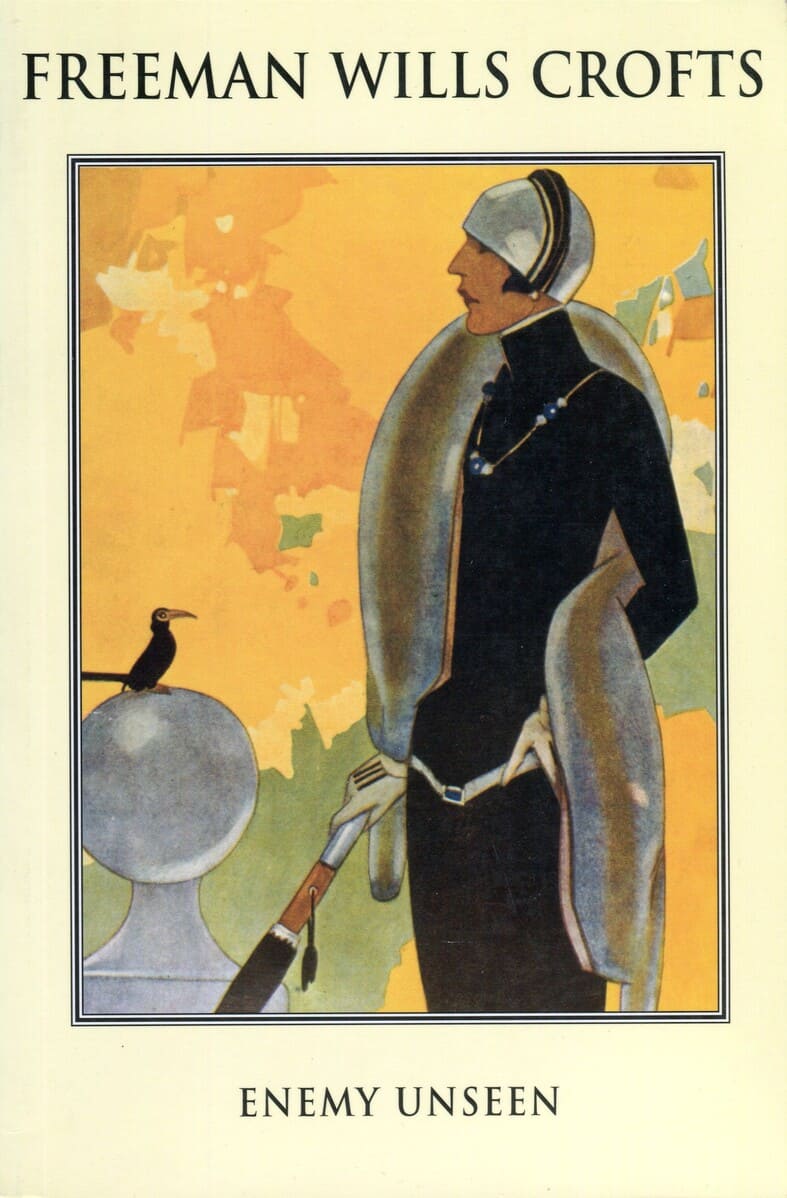


The twenty-fifth long form case for Inspector Joseph French, Enemy Unseen (1945) does not cover its detective or its author Freeman Wills Crofts in glory. While, given the era in which it was written and published, there’s an understandable desire to provide a positive impression of the work of the Home Guard, and for the workings of the country as a whole to appear reassuringly competent, the book seems to have no purpose beyond this, feeling to this FWC fan as if, for only the second time in the author’s long and storied career, he was perhaps putting something out to fulfil an obligation. And yet, its inexorable, dull plodding towards the finish line would be comforting to many — E.C.R. Lorac fans would lap this up, I feel.
The setup, at least, proves intriguing, and you wonder that you haven’t read of this sort of thing before: the Home Guard stores in St. Pols in Cornwall are discovered raided, and 12 live hand grenades stolen. That everyone is at pains to reassure HG Big Cheese Arthur Wedgewood that no blame lies at his door, and that his precautions match those of Home Guards up and down the country is an interesting wrinkle, because, damn, was it really this easy to get your hands on live grenades in the war?! Anyway, a few days later one of the fixtures of St. Pols society is blown up while walking on the beach, and, before long, murder is suspected. Sergeant Rollo, who first appeared in Fear Comes to Chalfont (1942), is in Cornwall on Army Business and given the initial task of investigating the matter, before consulting Scotland Yard — since they have “a file of specialists covering every conceivable department of knowledge” — and, once the matter is shown beyond the scope of Army activities, French is drafted in.
From here it’s a fairly tame plod through the various elements of St. Pols society, and Crofts does a pretty decent job of painting the small pool of those concerned — thriller writer Wickham Crane, local tartar Sir Charles Savory, crossword compiler Dick Little, and their various family members, secretaries, and others — and showing how “fear and dread and mutual suspicion grew among the inhabitants…in an ever-widening circle”. He’s just not in any rush to do it, so find a comfortable chair and settle in.
For all that the book is a good six chapters too long, there’s plenty here for the student of history, with a positive slathering of little points about Life In Wartime. Outside interference about crop rotation on private land, the unavailability of petrol for cigarette lighters, and the closest thing 1945 had to a mobile telephone, there’s the easy familiarity of grief from losing loved ones in bombing raids, paper shortages meaning Crane has completed books which are backed up and waiting to be published, the gradual emergence of the female working class to ‘fill in’ for called-up men, even the question I raised above about grenades:
When the authorities had thoughtfully placed instruments of death all over the country in insecurely fastened huts, why should not any taxpayer with murderous designs take advantage of their complaisance?
Honestly, part of me wished that there was no murder, and that I was just reading Crofts detailing the minutiae of these people living on the edge of the war, because I really liked the community (see, that Lorac comment above wasn’t the jibe you uncharitably suspected). The opening lines of chapter five contain a good joke, too, and Crofts is on witty form elsewhere…it’s just a shame that there’s the albatross of a stolid and woebegone investigation around the neck of this otherwise quite charming little book. Crofts commenting on the paper shortages in a book that uses an excess of paper during wartime feels almost boldly ironic, because the Joseph French of The Sea Mystery (1928) would have solved this in half the time.
This was the first of five French novels not included in the recent raft of Harper Collins reprints, and it’s to be hoped that the remaining titles show a little more life (it’s also to be hoped that I can find a pristine condition House of Stratus copy of Death of a Train (1946), the next book in the series, because I don’t have that yet). The war took its toll in many ways, and, as suggested above, there was perhaps a more important role in the writing of this, but it’s not a place to break bread with Crofts, however charitably one tries to view it.
~
Freeman Wills Crofts on The Invisible Event:
The Standalones
The Cask (1920)
The Ponson Case (1921)
The Pit-Prop Syndicate (1922)
The Groote Park Murder (1923)
Featuring Inspector Joseph French
Inspector French’s Greatest Case (1924)
Inspector French and the Cheyne Mystery (1926)
Inspector French and the Starvel Hollow Tragedy (1927)
The Sea Mystery (1928)
The Box Office Murders, a.k.a. The Purple Sickle Murders (1929)
Sir John Magill’s Last Journey (1930)
Mystery in the Channel, a.k.a. Mystery in the English Channel (1931)
Sudden Death (1932)
Death on the Way, a.k.a. Double Death (1932)
The Hog’s Back Mystery, a.k.a. The Strange Case of Dr. Earle (1933)
The 12.30 from Croydon, a.k.a. Wilful and Premeditated (1934)
The Mystery on Southampton Water, a.k.a. Crime on the Solent (1934)
Crime at Guildford, a.k.a. The Crime at Nornes (1935)
The Loss of the ‘Jane Vosper’ (1936)
Man Overboard!, a.k.a. Cold-Blooded Murder (1936)
Found Floating (1937)
The End of Andrew Harrison, a.k.a. The Futile Alibi (1938)
Antidote to Venom (1938)
Fatal Venture, a.k.a. Tragedy in the Hollow (1939)
Golden Ashes (1940)
James Tarrant, Adventurer, a.k.a. Circumstantial Evidence (1941)
A Losing Game, a.k.a. The Losing Game (1941)
Fear Comes to Chalfont (1942)
The Affair at Little Wokeham, a.k.a. Double Tragedy (1943)
Enemy Unseen (1945)
Young Robin Brand, Detective (1947)
The 9.50 Up Express and Other Stories [ss] (2020) ed. Tony Medawar


Crofts presents an attractive picture of a small cosy community in wartime. With weapons of war linked to nonmilitary killing, the how-dun-it is crucial to the who-dun-it; the author’s engineering background encourages him to indulge in technical detail. In his characterisation Crofts deserves credit for the varied use he makes of a much hated resident who is an obvious candidate for murder victim. Two pages from the end of the novel French is playing the waiting game and recalls the vigil at the end of ‘Sir John Magill’s Last Journey’, a more rewarding investigation for both detective and reader.
LikeLike
Nicely put; the atmosphere and sense of place in this are wonderful, and some of the characters are stronger than one might expect. But, yeesh, it’s not the most thrilling mystery he ever compiled. Hopefully he bounces back with the next one.
LikeLike
I hope you find Death of a Train -I read it in a classic Penguin paperback & while a mid level book overall it has some very strong points.
LikeLike
Thanks, Eric — I remain hopeful. I got very lucky in finding most of the titles I needed in these Stratus editions, but Death of a Train has always eluded me. Hope springs eternal…
LikeLike