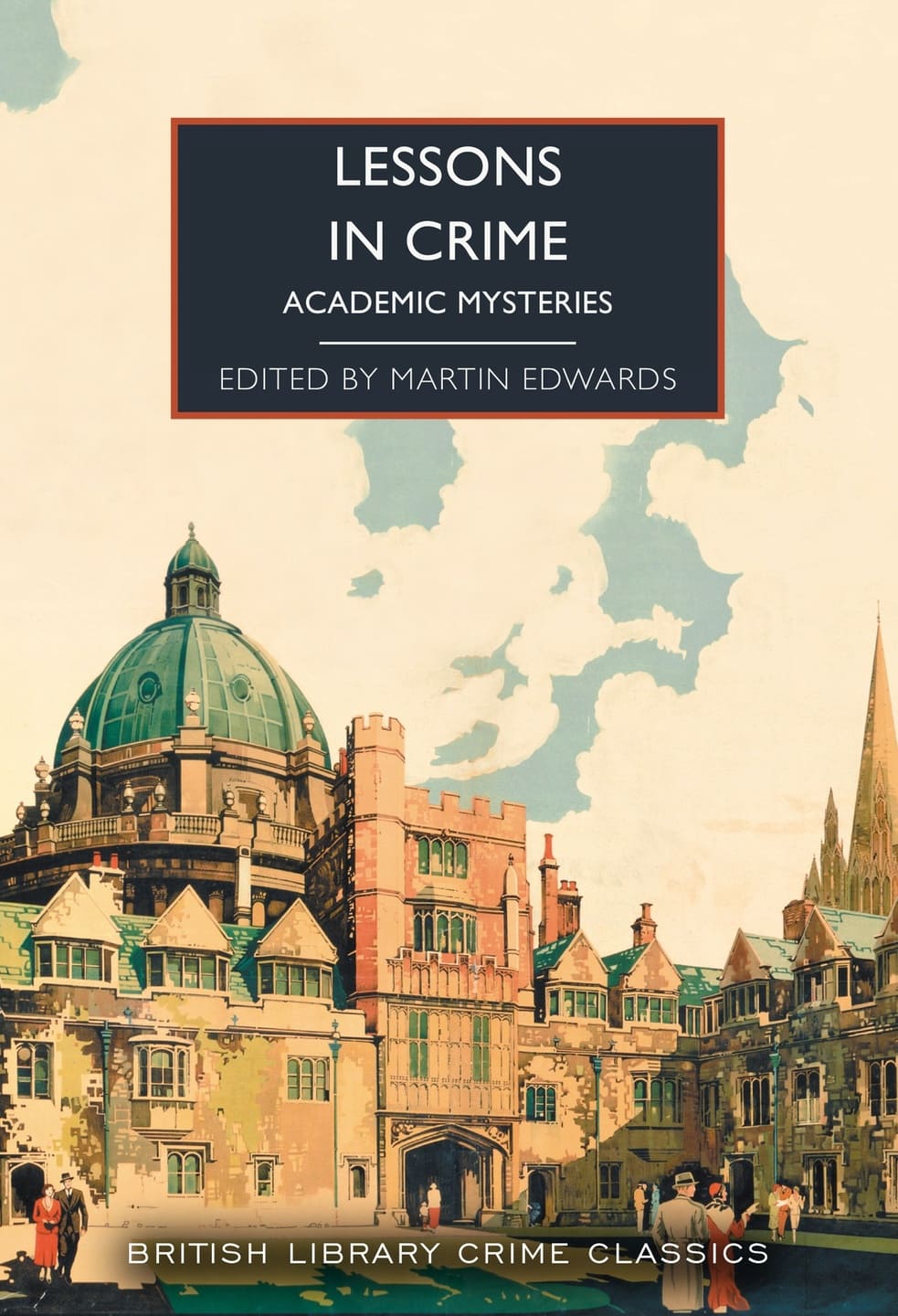
Featuring fifteen felonious fables from phrontistery factions, Lessons in Crime [ss] (2024) is another collection in the British Library Crime Classics range edited by the acme of appreciation of this era, Martin Edwards.
Edwards’ introduction is commendably broad-ranging, looking to explore the academic mystery through the Golden Age and beyond, calling on his no-doubt-enviable book collection and drawing out some interesting parallels and areas of development.
Why did Oxbridge and preparatory and boarding schools feature so heavily in vintage crime fiction, when redbrick universities and state schools were conspicuous by their absence?
So, can we expect lots of upper-class sleuths hanging around Oxford and Cambridge, dwelling on their past glories? Or might we get a few state school murders in there for good measure? I strongly suspect the former, but I’m willing to be wrong; let’s study these in more depth…

It’s a bold move indeed to open things with ‘The Greek Play’ (1930) by H.C. Bailey, one of the author’s Reggie Fortune stories. I find Bailey astoundingly variable — he’s written some of the best stories collected in this series, and also some of the worst — and for me this is an example of him at a low ebb.
When he writes well, Bailey is fast-paced, compelling, and bristling with inventive ideas. Here, the whole thing is soaked in facetious airs and everyone — the Fortunes, the schoolchildren, the police — talks in the exact same arch voice, rendering the whole thing like a one-man play that’s far less good than its star seems to think. As a fan of Mr. Fortune at times in the past, this very much made me understand why some people revile him.
Being a Sherlock Holmes story, ‘The Adventure of the Priory School’ (1904) by Arthur Conan Doyle will get its day in the sun on The invisible Event, and I’m saving it for that. Read my examinations of the other Sherlockian shorts starting here, and this one will join them in due course.
Having been thus far underwhelmed by the short fiction of Henry Wade, I found the opening stages of ‘The Missing Undergraduate’ (1930) conforming to my expectations, with a fairly obvious conclusion on the horizon. Then it took a most unexpected turn and developed into something rather different, and for the better. I’m still not convinced that Wade is cut out for short stories, but this was a pleasing example of some competency in that area.
Making much of its protagonist’s education, ‘The Gilded Pupil’ (1936) by Ethel Lina White crawls along, is told from an annoying number of shifting perspectives, contains an obvious kidnap plot, and holds back its one moderately diverting idea until the end so that it can sustain a modicum of interest. Despite some nice phrasing (“Her mouth and chin had assumed the nutcracker of age.”), I did not care for it.
Ahhh, to fall into the arms of Dorothy L. Sayers and ‘Murder at Pentecost’ (1933), one of her eleven Montague Egg stories. Apparently I thought this a “duff” when I read the collected stories, but here Sayers’ humour twinkles through (“Besides, the police have been called in, and are certain to annoy the Senior Common Room by walking on the grass in the quad.”) and little character notes delight, like the doddery Mr. Temple having a fixation that sees him confess “[e]very time a murder is committed in this country”.
Sure, there’s no rigour to Egg’s solution, and I can well believe that it was this which vexed me at first blush, reading it as I did in an era when such matters were becoming almost obsessively important to me. But reading this in the context of this collection, following several unsuccessful attempts to marshal a compelling short form of the criminous narrative, it really does show its class. Sayers really does shine amongst her peers in these contexts (see also: Six Against the Yard (1936)); we were lucky to have her.
Why might a trio of crooks want to break into the isolated boys’ school ‘Ranulph Hall’ (2000)? That’s the question posed by Michael Gilbert and, while the answer turns out to be rather pedestrian, it’s difficult not to enjoy the — alas, all-too-little — time spent with the three schoolboys who make up “the CID” and who vow to protect their property. I don’t share Edwards’ love of Gilbert’s writing, but this was pleasing enough if a little lacking.
A return to gentleman cricketer-thief Raffles in ‘The Field of Philippi’ (1905) by E.W. Hornung. When an unpopular ex-Head Boy of the school Raffles and Bunny attended as young men speaks out against the Old Boys subsidising the future of the school, Raffles does what he does best and plans to force the man to contribute through burglarous means. There’s a point of refinement at the close which I’m not entirely sure I understand, and the story takes a lot of telling for how simple you know it’s going to be, but Raffles is fun and Hornung writes well both from an incident and a historical perspective:
“I call first-class cricket a disgraceful calling, when it’s followed by men who ought to be gentlemen, but are really professionals in gentlemanly clothing. The present craze for gladiatorial athleticism I regard as one of the great evils of the age; but the thinly veiled professionalism of the so-called amateur is the greatest evil of that craze.”
Next up, 24 pages of hell, a.k.a. ‘Lesson in Anatomy’ (1946) by Michael Innes. And yet, god help me, has Innes ever been this witty before (“Appleby, though not unaccustomed to such places, had no aspirations toward connoisseurship.”)? Has he ever been this much fun, with an end-of-year demonstration of the autopsier’s art bedevilled by undergraduate horse-play and sudden death? Why does the description of the university’s Vice Chancellor as “very Welsh” amuse me so? Dear lord in heaven, did I enjoy this? What have I become?!
We step beyond the Golden Age with ‘Dover Goes to School’ (1978) by Joyce Porter, in which a strangled body in the bathroom of an adult education college sees the obese, unpleasant Inspector Dover brought in to investigate. I think Dover’s truculence is supposed to be funny, but I found him an unbearable tosspot and didn’t finish this on that account.
‘When the Deaf Can Hear’ (1959) by Malcolm Gair is a short, sweet, and well-written tale of theft, and it’s a shame that the key clue isn’t more rigorously introduced so that the story was more satisfying in its conclusion. Gair drops in some neat little asides and has a light touch with key events, I just wish this had been written 20 years earlier when the overall scheme might have been tighter.
I enjoy a good semi-inverted mystery short in which we watch someone plan out and commit a crime, and ‘Low Marks for Murder’ (1971) by Herbert Harris is a good one — indeed, Edwards has included quite a few good examples of this style of story in these BL collections over the years. There’s a sense here of our murderer’s vanity getting the better of him, but the whole thing is so swiftly and cleanly told that you wouldn’t accuse Harris of belabouring a point. You’ll not hear from me whether he gets away with it, let’s sustain some tension, but it’s pleasing how the final stretch of this leans so easily into a few simple ideas — showing you don’t always need to be ingenious to write well.
‘The Harrowing of Henry Pygole’ (1974) by Colin Watson sees two boys in the Sixth Form of a public school decide to play a prank on the eponymous Pygole purely because he irritates them, and the scheme they dream up is rich in the calculated cruelty of the young. The eventual destination of this will hardly surprise anyone, and it’s to be felt that the psychology on which the denouement hinges could have been more appropriately prepared, but as an attempt at a sort of Roald Dahlian Tale of the Not Completely Unexpected it has horrors enough and a grubby enough air to its developments to ensure it lives on in the memory.
Another short one next, with ‘Dog in the Night-Time’ (1954) by Edmund Crispin concerning two dead men and a missing diamond. This was written for the newspapers, so shouldn’t be judged too harshly, and turns on the sort of clever small points that betokened much of Crispin’s very short fiction.
If at times ‘Battle of Wits’ (1967) by Miriam Sharman feels a little over-earnest (“I’m fighting you with my intellect, that is what you wanted. I’ve pointed out the serious flaw in your juvenile scheme of vengeance.”), this story of a headmaster being confronted by a parent with a grudge benefits from a superbly compact telling and a canny idea well-inserted into the closing stages. It’s very 1960s, but that plays into its strengths: something this po-faced would be hard to take from the Golden Age, but the extra couple of decades of marinading means it portions out its various ingredients very well indeed.
Finally, another non-Golden Age story, from perhaps the most surprising source of all these collections: ‘The Boy Who Couldn’t Read’ (1978) by Jacqueline Wilson. Putting these last two stories next to each other is a stroke of genius, because they’re both two-headers concerned with power dynamics, but in Wilson’s story there’s never any sense of equity, of a fair fight, and the sense of domestic horror it brings to proceedings is magnetic.
This is also a compelling character piece, as a washed-up teacher nearing the end of his career keeps a recalcitrant child back after school, with a lifetime of petty furies and disappointments coming out through the third-person narration. I had no idea Wilson had written some crime novels earlier in her career, and on this evidence I can believe they’d make very fine reading.
A top 5, then:
- ‘Lesson in Anatomy’ (1946) by Michael Innes
- ‘The Boy Who Couldn’t Read’ (1978) by Jacqueline Wilson
- ‘The Missing Undergraduate’ (1930) by Henry Wade
- ‘Low Marks for Murder’ (1971) by Herbert Harris
- ‘Battle of Wits’ (1967) by Miriam Sharman
To be honest, I feel as if I didn’t care for this collection as much as I have others in this series, and yet the highlights are among some of the best Edwards has ever chosen. Maybe it was that Reggie Fortune story up front throwing me off my stride, but I never felt like I really settled into this in the same I way I have elsewhere. And the times I did settle, strange things were afoot — like finding Michal Innes enjoyable, which has already provoked much soul-searching.
There are some good ideas here, and some strong stories to finish the collection off, and it is of course no surprise that a multi-author collection should elicit a range of responses. I really did rip through this one very quickly indeed, and Edwards’ editorial eye remains on point when it comes to a variety of takes and styles within a theme. I’ll leave this with fond memories of the Wade, Innes, Wilson, Gair, Harris, and Sharman stories, and it is good to be reminded that Bailey is a somewhat variable proposition where future reading plans are concerned. So, all told, this has been another lively time in the arms of a genre I still love, enriched by some unexpected selections and a pleasingly catholic approach to the notion of a crime story.
See you in a month or so for another…
~
See also
Adam @ Murder at the Manse: Although I enjoyed the strong unifying theme of this collection, I found the overall quality of stories lower than average for a British Library anthology. A few are especially uninteresting, namely those by E. W. Hornung (who I often struggle with), Malcolm Gair (who gives the game away with his title) and Edmund Crispin (a controversial opinion, perhaps). There are still a number of very good stories, though.
~
British Library Crime Classics anthologies on the Invisible Event, edited by Martin Edwards
Capital Crimes: London Mysteries (2015)
Silent Nights: Christmas Mysteries (2015)
Crimson Snow: Winter Mysteries (2016)
Continental Crimes (2017)
Foreign Bodies (2017)
The Long Arm of the Law (2017)
Deep Waters: Mysteries on the Waves (2019)
Settling Scores: Sporting Mysteries (2020)
Guilty Creatures: A Menagerie of Mysteries (2021)
Murder by the Book: Mysteries for Bibliophiles (2021)
Final Acts: Theatrical Mysteries (2022)
Crimes of Cymru: Classic Mystery Tales of Wales (2023)
Who Killed Father Christmas? and Other Seasonal Mysteries (2023)
Lessons in Crime: Academic Mysteries (2024)
Cyanide in the Sun and Other Stories of Summertime Crime (2025)
As If by Magic: Locked Room Mysteries and Other Miraculous Crimes (2025)


I actually like The Greek Play! Having read so many Reggie stories, it was fun to read a Joan-heavy one and there are some fun dynamics as a result. The mystery itself was meh, but I enjoyed the atmosphere (and the fact that it was one of the few stories in the collection with girls in it lol- as someone who went to an all-girls school that’s always fun) and I think that Bailey at his most irritating-to-others doesn’t bother me much.
Otherwise I agree, a weakish collection despite a fun Monty Egg (when you reviewed it separately I was sad to see you score it so low and it’s nice to see you appreciate it a bit more now! I’m so curious what you’ll think of her non-detective crime fiction) and a pretty good Raffles (though not one of my favorites). I feel like the number of non-GAD crime stories was a bit excessive for my tastes.
Completely random question unrelated to the collection, but while I’m here- have you read any John J Malone (Craig Rice) books past Having Wonderful Crime? I just read that and saw it’s the last you reviewed and I wasn’t sure if it was because the others hadn’t made it to the top of the pile yet or you dropped them because you Knew Something lol. (Having Wonderful Crime was definitely fun, especially as a NYC resident, but it does kind of stretch Rice’s shtick of achieving suspense by separating all the characters and refusing to let them talk to each other as they each investigate different things to the limit.
LikeLike
I have not read any Rice since Having Wonderful Crime, no. Part of the difficulty is finding them: the next one chronologically that I own is The Lucky Stiff (1945), which means I need The Thursday Turkey Murders, Murder Through the Looking Glass, and To Catch a Thief before I can get to that one. At the moment I’m merely remaining hopeful, but I’m sure the despair will set in at some point 🙂
There are times I wish I lived in the US, since the larger population means a more active secondhand book market, which would a) solve many of my problems, though b) probably bankrupt me. So rest assured that you’ve missed nothing in that corpus on this blog, but also that it may be a while before any more crops up.
LikeLike