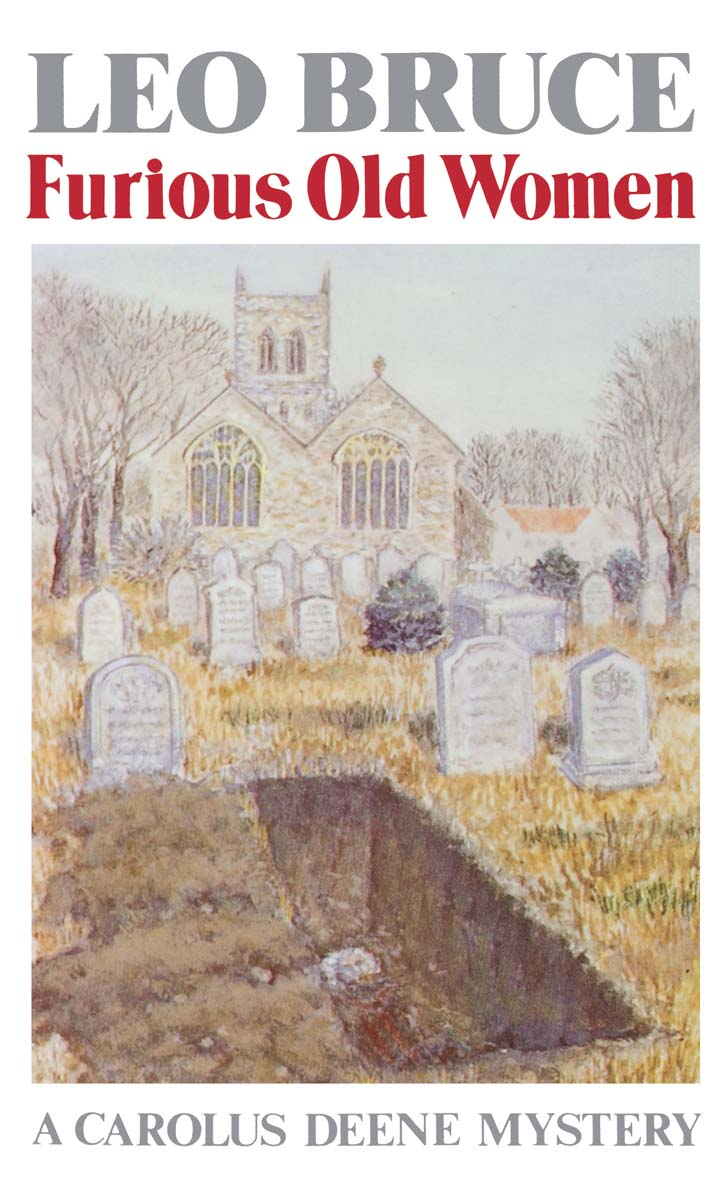


“Milly may have been mean and sanctimonious but she was my sister. To club her to death on her way to church was quite damnable.” So speaks Mrs. Bobbin, the elderly widow who has approached History master Carolus Deene to investigate the murder of her elder sister, Millicent Griggs having been found beaten over the head and hidden in an open grave in the churchyard in the small village of Gladhurst. Since all the police have done in the intervening week is ask “a series of questions even more moronic than [Deene’s],” Mrs. Bobbin wants something more achieved: “I’m livid. So don’t take too long in solving the thing.”
Furious Old Women (1960), the seventh of Leo Bruce’s twenty-three novels to feature his crime-solving teacher, gets us off to the start it promises: for all that Gladhurst “looked friendly…a Christmas card village in which one would have supposed there lived only jovial farmers and their amiable workers, kindly cosy people with no enmity or cruelty among them”, it takes only a small amount of poking around before Deene uncovers enmity enough for “the outwardly cheery people he met [to] turn into malicious, jealous and violent brutes before his eyes”.
What Bruce captures well here is a strong sense of a village where everyone is, whether they want to be or not, involved in the lives of everyone else. This is captured not merely by the way information spreads in a manner that makes wildfire look lethargic — see churchwarden Colonel Fyfe talking to local coquette Flo in the High Street, only to be challenged by his bed-ridden wife about it as soon as he gets home — but also in lovely subtle touches like the local aphorisms (“Good with boys.”, “She doesn’t mind.”, etc) trotted out at the mere mention of certain names. Bruce celebrates village life — see his railing again against the loss of identity of the local pub in favour of “standardized swilling-houses for standardized products at standardized prices, [which] have lost all character, and in a few years their customers will be as standardized as they are” — but he’s wise to its less desirable aspects and shows them well.
In a cast of Types, Bruce again does well to keep the people feeling fresh and memorable, from the taciturn publican and his son to the sexually-rapacious Mugger, from High Church-favouring Grazia Vaillant to supposed termagant Mrs Rumble, wife of the deacon. Some good character notes scatter proceedings (c.f. the long-sought Dundas Griggs immediately captured as “a thin jocular man, all neck and wrists, long teeth and chuckles”) and the way strong-minded people will rub each other the wrong way feels baked into the earth. Like the best village mysteries, the village here really feels real, with plenty of anger at the intrusive ways of others (“When a woman reaches my age, Mr. Deene, she is entitled to her wrath.”) and Deene artfully picking his way through the more sensitive areas.
As a mystery, alas, the book does not match its setting. Solidly two-thirds of this is very easy to see through, even if Bruce does delay a key piece of information until the latest possible moment, and the remaining third, I must say, is only difficult to call because I read the explanation twice and till don’t understand it. The conversations Deene has aren’t as stultifying as I’ve encountered elsewhere in this series, but the general air stirred up is ephemeral at best (“Deene himself laments “[a]ll this vagueness” at one point) and the few palpable clues there are are then dropped with the grace of Chesterton falling on a sheet of tin. But, well, what’s good here is good, and Bruce doesn’t need to resort to one or two ‘big’ characters to make up for shortcomings, as he has done elsewhere; the humour is suitably British, with perhaps the best joke pertaining to the landscape painter John Constable.
Elsewhere, Bruce is clearly — and, given his own personal experiences, understandably — jaded about the professional ranks of the police…
“I do not like policemen. They are paid to protect the public and their failure to do so in the last twenty years has turned the country into a paradise for criminals while decent citizens who overstep some silly little law are harassed and persecuted. I believe the police are often corrupt and unscrupulous and I’m almost as angry when I think of their failure in this affair as when I think of the murderer’s success. If the police should hit on a solution before you it will either be a miracle or a mistake.”
…and this, along with a frank discussion of suicide and insanity, shows a clear progression from the Golden Age which gave our author his start, where such matters would be, at best, merely heavily implied. As such, the book makes an interesting example of a genre straddling the period of change it had to navigate, and commends itself to anyone interested in how that segue was achieved. For the rest of you, this is light, enjoyable, and none-too-taxing, and may be exactly the book you’re looking for after a long day; not high praise, no, but, in these divisive days, at least it won’t make anyone angrier than necessary.
~
See also
Rusty @ Justice for the Corpse: Bruce’s strengths and weaknesses are both on display here. The solution to the mystery is surprising and well-clued (Bruce was very strong on being fair to the reader who approached one of his books as a puzzle, sometimes even delivering an Ellery Queen-style challenge just before the denouement). Carolus – who starred in 24 [sic] of Bruce’s books – is a low-key but likeable series detective. And if a lot of the action consists of Carolus interviewing suspects, the interviews are entertainingly written. Also, there are enough fresh developments to keep the books from becoming too Ngaio Marsh-like with regard to story structure.
~
The Carolus Deene novels by Leo Bruce
- At Death’s Door (1955)
- Death of Cold (1956)
- Dead for a Ducat (1956)
- Dead Man’s Shoes (1958)
- A Louse for the Hangman (1958)
- Our Jubilee is Death (1959)
- Furious Old Women (1960)
- Jack on the Gallows Tree (1960)
- Die All, Die Merrily (1961)
- A Bone and a Hank of Hair (1961)
- Nothing Like Blood (1962)
- Crack of Doom, a.k.a. Such Is Death (1963)
- Death in Albert Park (1964)
- Death at Hallows End (1965)
- Death on the Black Sands (1966)
- Death of a Commuter (1967)
- Death at St. Asprey’s School (1967)
- Death on Romney Marsh (1968)
- Death with Blue Ribbon (1969)
- Death on Allhallowe’en (1970)
- Death by the Lake (1971)
- Death in the Middle Watch (1974)
- Death of a Bovver Boy (1974)


This was the first Bruce I read, in 1999. (Tempus fuggit.) Barzun and Taylor reviewed a great many Bruces, and I expected something akin to Edmund Crispin! I was rather underwhelmed. And isn’t the structure (accident, suicide, murder all looking like each other) the same as Taken at the Flood? Most of the Deenes pinch other people’s plots, not as well.
LikeLike
Yes, the plots of the 8 I’ve read have all popped up elsewhere first. But, in fairness to Bruce, that by the time the Deenes came around — post-Golden Age, after all — pretty much everything had been done. And I doubt he had the spirit to try and innovate too greatly.
I think there’s a reason he’s better known for the Beefs — despite their flaws, they’re more in the spirit of innovation that the Golden Age thrived on.
LikeLike