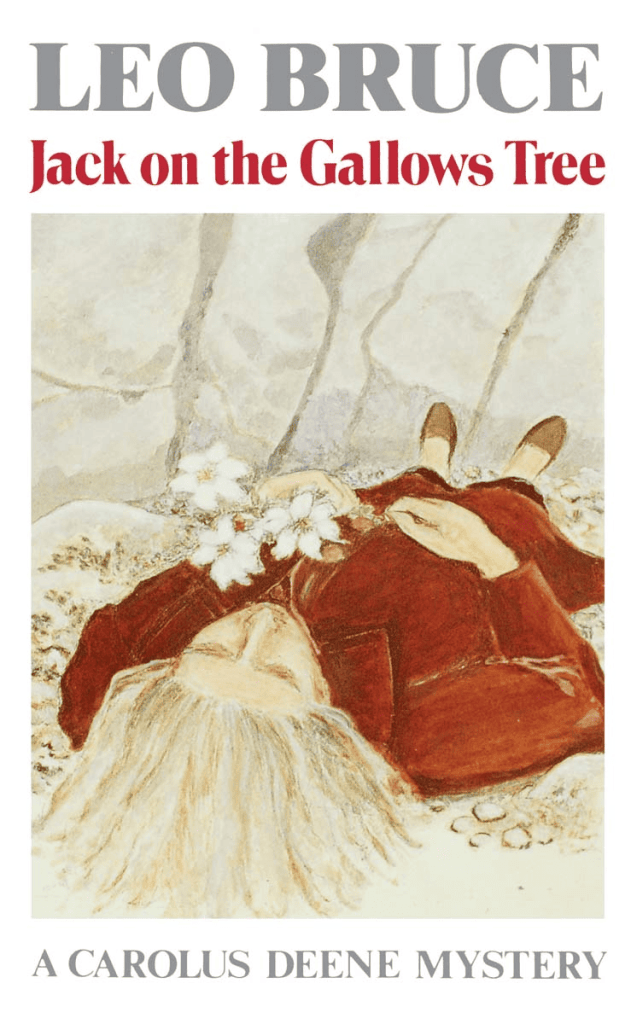


Recovering from a bout of jaundice, History master Carolus Deene is sent by his headmaster to sleepy Buddington, “famous for its population of rich and aged invalids” and the fact that “[t]here, alone in all England, the bath-chair survives as more than a relic”. There it is hoped that Deene will refrain from “jeopardizing the fair name of the Queen’s School by embroiling [him]self in detective work of a nature likely to result in unfortunate publicity”. Alas, immediately prior to his arrival, two elderly women are found strangled to death on the same night, the arrangement of their bodies suggesting some link. And Deene’s reputation precedes him to the point that he finds himself investigating almost against his will.
Jack on the Gallows Tree (1960) is the eighth of Leo Bruce’s Carolus Deene novels, and improves upon my previous encounter with this series, Dead Man’s Shoes (1958), in that it is both more readable and more obscure in its mystery-making. Able to concoct plots for the murder of either woman but not both, Deene becomes convinced that he’s “up against intelligence, desperate cunning, and a kind of diabolic nerve”, though his friend DI John Moore dismisses the history teacher as “a dabbler looking for complicated, intricate motives and mental processes, whereas I’m pretty sure that the truth here is a simple one”. Undeterred, Deene takes it upon himself to speak to the locals to see what he can conclude.
And so he talks. And talks. And talks. And, when he’s done talking, he does some more talking, has a bit of a chat, and engages a few others in a natter or two. Oh, my god, it’s tedious — at the three-quarter mark he is still hashing over information we learned in the second chapter, and despite claiming to have got wise to the motive at the halfway point he proceeds to tell no-one, have more chin-wags, and then track down a few more of the too many satellites of the case for a conversation. “Will you ever stop talking, Deene?” he’s asked in the multi-chapter summary he provides, and, no, it seems he won’t.
For all the tedium of endless yakking, Bruce litters the book with some fascinating ideas, accidentally making this much more interesting for the student of social history, with social division more prominent (“They let rooms.”), “the National Health” getting a few mentions, and a sense of the world moving on inexorably creeping through:
He realized that in England the wearing of black clothes and strict rules of mourning had gone out when the first world war brought the necessity for mourning to most homes and the thing had lapsed through excess. He did not expect to see widows’ weeds and crêpe arm-bands, but surely near relatives, in this case a son and daughter-in-law, might have been a little less jovial in manner and flamboyant in dress.
Indeed, Bruce seems almost at pains to cynically chart the differences between this era and those of his Sergeant Beef books, be it regarding detection (“Why start again the old routine of enquiry, observation, deduction, analysis till a conclusion was reached and some wretched being was arrested, charged, tried and hanged?”), detecting as a science (“Couldn’t be cornier, could it? I suppose if you’d gone out on the day after the murder you’d have been looking for footprints.”), the notion of the likeable sleuth (“I believe you like all that phony darts-with-the-locals stuff. Personally, it makes me sick to my stomach.”), or simply the world of publishing in general (“she…had been satisfied with her one book and had not tired everyone with unnecessary and artificially compounded sequels.”).
Some wonderful characters litter the piece — the hypochondriac Mr. Gilling a particular highlight, as is the pub landlady Miss Shapely (“I’m listening, Mr. Carew.”) — but there are far too many people mentioned too casually in the opening stages who are then steadfastly sought and spoken to as if we’ll remember them ten chapters later. And Deene’s student Rupert Priggley is on the scene again, doing virtually nothing once more and adding nothing to proceedings except to remind us that we could be reading a far more interesting book:
“If you suppose that at your time of life you can turn yourself into one of these hard-boiled, steel-gutted, lynx-eyed American sleuths who carry guns and risk their lives every few pages, you’re wildly mistaken. You’re English, sir, as English as Sherlock Holmes and Hercule (Ma foil) Poirot.”
And, at the end of it all — assured, in the anti-Golden Age spirit that “[t]his case isn’t going to be cleared up by question and answer and a solution like a crossword’s” — Deene has the temerity to tell us that “[n]o old-fashioned ‘clues’ were left to help us, no bits of fluff or cigarette ash or fingerprints,” despite having spent zero time looking for them (the New Age of Mystery wouldn’t stoop to demean itself with such matters, you feel). It’s vexing when he won’t tell Moore of his “notions” early on, but then you realise how thin the whole thing is and you wonder if he’ll ever be allowed near an investigation again (he would, fifteen more times).
There’s fun to be had — Rupert Croft-Cooke, the man who was Leo Bruce, apparently exists in this universe — but Deene is so bland, for all the talk of that “during the war he did violent things, always with a certain elegance for which he was famous”, and the story so glacial in its developments that the occasional glitter is alas o’ercome by the dullness surrounding it. There are distinct aspects of this post-Golden Age mystery form which are very appealing, but I’m currently not exactly ruing having made a study of GAD over its chronological brethren. Bruce writes well and his characters are fun, though, and more forgiving minds than mine might well love this.
~
The Carolus Deene novels by Leo Bruce
- At Death’s Door (1955)
- Death of Cold (1956)
- Dead for a Ducat (1956)
- Dead Man’s Shoes (1958)
- A Louse for the Hangman (1958)
- Our Jubilee is Death (1959)
- Furious Old Women (1960)
- Jack on the Gallows Tree (1960)
- Die All, Die Merrily (1961)
- A Bone and a Hank of Hair (1961)
- Nothing Like Blood (1962)
- Crack of Doom, a.k.a. Such Is Death (1963)
- Death in Albert Park (1964)
- Death at Hallows End (1965)
- Death on the Black Sands (1966)
- Death of a Commuter (1967)
- Death at St. Asprey’s School (1967)
- Death on Romney Marsh (1968)
- Death with Blue Ribbon (1969)
- Death on Allhallowe’en (1970)
- Death by the Lake (1971)
- Death in the Middle Watch (1974)
- Death of a Bovver Boy (1974)


Should’ve named him Garrulous Deene.
LikeLiked by 1 person
I am furious with myself for not thinking of this. Chapeau.
LikeLike
Yes, the endless static talk! I said: “Bruce’s style mars one’s enjoyment of the plot. There are extremely few digressions or descriptions; instead, it is nearly all conversation, which, while advancing the plot, can sometimes give the impression of talking heads in an under-funded set.”
LikeLike
Yes! That reference to an under-funded dramatisation is spot on.
LikeLike
Yes something changes in Bruce’s plotting when he switches from the Beef mysteries to the Deene ones. A few years ago I did a comparison post for Case for Three Detectives and A Bone and a Hank of Hair. There are certainly a lot of differences in approach/style between the series. I recently picked up a copy of Such is Death, mainly because it is set near to Christmas and I like to find a festive classic crime title to read in the Autumn.
LikeLike
I have a theory of sorts about this, but am trying to get it into shape for June so won’t attempt a diluted version of it here 🙂
LikeLike