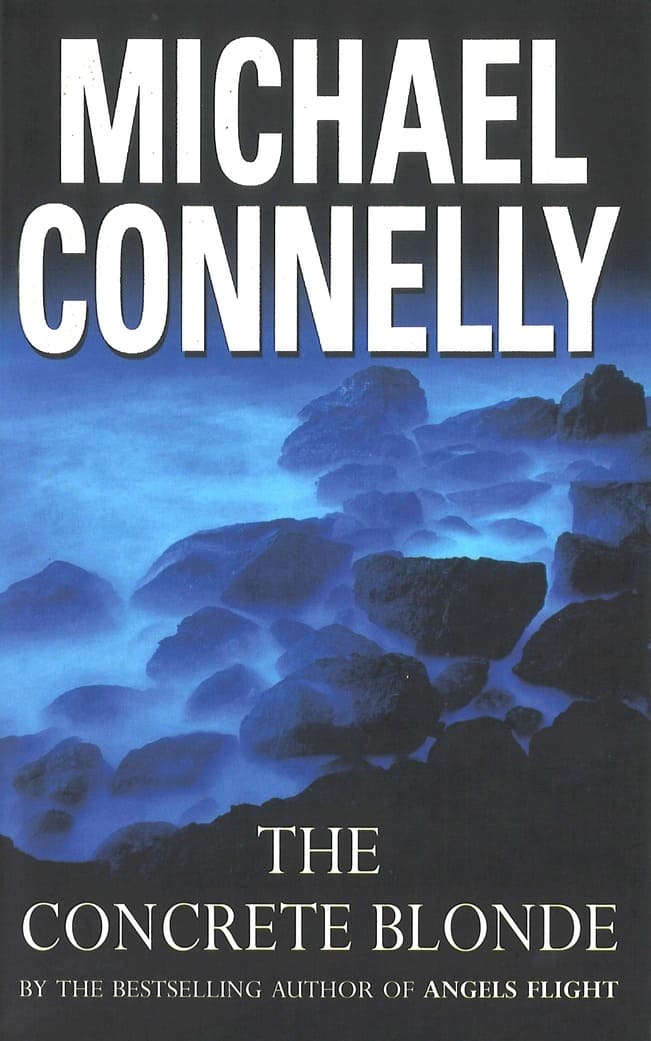
Another crime novel from my early-2000s reading that put me on the path to classic detection and hence this blog.
A serial killer is on the prowl, who is…
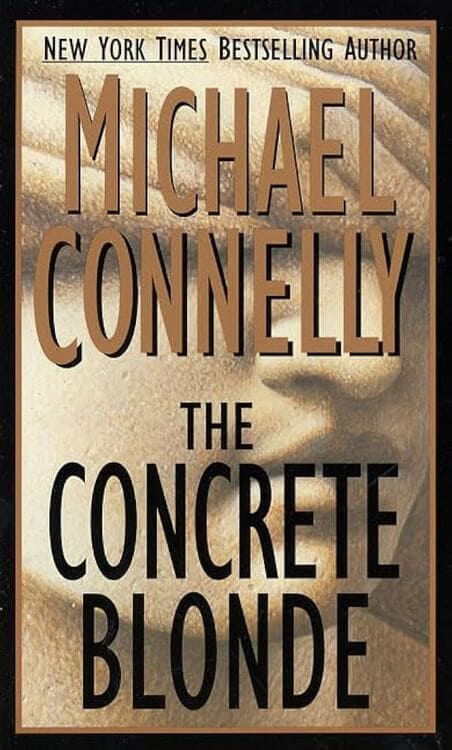
The Concrete Blonde (1994) by Michael Connelly
How I encountered this book
After first encountering Connelly through his standalone thriller Blood Work (1998) I went on to read his other standalone thriller The Poet (1996) before starting his series featuring LAPD detective Hieronymous ‘Harry’ Bosch. The received wisdom on the internet forums I frequented at the time was that the Bosch series — at the time only seven books long, but now in the thirties — should be read in order, so I started with The Black Echo (1992) and The Black Ice (1993) and, despite not really loving either, continued. The Concrete Blonde (1994) is the third Bosch novel, and probably the point at which the series began to really interest me.
What’s it about?
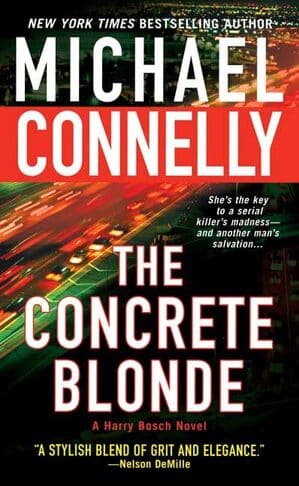
Harry Bosch is on trial for the fatal shooting, four years previously, of Norman Church, a man believed to be notorious serial killer the Dollmaker, who was responsible for the murder for eleven women. As the trial starts, the LAPD receive a note in the same style as those received from the Dollmaker, pointing them to a previously-unknown victim, who bears all the hallmarks of the Dollmaker’s crimes. And when evidence reveals that this victim died after Church, Bosch must face up to the possibility of having killed the wrong man, that such a mistake could cost him his career.
Any seeds of detection?
Given that the Bosch books are largely police procedurals, there’s often a fair amount of detection within the stories. The Concrete Blonde does, however, seem to possess a slightly higher percentage of clewing and provision of information than I remember from elsewhere in the series — though, given that I read a lot of them and it’s been a few years, I could be misremembering here.
What’s pleasing is the way this attention to important details bleeds into various aspects of the plot: Bosch is able to deduce that someone is leaking information about the newly-discovered body when prosecuting attorney Honey ‘Money’ Chandler asks him a question that she would have no basis to otherwise ask, for instance, and then seeds of this betrayal are sewn within the narrative in a way that, if not exactly watertight, at least pays off some small details later on. The thriller aspect of these books could simply blindside you with this without taking the time to establish that Bosch is intelligent enough to have reasoned it out himself, but that Connelly took these extra couple of steps reflects well.
When it comes to the identity of the serial killer, things are a little more wobbly, but probably just about enough is done to get us over the line. It’s fairly staggering to me how rocked everyone is when evidence is produced to show that Church definitely didn’t have the opportunity to commit one of the crimes, and it seems to take them an age to put the correct spin on this information, but, again, there is probably just about enough of a sprinkling of detail elsewhere in book to set up a more (ahem) concrete basis for where this leads. The biggest dud for me is when the guilty party supposedly drops a key piece of evidence in dialogue, and when Bosch challenges them over what was said it actually turns out that what Bosch claims the person — who is guilty, remember — said isn’t what’s reported on the page. That’s…unfortunate, since it either means that Connelly wasn’t paying attention or that Bosch’s leap of intuition isn’t based on accurate data.
There’s also a terminal clue — arguably the clue — which comes astonishingly late, though it’s arguable that Bosch had already figured out the answer by this point and it’s being included just for the reader. But, holy hell, it’s clunky as anything, and really could have been done much more subtly in the preceding 380 pages. And then, for all the cleverness displayed by our killer to this point, to finally snap and leave the most obvious of pointers — rot13: serfu ovgr znexf ba gur svany ivpgvz’f obql — just so the cops can absolutely, definitely nail the right man is…well, narratively helpful, and decidedly not in character.
So, a mixed bag.
Can you go home?
Just as novels of the Golden Age are time capsules to that era, there are elements here that make me almost yearn from the simpler times of the 1990s. At the site of the victim they’re initially directed to, we’re told of media-happy Lieutenant Harvey Pounds that…
[I]t was only TV he was interested in. Not print media. You had to make sense for more than two sentences in a row with a newspaper reporter. And then your words became attached to a piece of paper and were there all the next day and possibly forever to haunt you. It wasn’t good department politics to talk to the print media. TV was a more fleeting and less dangerous thrill.
In this age of endlessly-meme’d, reposted, and possibly-altered media, it’s incredible to think that something shown on a screen was, for most of in my lifetime, as ephemeral as this. Additionally, this sense of avoidance of responsibility, such as it is, feeds into a wider sense of this book being almost aggressively pessimistic at times. This fits the era — the riots following the beating of Rodney King by police officers are mentioned more than once — and it’s a shame that we’re unable to look on these events as part of a past we no longer recognise: Connelly referring to the “disproportionate number of cases in which black citizens died after being put in chokeholds by officers” makes even more uncomfortable reading 32 years later following the murder of George Floyd.
Beyond this, and going far deeper, there is an undeniable air of the police closing ranks in the sorts of situations like the one Bosch is on trial for:
“[Y]ou’re going to sit there and talk to me about truth? When was the last time you saw a truthful police report? When was the last time that you put down the unadulterated truth in a search warrant application? Don’t tell me about truth. You want truth, go see a priest or something. I don’t know where to go, but don’t come in here. After twenty on the job you should know, the truth has got nothing to do with what goes on in here. Neither does justice. Just words in a law book I read in my previous life.”
Connelly’s anger seems to be directed as much at the system that allows this as the nature of the wider world that seeks to want to examine and justify everything on its own terms and, through not being able to understand — “The lawyers, the jurors and the judge were going to take a week, maybe longer, to dissect what he had thought and done in less than five seconds.” — results in the very outcomes they should avoid becoming more commonplace. When Bosch’s attorney explains to him how Chandler could win as little as $1 of damages for her client, giving the jury the sense of having made a statement against the police, and yet after the trial put in a bill for her services in the hundreds of thousands of dollars that the city will be required to pay, the whole thing being dismissed as “a scam” feels like the system which allows this is getting off lightly.
It’s also unsurprising that so much time is spent heavily dealing with Bosch’s own psychology, which Connelly would be able to do far more lightly as the series progressed and his own authorly talents increased. Bosch questioning the darkness inside of him in the killing of Church, and the toll that killing people in Vietnam had on his psyche, all feel like very era-appropriate considerations which date this more than anything else.
But my biggest difficulty with The Concrete Blonde is how the plot simply evaporates in the second half. The trial concludes at the halfway point, and lots of nighttime scenes are described in minute detail so that a more standard police thriller from the 1970s can be written: pursuing obviously false leads to tedious effect before the ‘surprise’ ending. Indeed, Connelly very nearly seems to lose interest in the courtroom side of things, with the case being wrapped up almost as an anti-climax and then brushed aside so that pages and pages and pages can be spent on heavy psychology and a variety of conclusions jumped at purely to make the book longer and, if anything, more cynical. There’s a great two-pronged story in here that could be stripped down to half this length and made amazing, but here it has to reel around and get sad and introspective, and that’s just not my bag any more.
Also, “chomping at the bit” is not a phrase.
As much as I admire the characterisation of Bosch — Connelly’s very good at making him feel realistic in irritating ways, like when he’s surprised that a glass of wine he was drinking doesn’t taste as nice after he’s cleaned his teeth…well, duh — the book’s core cynicism is something that surprised me second time around, and it’s not generally the tone I look for in my reading these days. Maybe, given that the guilty seem increasingly able to get away without being held accountable, there’s something comforting in older novels of detection where the killer is caught, the crimes stopped, the consequences faced, and answers provided for even the most complex of questions. And while the dubious nature of most police work is a laudable idea to explore, I like my detectives simple, my cases baffling, and my surprises genuinely surprising, rather than this sort of pressing your face to the wall and rubbing it up and down in order to be reminded that everything is terrible and there’s no real way out of it. I get enough of that day to day, so a little relief in books is, perhaps, necessary.
~
Going Home on The Invisible Event:
Fade Away (1996) by Harlan Coben
Back Spin (1997) by Harlan Coben
The Concrete Blonde (1994) by Michael Connelly
Blood Work (1998) by Michael Connelly
Angels Flight (1999) by Michael Connelly
Dark Hollow (2000) by John Connolly
The Monkey’s Raincoat (1987) by Robert Crais
Airframe (1996) by Michael Crichton
The Vanished Man (2003) by Jeffery Deaver
Dead Meat (1993) by Philip Kerr
False Memory (1999) by Dean Koontz
A Drink Before the War (1994) by Dennis Lehane
Black and Blue (1997) by Ian Rankin

