One final visit for this month to the reading of my past, as I revisit the crime and thriller novels which paved the way into the Golden Age obsession that fills my every waking moment.
The hand is quicker than the eye, but how does that work on the page? It’s…
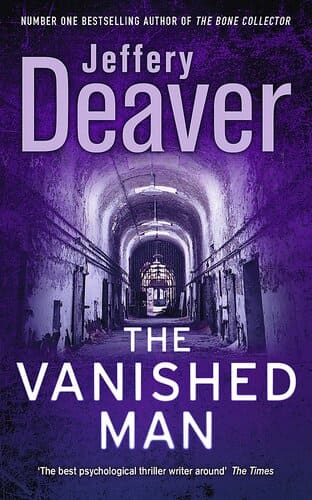
The Vanished Man (2003) by Jeffery Deaver
How I encountered this book
When I realised in probably about 1997 that crime and thriller fiction was where my interest seemed to lay, I spent a lot of time in bookshops checking out what was new in the genre — an approach which led to me finding the likes of John Connolly and Val McDermid, as well as now-forgotten authors like Jodi Compton, Paul Eddy, J. Wallis Martin, and John Rickards. #foreverinourhearts
Towards the end of 1999 I happened upon The Devil’s Teardrop (1999) by Jeffery Deaver, and was intrigued by the central plot device. I bought it in paperback the following year — this was when a lot of Deaver’s catalogue was republished in single-colour covers with embossed images on them — and worked my way through the likes of Praying for Sleep (1994), A Maiden’s Grave (1995), The Bone Collector (1997), The Coffin Dancer (1998), The Empty Chair (2000), The Blue Nowhere (2001), The Stone Monkey (2002), Garden of Beasts (2004), and The Twelfth Card (2005)…where we more or less parted company (I would later enjoy the short story collections Twisted (2003) and More Twisted (2007), though his James Bond novel Carte Blanche (2011) defeated me). The Vanished Man (2003) was part of that sequence, and possibly my first experience with the ‘magician in a mystery plot’ conceit.
What’s it about?
When a student at the prestigious Manhattan School of Music and Performing Arts is murdered, and when police surprise the murderer just as he’s leaving the scene only for him to vanish in apparently-impossible circumstances, it’s not long before quadriplegic forensics expert Lincoln Rhyme is called in to consult. And as more murders occur throughout the day, each with some element of the magically macabre about it, Rhyme and Amelia Sachs — the police officer who acts as his eyes and legs at crime scenes which are otherwise inaccessible to him — start to wonder at the pattern behind these crimes. Dubbing the killer The Conjuror, can they deduce enough from each crime scene to potentially prevent more deaths? And what is this sinister procession leading up to…?
Any seeds of detection?
Look, I have to be honest with you: I am kicking myself that it’s taken me so long to get back to the novels of Jeffery Deaver. Little I knew it at the time of first encountering them, but he sows seeds here of many of the principles that would go on to become the bedrock of certain fascinations for me in detective fiction: yes, Rhyme is a high-function borderline-genius in the manner of Sherlock Holmes or Gideon Fell, but Deaver also frequently relies on the concept of the police being a ravening organisation that succeeds because of the sheer number of people at its beck and call and the various different manner of expertise they represent (a core conceit of the Inspector Joseph French novels by Freeman Wills Crofts).
Additionally, the steady accrual of evidence through scientific means, and the intelligent dissection of that evidence via the balances of probability and inference owes a debt to the wonderful work of R. Austin Freeman‘s Dr. John Thorndyke. Equally, Deaver frequently has very clever bad guys and gals who are able to anticipate and pre-empt the investigators they know are coming after them, lending aspects of the books some of the puzzle plot which has very much been my flavour of jam for a couple of decades now. We also spend a lot of time following the killer’s thoughts and actions, and learn their name not long after the halfway point, rendering this another early example of an inverted mystery to my eyes. Yes, Deaver’s books are more thrillers than novels of detection, but if you took out the life-or-death stakes chases and shoot-outs and threats to the life of the core group then these would fit a lot more squarely into the Golden Age shape of things than I feel most people would credit.
Also, this one contains an impossible disappearance — one of my main reason for revisiting this title ahead of the others I’d enjoyed — and we know how the undoable done has come to dominate so much of my reading life. So, yes, there are acorns here from which a positive forest of mighty oaks may well have sprung. I can only begin to think that it was because my fixation on the Golden Age became so strong in the early 2000s that I stopped reading Deaver in the first place, because at his best he really it a lot of fun. Though it probably didn’t help that he seemed hard to pin down just as he started getting big, writing several new series at once, mixing in some standalones, writing a James Bond novel — not all of it worked for me, and it got a little tiring trying to keep up. Honestly, if he’d just pumped out a Rhyme novel every two years in the early 2000s and built a brand around that as Harlan Coben did with his switchback-twist standalone thrillers, I reckon he’d be bigger than just about everybody now.
Can you go home?
With an increased appreciation for the more rigorous aspects of this comes a more aware perspective on the book’s flaws, too. This extends not just to some of the individual sentences…
Ironic, Rhyme thought, gazing at the picture, the [suspect’s] left ring finger is damaged; mine is the only extremity below my neck that can move at all.
…but to quite a few of the era’s preoccupations in the writing. More time is given here to the emotional make-up of the villain and to explaining why Rhyme is motivated to do what he does that was ever spent explaining why Gideon Fell felt the need to investigate crimes, or why Jane Marple was drawn to the darker side of life. And while the novel of psychology did end up becoming big in the genre, such aspects are a long way from the scratching the classic Golden Age itch. Part of the fun of the Golden Age was that villains could be found anywhere, behind any face, without someone taking the time to extol the issues that may have made them the way they are, and one of the things that puts me off modern crime writing is the repetitive delving into psychology to explain something away that doesn’t really need explaining.
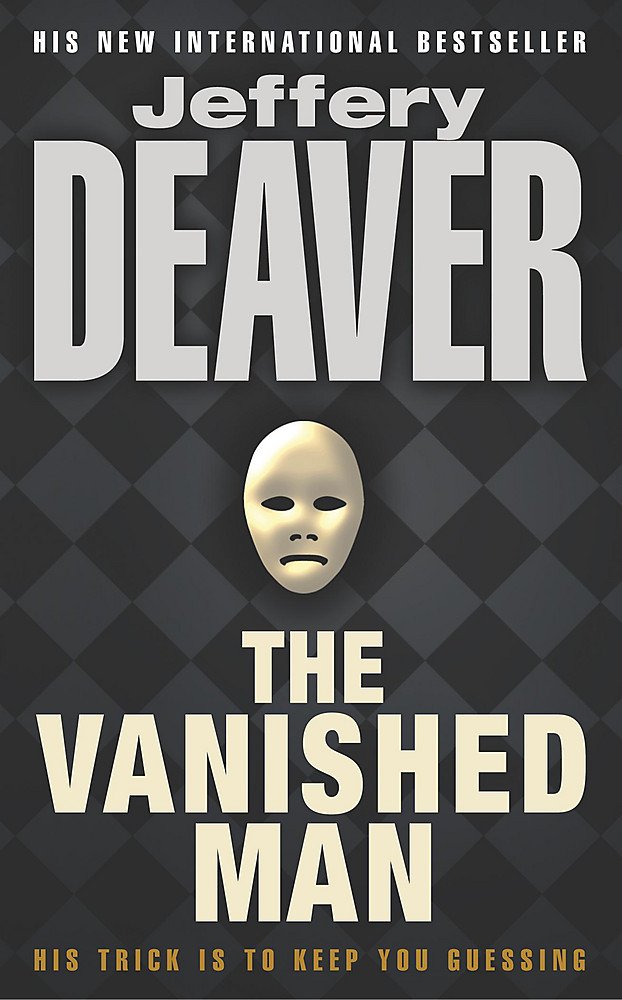
Additionally, the book gets increasingly jumbled about the motive for all the mayhem and, yes, while I’ve never been a strong one for remembering or really caring too much about motives, things are not helped here by Deaver telling you an outright lie on page 321 of the 2003 Coronet edition shown at the top of this post and then directly contradicting that 80 pages later. Indeed, the closing stages of this contain about six twists too many, with motivation and action overthrown and overthrown again so that what you’re previously told was borderline impossible or blazingly unexpected to someone actually turned out to be part of their plan all along and, look, I like a good OTT plot, but, jeepers. I love a false solution, Jeffery, but here it feels like twist after twist just because he can (the actual plot is tied up with about 60 pages remaining) and it gets kinda exhausting. Plus, if you look back from the end to the beginning, I’m not entirely sure the beginning makes sense.
And yet.
Some of what’s here beyond the plot makes for depressing reading simply because of how far we’ve failed to come in the 23 years since its publication — how difficult it can be for women in certain professions, say, or one subplot involving a semi-paramilitary group with unsavoury opinions about immigrants and anyone who isn’t white and Christian, a perspective that seems to have moved into the mainstream of Western politics — if you needed evidence to feel even more dispirited about where we are nowadays. Yet, for all the occasional sidesteps into examination of mindset and long scenes involving victims before they become such, Deaver’s writing nips along and contains a few good lines that raise a smile.
Rhyme thanked him and told him to keep [searching the crime scene for evidence]. The man said he would but with such fake enthusiasm that Rhyme knew the search had already ended.
I’d also love to read more about Jasper Maskelyne, “the British magician who created a special military unit in World War Two, which used illusionist techniques against the Germans in North Africa”. So while I can be more critical of some of the supposed tension in some of the scenes, like a conjuror forcing a card upon you — when a car is careening towards you, you don’t have to shoot the driver, you could just shoot the tyres — I reckon I could easily drop back into Deaver’s work every now and then and have a very enjoyable time. And I’ve not said that about any of the previous Going Home authors — hell, I gave away all my Harlan Coben and Michael Connelly after writing about them in previous weeks, but I bought another of Deaver’s novels while only halfway through this one.
I’m not saying that this will be the final Going Home post I’ll ever do on the blog, but it would be fitting if the last effort to revisit some of the joys of my youth concluded with me finding something from those youthful days which still gave me joy and then became a part of my modern reading, effectively closing a loop. Maybe I’ll start a new feature called Deaver Pitch in which I just write about the novels of his I’ll go on to read, or maybe I’ll read a couple and be reminded of something that made me give up on him in the first place and so never read him again. Whatever happens, with Going Home or otherwise, I very much enjoyed returning to The Vanished Man with older eyes, and I’m delighted to have found so much in here that I have been fortunate to track down in the decades since.
~
Going Home on The Invisible Event:
Fade Away (1996) by Harlan Coben
Back Spin (1997) by Harlan Coben
The Concrete Blonde (1994) by Michael Connelly
Blood Work (1998) by Michael Connelly
Angels Flight (1999) by Michael Connelly
Dark Hollow (2000) by John Connolly
The Monkey’s Raincoat (1987) by Robert Crais
Airframe (1996) by Michael Crichton
The Vanished Man (2003) by Jeffery Deaver
Dead Meat (1993) by Philip Kerr
False Memory (1999) by Dean Koontz
A Drink Before the War (1994) by Dennis Lehane
Black and Blue (1997) by Ian Rankin


Funnily enough, I have not read many Deaver books but I did read this one in 2017, and I think had a similar reaction to yours. I will make so bold as to link to my post:
The Vanished Man by Jeffrey Deaver
I loved finding magician posters to illustrate it: there are some great ones around.
In my post I mention the Ellie Griffiths books about a magician – one of them deals with the WW2 illusion goings-on – I don’t know how fictionalized her version is, but it is definitely based on the true story.
LikeLike
Thanks, Moira — it didn’t occur to me to look for other reviews on GAD blogs as this doesn’t fit the bill, so I appreciate your link.
If you enjoyed this, don’t be put off my the magnitude of Deaver’s catalogue; he’s written some excellent thrillers in this vein. The Coffin Dancer and The Devi’s Teardrop are huge fun, and I’m very much looking forward to getting back into a selection of his titles now I’ve finally reminded myself about him. Watch this space!
LikeLike
That’s helpful thanks, I really get confused by great long lists of identical-sounding titles. But would deffo go for another
LikeLike