I was quite excited to return to this week’s Going Home book, since it feeds into a key part of what I’ve come to enjoy about classic mystery and detective fiction.
Darkness stalks you all/Fear what you can’t comprehend/Don’t trust a haiku…it’s…
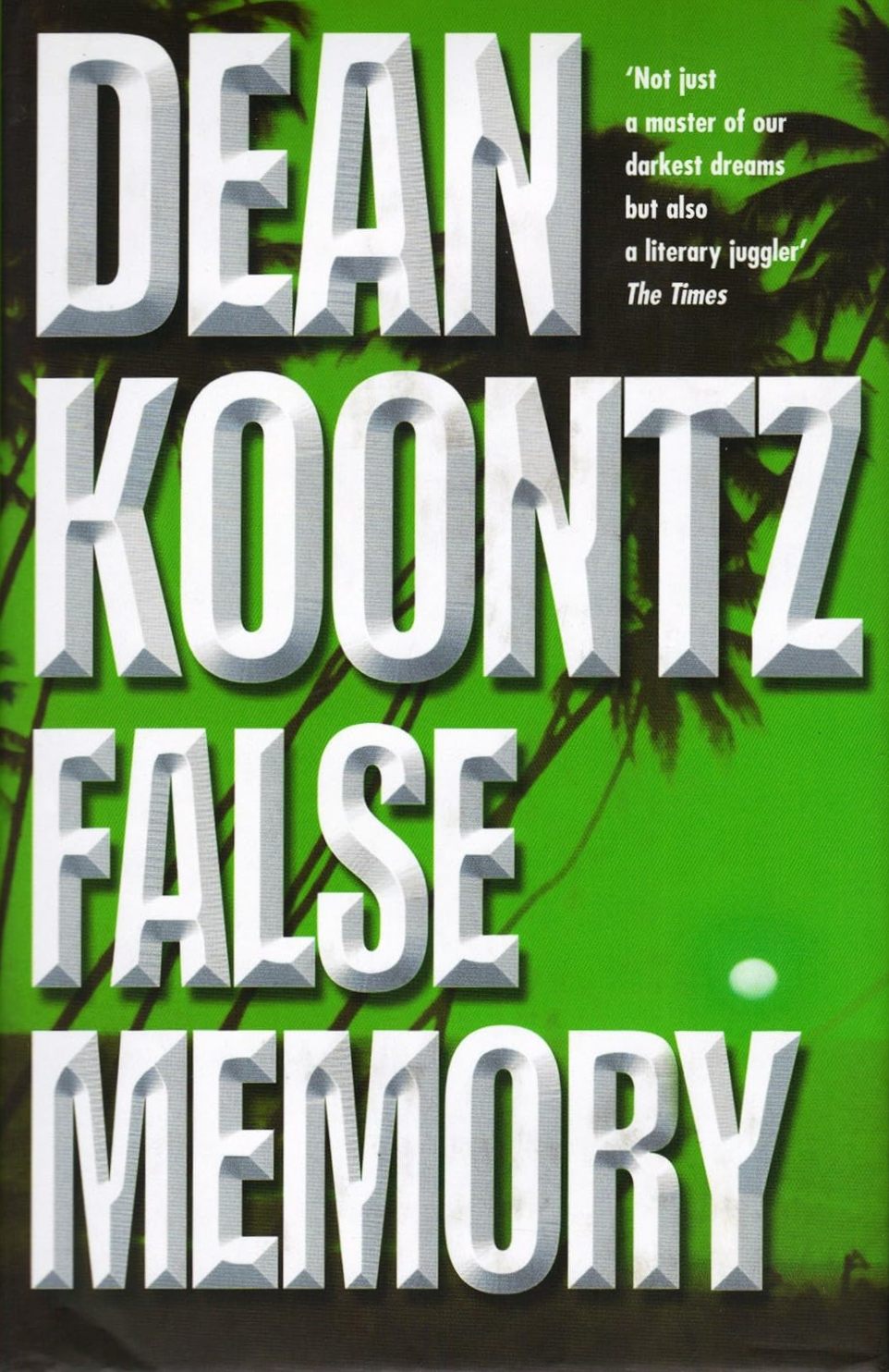
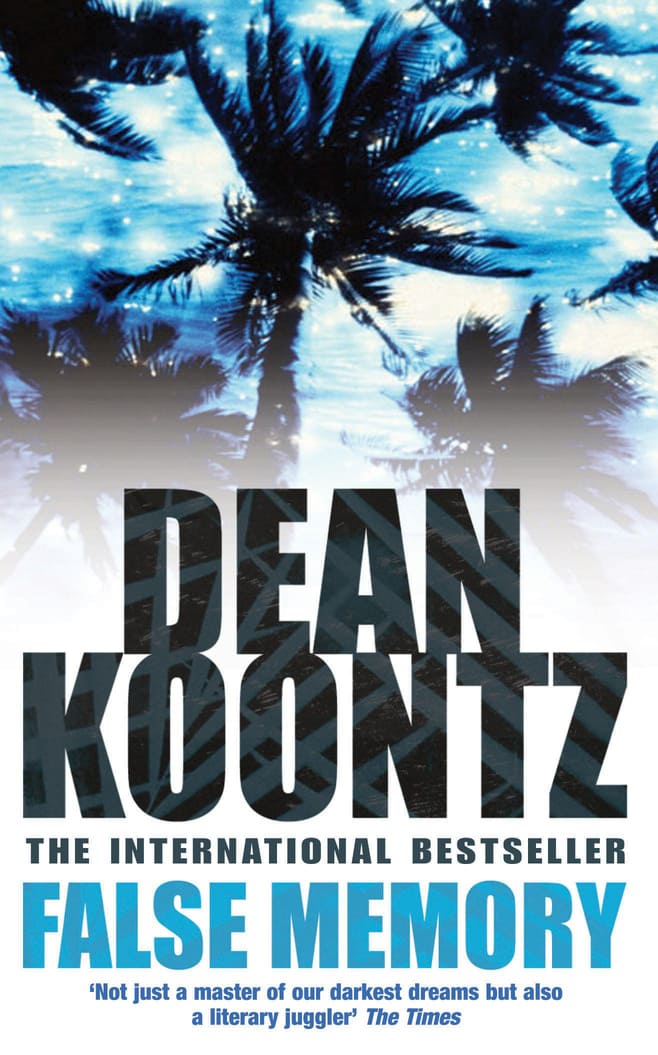
False Memory (1999) by Dean Koontz
How I encountered this book
As I’ve gotten deeper into crime and detection works published during the Golden Age, I’ve used many blogs and recommendations from people met through blogging to inform my choices. And yet for years I didn’t really know anyone to talk to about books: my best friend put me onto Terry Pratchett when I was about 12, and apart from that I took a rather catholic approach, pretty much picking up and reading anything that caught my eye. This was about as successful as you’d expect, with every Latitude Zero (1997) by Windsor Chorlton compensated for by a The Church of Dead Girls (1997) by Stephen Dobyns.
So when a friend of mine mentioned in passing that they were reading a book by hot young prospect Dean Koontz, and that the main characters in it “didn’t behave like idiots, and are actually quite intelligent in what they do”, well, that stuck with me. I asked him the title, and tracked it down soon thereafter (it had recently come out in paperback). And a quarter of a century later, I’m back!
What’s it about?
Helping her friend Susan navigate the complexities of a suddenly-developing agoraphobia, late-twentysomething video game designer Martie Rhodes begins to exhibit the symptoms of autophobia: essentially fear of herself, coupled with violent hallucinations. As her anxiety spikes over the course of a single afternoon and her world becomes increasingly frantic, Martie’s husband Dusty also begins to exhibit signs of some psychological condition of his own, becoming aware of lapses in his memory and of missing minutes and hours in his days. Can the three conditions be related? It seems unlikely, but some real shocks are in store…
Any seeds of detection?
There are sown here seeds of two facets of fiction that have become increasingly interesting to me down the years: detail-based reasoning and the inverted mystery.
The first is supplied by Dusty, a man with an eidetic memory, who begins to notice that little parts of his experiences feel off. At first these are mere suspicions, but with a weight of conviction behind them — “The bastard son of Sherlock Holmes, born of Miss Jane Marple, would be hard pressed to find good reason for the suspicion that sawed at Dusty’s nerves,” we’re told early on — that he cannot ignore. Gradually, as minute details begin to assert themselves, not least when he remembers two events happening close together which common sense tells him must have been separated by a significant interval, or when his perfect memory recalls events which cannot have happened as they wouldn’t have resulted in the situation he’s now in, he starts to piece together a sense of what must be happening to him and his wife. It’s not solid, formal detection, but it’s certainly a step up from the floundering in the dark that so many thriller protagonists seemed to do in the reading that occupied me at the time (cf. Jason Bourne).
The second comes from the fact that, at approximately a third of the way in, Koontz drops the reveal of the central evil-doer at the core of things and their scheme in an extended set-piece which is as horrifying as it is frankly incredibly described. Honestly, this reveal, completely unexpected by me first time around, was one of the most incredible moments of my young reading life, and over the last 25 years I have thought of it often — not least when similarly brilliant drops occur in the like of The Chocolate Cobweb (1948) by Charlotte Armstrong and…well, little else, if I’m honest. I have had many a surprising murderer or a brilliant linking thread thrown at me in final chapters down the years, of course, but to be only a third of the way into this doorstep of a book, and for so black-hearted a scheme to be laid completely open with no attempt to disguise its ways, means, and intentions, was an experience I’ll long remember fondly.
And, yes, I’d seen Columbo (1971-88) and Rope (1948), so I knew about being shown the killer early on, but, man, you really had to be there to understand what an effect this particular book had on me. I wouldn’t say I’ve been chasing this sort of high ever since, but nothing else I read by Koontz — Intensity (1995), Sole Survivor (1997), Fear Nothing (1998), Seize the Night (1999), From the Corner of His Eye (2000), One Door Away from Heaven (2001), Velocity (2005), The Good Guy (2007) probably a few others because, wow, has Koontz ever written a lot of books — came close to the sheer giddy immersion I felt while reading this. A friend of my parents called at the house when I was reading this and, after inquiring about the book, summarily and scornfully dismissed it as “lowbrow” — Alastair, you’re not reading this, but all these years later I still think you’re a prick for doing that.
Can you go home?
Rereading False Memory, I have to admit that I found it a little overlong — I tracked down a BCA hardcover that comes in at 626 pages, but my original paperback was definitely longer — and yet it’s still a fascinating book. I have now a far better appreciation of the way Koontz cooks up suspense by drawing events out over multiple detail-rich chapters (this is a guy who spent an entire chapter in Intensity with the heroine trying to escape being tied to a chair — and my palms are still sweating from that). Martie careening around her house finding terror in the most everyday items is just one of several incredibly-parsed set pieces that really does exceptional work in making you feel the irrational dread of it all:
The stainless steel rack of knives hung from two hooks on the wall, like the totem of some satanic clan that used its kitchen for more sinister work than cooking dinner.
There’s a repeated refrain in this sequence in which Martie keeps losing and finding her car key, and imagines herself plunging it into someone’s face or soft tissue, and the uncertainty this draws out — does she have the key on her now? did she pick it up without telling herself she did so? why would she do that? — is another magnificent spiral in a cavalcade of lurching horror and unknowable fright.
The apprehension that she, Martie herself, harbored the dark potential for some unspeakable act of violence was so disturbing that she refused to dwell on it. This was the most irrational of fears, for she was certain in mind and heart and soul that she had no capacity of savagery. And yet she had not trusted herself with the bottle opener…
Alongside this, once that villain’s identity is out and the malevolent nature of their conduct is made clear to the reader, the horror we feel at seeing this — Koontz was always very good at very, very bad baddies — only escalates the stakes against Martie and Dusty. That Dusty’s involvement in proceedings comes from such a quotidian angle, too, is a stroke of brilliance: whomst among us hasn’t been surprised to find at some point that more time has passed than we thought? How many of us have struggled to recall the precise details of a conversation moments after it has finished? Hell, do you even remember someone’s name the first time they tell it to you? These little moments in themselves are necessarily minor, so that once Dusty dovetails his missing moments and hours with the far more harrowing experience Martie is suffering through, that greater hideous possibility feels all the more inculcated into the realm of the not just plausible but downright likely.
There’s an interesting bit late on, too, about the nature of communication on the Internet — and remember that the home Internet wasn’t the oldest of things in 1999 — and how a discussion about how “[f]iction and reality don’t matter, [as] it’s all the same” online is played against the realisation that these characters are “in a world where everything was upside down and backwards, where lies were celebrated as truths, where truth was unwelcome and unrecognized”. Those two ingredients make for uncomfortable reading in 2026, and while I doubt Koontz knew he was being — or was trying to be — prescient, well, like prescience it sure does feel.
For all the hideous implications of the villain’s doings, and for all the insidious possibilities this opens up about our fairly common human experiences, Koontz is also having fun at times: see Dusty “smouldering with more frustration than a monastery full of celibates”, or our villain — I could have done without them playing with literal figurines quite so much, which is a little on the nose — given a surprising amount of character throughout rather than simply drawn in blunt, broad lines as A Real Bad ‘Un and left there for us to point at and hiss:
“Don’t torture me with clichés. If you’re going to try to intimidate me, have the courtesy to go away for a while, acquire a better education, improve your vocabulary, and come back with some fresh metaphors.”
Additionally, this was in the era where Koontz would insert an intelligent dog into almost every book he read, and here we have the Golden Retriever Valet, who is the very goodest boy:
The retriever took each bit of [chicken breast] from his master’s hand with a delicacy almost equal to that of a hummingbird sipping sugar water from a garden feeder, and when it was all gone, he gazed up at Dusty with an adoration that could not have been much less than the love with which the angels regard God.
Yes, the denouement requires a degree of deus ex machina which doesn’t quite wash today, and yet in 1999 felt pretty close to perfect, and if you read this book and go “Hey, it’s just an updated version of (rot13) Gur Znapuhevna Pnaqvqngr (1959) ol Evpuneq Pbaqba,” don’t fret — Koontz knows and is ahead of you, and indeed it’s this exact thread which give his villain so much of the character that makes them so fascinating. Sure, it’s a shame that Dusty and Martie have to be told the villain’s identity so early, but all things considered this stands up pretty well some quarter of a century later. It doesn’t make me want to start reading Koontz again, but I’m delighted that my positive memories of this were so largely borne up by this second reading. And, oh my, I wish he’d written a dozen of this sort of thing. As it is, I’ll remember Koontz fondly for this title in particular, and more generally as someone who brought huge imagination and some wonderful humanity to what else he wrote. But he’s a part of my past now, I feel, no matter how well that past stands up to scrutiny.
~
Going Home on The Invisible Event:
Fade Away (1996) by Harlan Coben
Back Spin (1997) by Harlan Coben
The Concrete Blonde (1994) by Michael Connelly
Blood Work (1998) by Michael Connelly
Angels Flight (1999) by Michael Connelly
Dark Hollow (2000) by John Connolly
The Monkey’s Raincoat (1987) by Robert Crais
Airframe (1996) by Michael Crichton
The Vanished Man (2003) by Jeffery Deaver
Dead Meat (1993) by Philip Kerr
False Memory (1999) by Dean Koontz
A Drink Before the War (1994) by Dennis Lehane
Black and Blue (1997) by Ian Rankin


I really enjoyed reading this review because it captures what makes False Memory so compelling without giving away the suspense. I like how you highlighted the psychological tension and clever mystery elements, and your personal reflections made the review even more engaging. It definitely made me curious to experience the story for myself and see why it left such a lasting impression on you.
LikeLike
I hope you enjoy it when you get to it; there was a lot here that hit me just as hard second time around.
LikeLike