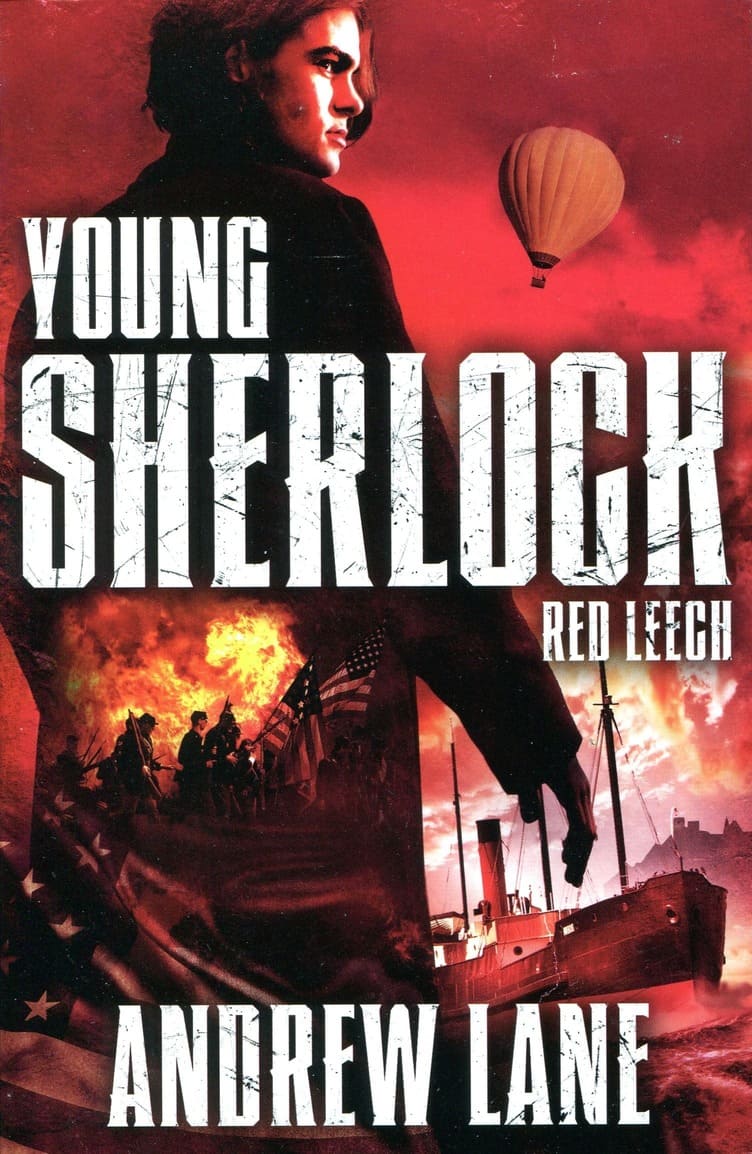
In a pure coincidence of timing, I read the first of Andrew Lane’s Young Sherlock Holmes novels, Death Cloud (2010), at about the time a series based on the books was announced by Amazon. The trailer, however, seemed to share ‘teenage Sherlock Holmes’ with the books — “teenage” in Hollywood meaning “played by someone who’s nearly 30 years old” — and nothing more, so let’s get onto the second volume today instead.
Red Leech (2010) picks up a few months after Death Cloud, and thankfully I wasn’t required to remember much from that first book because, well, I couldn’t. Sherlock is staying with his aunt and uncle, Mycroft — busy with government affairs in London — has hired Amyus Crowe as a tutor for his younger brother, and Amyus comes complete with attractive daughter Virginia for our teenage sleuth-to-be to get all flustered around. There’s also the barge-dwelling Matty Arnatt, befriended in the course of that first book, who is here to get kidnapped and thus require rescuing (hey, that’s progress: 30 year prior to this the tomboyish Virginia would have been helplessly tied to the railroad tracks or similar).
When rumours begin to circulate that John Wilkes Booth may have survived the fire that was supposed to have killed him, and have made his way to the vicinity of Holmes Manor, Sherlock and Matty take it upon themselves to investigate, and…well, that’s the plot for most of this, streamlining the complexities down to a series of well-written extended action sequences (fight on a roof! horse chase! boat fight! train escape!) and weaving amidst the enjoyable mayhem a few stitches of the man the young Holmes is to grow up to be.
This feels like a slighter effort than its predecessor, but it’s an easier read if only because you feel Lane has now most of the pieces he needs and so can concentrate on hooking readers in. The characters are clearly-drawn, the sequences around which the plot is tacked are very well-written, and there’s an undeniable excitement to some of the progression. Once again, you feel the influence of the James Bond corpus in the revelation of our hideously-disfigured bad guy, and once more there’s a certain amount of…if not exactly moralising then at least acknowledging the difficult in how a cultured society deals with those who would usurp its intentions:
“If we act barbarically then we have no right to stop anyone else from acting barbarically, and the world will slide into anarchy.”
“Even if politeness leads to the injury or death of someone we should be protectin’?” Crowe asked.
“Even then,” Mycroft said. “We must maintain the moral high ground, no matter what tempts us down into the valleys of iniquity.”
Indeed, Lane is to be commended for the way he lightly touches upon some of the difficulties herein that it would have been easier not to include at all: there’s a moment late on when it’s acknowledged that the settlers in America faced violent opposition from the Native Americans whose lands they were simply moving onto and, fundamentally, stealing and…it adds nothing to the plot, but it’s pleasing to see it mentioned, however briefly.
In some places it would be nice to see a little more of this complexity — Mycroft and Amyus deducing details of the fight Sherlock has just been in is dismissed as “a trifling matter”, and it sort of reduces the impact of the moment since there’s no way they could know the details they do — but I guess Lane isn’t exactly veering too far from the Doyle blueprint in that regard (Sherlock’s deductions seem to go increasingly unexplained in the later stories, I seem to remember). And while there’s some commentary passed on this in a way…
For the first time, Sherlock realized that logical thought could only go so far, and that it produced a single answer only rarely. More often than not, logical thinking produced several possible answers, and you had to find another way to choose between them. You could call it intuition, or guesswork, but it wasn’t logic.
…there’s nothing really done with this, most egregiously felt in the closing line of chapter seven, which might be the single purest surmise in any Holmes pastiche ever written.
Moments of interest litter the book beyond the grandstanding action, such as the discussion about sailors’ tattoos and the mystery of precisely what the ominous housekeeper Mrs. Eglantine is doing at Holmes Manor (“We are where we are. And we do what we do.”). I still don’t believe for a second that the Holmes boys would ever express love for each other, Chekov’s Ill Sister in the background or no, but that’s fine. This builds to a pleasing finale, wrestles with a moral conundrum or two, and provides a good basis to springboard into the third adventure in the months ahead. I don’t yet fully see the masterplan Lane has for this series, but he’s earned enough goodwill to give him a couple more books to do something interesting with these ingredients. Onwards!
~
The Young Sherlock series by Andrew Lane
- Death Cloud (2010)
- Red Leech, a.k.a. Rebel Fire (2010)
- Black Ice (2011)
- Fire Storm (2011)
- Snake Bite (2012)
- Knife Edge (2013)
- Stone Cold (2014)
- Night Break (2015)


Not sure how I feel about this based on your description. It’s kind of a pet peeve of mine when Holmes is pastiched to seem like a James Bond sort of action hero. I just think it makes him less himself and less intriguing as a character, and that whole thing about logic not being enough feels weird from Holmes. Although since Doyle believed in fairies…
Thanks for a great review!
LikeLike
Yeah, I’m not big on the whole “someone else writes a prequel for a beloved character years after the event” as a rule, if I’m honest, so I understand where you’re coming from.
In a way, I suppose I’m not really thinking of this as canon Holmes, and it’s not like Lane is just spinning his wheels: he did apparently have a plan going into these books, with the intent being that reader could go from the last one into A Study in Scarlet…and that’s an intriguing proposition. So, while undeniably interested in seeing how that pays out, I can’t deny that I’m still approaching each of these with a little hesitation.
And, yes, it’s very Young James Bond at times. But, well, the intended audience are, like, 9, so I suppose I can for give that 🙂
LikeLiked by 1 person
Without having read the books, it seems to me that the Amazon Prime series took the word “young” from the book series and the emphasis on action, and left the rest behind. They aged the character enough to make him a young hunk (nephew to Ralph Fiennes, in fact – and Uncle Joseph plays his father), eschewed the references to history outside of the Holmesian character, and stuck in Moriarty – also a hunk – because why not? Mycroft is a hunk, too (played by Jeremy Irons’ son), and I thoroughly enjoyed the show for all its twists and turns and, er, hunkiness! Yes, it’s sometimes annoying when modern authors create a whole new history for iconic characters – I was particularly nonplussed when Sarah Phelps turned Hercule Poirot into an ex-priest! – but this didn’t particularly bother me here. Another season is coming, and it’s definitely not aimed at the 8 – 12 year-old set!
LikeLike
I think, too, that there’s been so much written about Holmes — there are books with him fighting Cthulu, books in which he’s a ghost, books in which he’s Jack the Ripper, etc. — that another take on the character hardly stands out as especially egregious. The Poirot example you cite stands out because there’s so little about Poirot that isn’t either from Dame Agatha or inspired directly by her.
The next time I get Prime, I’ll give the series a go. Should have read more of the books by then, not that I imagine that’ll make a great deal of difference by the sounds of things.
LikeLike