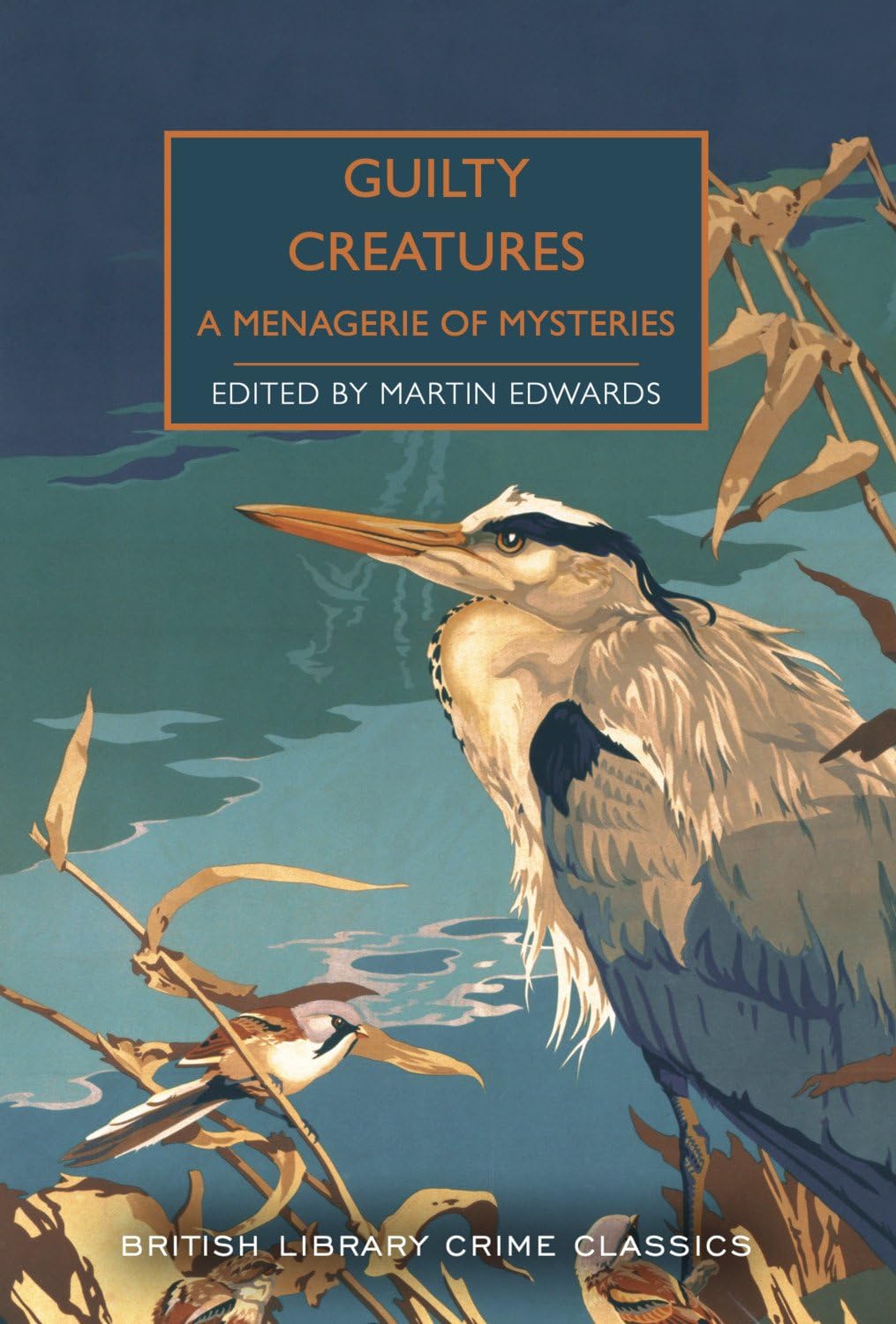
The idea of a collection of Golden Age short stories based around a theme of animals seemed like an unusual one, until I remembered that one of the genre’s foundational short stories and one of its most famous novels both have animals in fairly central roles. So that’s all right, then.
Assembled once again by Martin Edwards, we have here 14 tales featuring animals involved in crime — though not, I’m sorry (?) to say, in the sense that we have a story told from the perspective of a felonious badger, a homicidal capybara, or a financially defaulting arctic seal (hey, Stanley Ellin wrote one about a murderous flea, I seem to remember, so it’s not without precedent).
So is the collection the bee’s knees, the cat’s pyjamas, the dog’s–? Let’s find out together.

The Sherlock Holmes canon is already getting its own dedicated series of posts, so ‘The Adventure of the Lion’s Mane’ (1926) by Arthur Conan Doyle will have to wait its turn in that undertaking, I’m afraid. I remember it being notable as one of only a few not narrated by Watson, but I also remember it taking Holmes an age to put the necessary facts together. We’ll see in due course, and I’ll add a link here when I’ve read it again.
And, hey, full credit to Edwards for not putting in ‘The Speckled Band’ (1892) or ‘Silver Blaze’ (1892) — both of which I remember to be better, but are arguably over-familiar.
‘The Case of Janissary’ (1897) is my first encounter with Arthur Morrison‘s Mr. Dorrington, and this story of a valuable race horse is so cannily written (“More was drunk than thirst strictly justified.”) and cynically constructed that it absolutely will not be my last. The main part of the story is pretty boilerplate, but the way Morrison widens his canvas in the closing pages makes one lament that we didn’t see more of this sort of thing in his Martin Hewitt stories.
[I]t was an important thing in Dorrington’s rascally trade to get hold of as much of other people’s private business as possible, and to know exactly in what cupboard to find every man’s skeleton.
I feel an almost reluctant obligation to read more Hewitt; I eagerly anticipate more Dorrington on this evidence.
I was unaware of Headon Hill‘s detective Sebastian Zambra, apparently created as a rival to Sherlock Holmes, and ‘The Sapient Monkey’ (1892) perhaps demonstrates the reason for my lack of awareness. There’s none of Doyle’s richness here, and none of his engaging ideas, with instead a man accused of theft and a simple substitution holding the key. And despite the theme of the current volume, a reference to “my ferret” does not play out as I had hoped.
Did people really keep records of the individual numbers of the banknotes the possessed? You always read of the banks having kept a record of the numbers in early detective fiction, but I don’t think I’ve ever really considered the practicalities for the individual before now.
‘The Green Parakeet’ (1918) gave me more reason to be unenthusiastic about the work of F. Tennyson Jesse. A couple renting a villa in the French countryside seem to prevent their adopted daughter from doing any housework, and Solange Fontaine, who detects by sensing vibes, it seems, doesn’t get her spidey-sense tingling in time to prevent a murder. Not among the leading lights of Edwardian crime fiction, this, and interesting for how off the pace of the emerging genre staples it seems to be given its era of provenance.
Another of the genre’s greats comes in the shape of ‘The Oracle of the Dog’ (1923) by G.K. Chesterton. This evinces that good and bad of Chesterton, in that his language is sometimes divine (c.f. a young man with “blond hair that seemed to be brushed back, not merely with a hair-brush but with the wind of the world as he rushed through it.”), but his prolixity can grate. Having read this about four times now I was amazed at how long it maunders on for, and while the ideas are clever — Chesterton frequently was — it doesn’t justify its own volubility in my eyes.
The possibly lunatic Dr. Viglow is ‘The Man Who Hated Earthworms’ (1921) — creatures which, Edgar Wallace reminds us, are “neither cunning nor intelligent and [are] moreover notoriously devoid of ambition”. This is a slight tale, but a pleasingly cynical one, taken from The Law of the Four Just Men (1921), which, on this evidence, might bear examination. I do like Wallace when he gets steadfast in his morals, and he very much does that here.
I’d previously encountered ‘The Courtyard of the Fly’ (1932) by Vincent Cornier in The Art of the Impossible [ss] (1990) and thought it merely okay. Revisiting works that struck me as merely fine has worked out well before, however, and I keenly anticipated a second visit to this, because I remember it having promise if not exactly prestige.
On second visit…I feel justified in that. Cornier seems, in my limited experience of his writing, to have at least tried to bring something a little out of the common to his crime stories, and it would be harsh to dismiss him too roundly. Perhaps a few more conventions in his plotting might have found him on steadier ground, but I’m reluctant to criticise this too harshly despite it not really working for me.
A young boy trying to drown himself and his younger sister in a pond isn’t the most optimistic of starts to a story, and ‘The Yellow Slugs’ (1935) by H.C. Bailey bears this out by subtly and gently working its way towards a denouement that is in keeping with the sombre tone. I keep saying I’ll read one of the Reggie Fortune collections, and I’ll come good on that this summer, I promise.
Bailey doesn’t necessarily write the children well, but Fortune is on fine form (“I’m not here to do what I like.”) and this is a strong example of how to meld physical and psychological clues for optimum detection. A good dialogue clue, too, which is always welcome. Solemn, maybe a little earnest, but a reminder that the Golden Age could take death seriously for all the playful complications it sometimes evinced.
When news of a new tax leaks to the denizens of an Indian province before its official announcement, one of the clerks who must have revealed the information is condemned to die in the ‘Pit of Screams’ (1950) by Garnett Radcliffe. This is a very entertaining story, with a thoroughly bizarre duel at its core that renders it quite unlike anything else in these collections. I don’t know if it’s good, and it probably hasn’t aged well, but I enjoyed it a great deal.
Every single Clifford Witting novel I’ve read to date has been too damn long; conversely, ‘Hanging by a Hair’ (1950) could, frankly, do with being a bit longer, since it seems to lack any decent misdirection or clever ideas. When it’s established that a man must be lying about an aspect of visiting his lover who is later found murdered, why is nothing done to resolve that? And how convenient it is that only one person was seen leaving their house during the crucial time? Edwards tells us in the introduction that this is Witting’s only known published short story, and that lack of familiarity with the form shows.
A recuperating medical student being visited by a tame jackdaw doesn’t seem like an auspicious start to a crime story, but ‘The Man Who Shot Birds’ (1954) by Mary Fitt starts this way and turns in to something rather superb. Fitt has a marvellously gentle way with her plotting that brings in uncommon occurrences so that the events really do feel like a slice of someone’s life, with the measured stirring in of a murder plot very craftily handled. Another example of Edwards finding something uncommon for these collections that is also quite wonderful.
Following a pea-souper fog, a dead body is found being picked over by the vultures in the enclosure in London Zoo. From such grisly beginning does ‘Death in a Cage’ (1950) by Josephine Bell build, though I can’t believe there wouldn’t have been more of an investigation into how the cage came to be unlocked in the first place. Anyway, this is a fun little romp with a good medical twist, and it shows how intelligent consideration of the facts can lead to surprising revelations.
Penelope Wallace was, interestingly, the daughter of Edgar Wallace, and ‘The Man Who Loved Animals’ (1965) has about it a directness that feels more nuanced than most of what that prolific gentleman put out. A lady seeks the services of a man who seems to be able to calm any animal, no matter how wild, and where this goes is…I dunno. Is it good? It’s certainly unusual in its lack of clarity, and I quite like how the element of doubt about what’s going on pairs beautifully with the certainty of the final line. I’d read more by Wallace, Jr. on this evidence, and that says a lot.
Another revisit for me, I first encountered ‘The Hornet’s Nest’, a.k.a. ‘Twist for Twist’ (1967) Christianna Brand in the Buffet for Unwelcome Guests [ss] (1983) collection. Concerning the odious Harold Caxton, who dies during his own wedding breakfast, this is a neat study in possible explanations and canny reinterpretations of the sort Brand practically made her own in her too-little output.
I still like the initial solution to this poisoning more than the final one, though; there’s a real subtlety and neatness to it all. And while I have no doubt that Freeman Wills Crofts‘s Inspector French could find the evidence that Brand’s Inspector Cockrill is convinced must exist, the need to veer into such Humdrummery isn’t very Brandian, and so feels a little…too cautious, given her well-established and profound ability with ingenious reversals.
A top 5? Well, since you’ve asked for it…
- ‘The Man Who Shot Birds’ (1954) by Mary Fitt
- ‘The Case of Janissary’ (1897) by Arthur Morrison
- ‘The Hornet’s Nest’, a.k.a. ‘Twist for Twist’ (1967) Christianna Brand
- ‘The Yellow Slugs’ (1935) by H.C. Bailey
- ‘The Man Who Loved Animals’ (1965) by Penelope Wallace
Any multi-author collection is going to provoke a range of responses, but what’s pleasing is again how Edwards manages to find the uncommon and interesting within the genre to fill out his milieu. The Fitt, Morrison, Wallace, Jr., and Radcliffe stories all augur well for the depth and breadth of what was produced in this genre — and since Fitt has recently been republished by Moonstone Press I’d happily take recommendations for her longer work that any reader can offer.
Guilty Creatures is mainly just a strong reminder of why these collections sell so well, and another point in the question of quite why it’s taken me so long to get to reviewing these collections (hey, in fairness, my TBR is insane). An excellent job by all involved, with love lovely discoveries herein; see you in a month or so for another of these expertly-curated smörgåsbords.
~
British Library Crime Classics anthologies on the Invisible Event, edited by Martin Edwards
Capital Crimes: London Mysteries (2015)
Silent Nights: Christmas Mysteries (2015)
Crimson Snow: Winter Mysteries (2016)
Continental Crimes (2017)
Foreign Bodies (2017)
The Long Arm of the Law (2017)
Deep Waters: Mysteries on the Waves (2019)
Settling Scores: Sporting Mysteries (2020)
Guilty Creatures: A Menagerie of Mysteries (2021)
Murder by the Book: Mysteries for Bibliophiles (2021)
Final Acts: Theatrical Mysteries (2022)
Crimes of Cymru: Classic Mystery Tales of Wales (2023)
Who Killed Father Christmas? and Other Seasonal Mysteries (2023)
Lessons in Crime: Academic Mysteries (2024)
Cyanide in the Sun and Other Stories of Summertime Crime (2025)
As If by Magic: Locked Room Mysteries and Other Miraculous Crimes (2025)
 The Invisible Event
I was intrigued to see the yellow slugs – which I immediately identified as having been mentioned in a Gladys Mitchell novel.
‘The Yellow Slugs,’ said Mrs Bradley with relish. ‘You must have read it.’
It’s in Sunset over Soho, and I don’t at all remember the context, presumably it might give a clue to the insane (but typical Mrs B) goings on in the book.
LikeLike
Not read that Mitchell, I’m afraid, so I can’t help you. Anyone?
LikeLike
Like you I have not read, as yet, Mitchell’s Sunset over Soho, but there is a reference in the following blog:
https://www.gladysmitchell.com/sunset-over-soho-1943
with the actual quote/reference found at this post:
https://www.jasonhalf.com/blog/mitchell-mystery-reading-group-sunset-over-soho-1943-post-2
The quote from the blog being:
“And one last fun fact from Chris: “While examining maggots in the mystery house in Chapter 10, Mrs Bradley suddenly mentions ‘The Yellow Slugs… You must have read it.’ She refers to a short story by [fellow crime fiction writer] H. C. Bailey, “The Yellow Slugs” (Windsor Magazine, March 1935; reprinted in Bailey’s collection Mr Fortune Objects, 1935).”
For those who have read “The “Yellow Slugs”, the allusion by Mrs Bradley can, I suggest, be guessed.
LikeLike
Many thanks!
LikeLike
ThanksI have been following you for 5 years plus and very much enjoyed your The Red Death Murders which got a call out
LikeLike
Thanks for kind words, and your continued interest in my blatherings 🙂 Lovely to know that there are real people out there reading the blog, and not just bots scouring it for financial information.
Hopefully see you around…
LikeLike