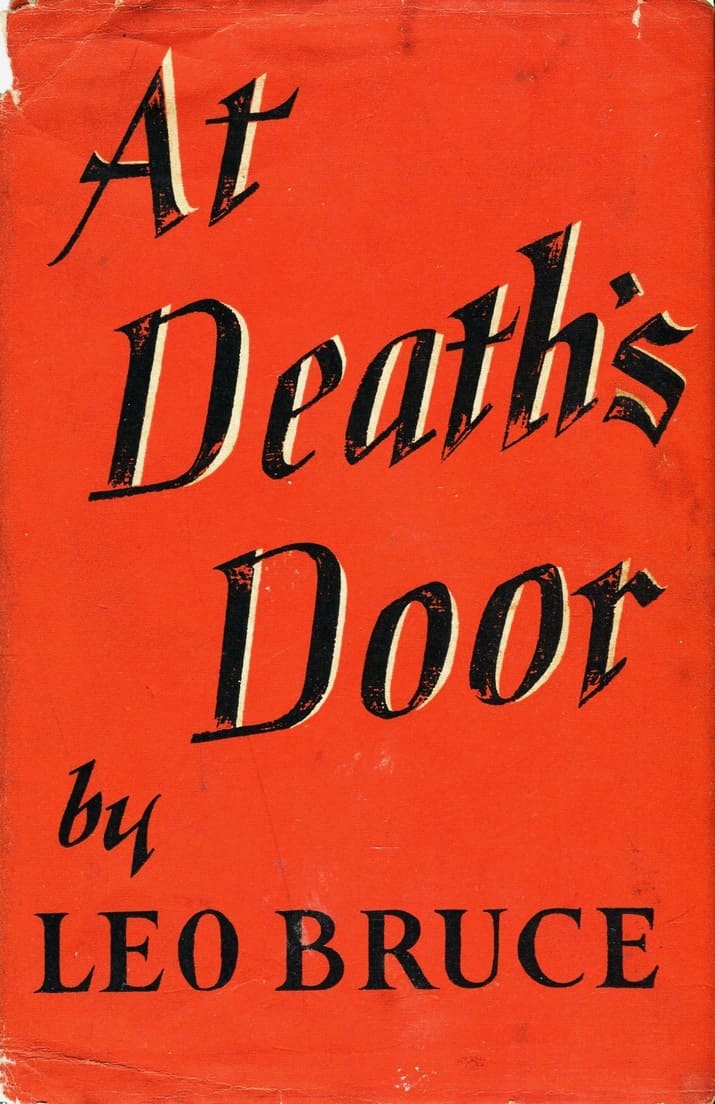


“There were moments when the police felt like giving up their attempt to find among the scores who hated or feared Emily Purvice the one who had killed her”. That sums up At Death’s Door (1955), the first novel to feature crime-solving History teacher Carolus Deene by Leo Bruce, pretty well: Mrs. Purvice has her claws into the finer business of more than a few people in Newminster, and when she’s found beaten over the head in the back room of her shop late one evening, no-one is surprised or especially grieved. But whodunnit? The parson? Her wastrel son? The recently-released borstal boy? The two women running the pet shop next door? The list goes on and on.
Goaded into investigating by the boys he teaches — “You, the amateur with genius, find the right man while [the police] are arresting the most obvious one.” — Deene’s credentials come from his well-received book in which he applied modern crime solving techniques to crimes of the past. “He has always known that sooner or later he would have to turn from an examination of the dusty, half-forgotten crimes of history to the vivid and horrible murders of today,” Bruce tells us, a motivation I’m not entirely sure holds water, but it’s what we get and Deene is away.
Accompanied by student Rupert Priggley, determined to cast himself in the classic accomplice role…
“I’m your right hand, and I’m not supposed to know what your left hand’s doing. You’re expected to be working out something that’ll send me for a Burton when I hear it.”
…Deene begins questioning the seven suspects who were known to be in Mrs. Purvice’s shop the afternoon and evening of her murder. Much jocularity is made of whether Deene is searching for “cloos”, and whether “a nice old-fashioned bit of evidence” is going to win the day, but from all his examination of primary sources it’s pleasing that our sleuth is in no rush to jump to easy conclusions: “He had formed no idea at all as to who might be guilty and he was not in a hurry to do so”. Such a pleasant change from the lynx-eyed genius who claims to know the killer, chews their knuckles over lack of evidence, and lets three people die in the meantime.
As would become the case in this series, it’s the minor characters who get the most attention: a “large, sad-looking man” of a greengrocer “who seemed to have caught something of the…placid downcast lifelessness of an elderly cabbage or turnip”, the moment that “a stretching of the lips — which on someone else’s face might have been called a smile [is] seen for a moment on the sour bilious old features of Emily Purvice”, the way that not everyone is delighted with Deene’s amateur status…
“You’re not a policeman.”
“No, I’m a schoolmaster as a matter of fact.”
“Then what the hell?”
It’s a far from compelling series of interview after interview, but the people we encounter are all excellently-drawn and commend their individuality upon the reader effortlessly. An interesting wrinkle is added to proceedings in that everyone seems more eager to display their motives for murder than to occlude them, but this fairly standard trudge through a series of two-headers isn’t really enlivened much even when someone takes a shot at Deene to stop him investigating. It’s a little dull if I’m honest, an experience borne out elsewhere in this series.
It is, however, perfectly pleasant, and always ready to unseat you with some well-placed wit (“Carolus rose, but was unprepared for that long delay, beloved in a home like this, between the time at which the guest stands up and that at which he eventually takes himself off.”). Interesting, too, for all Deene’s professed respect for the police, that Bruce has one character raving against them, a turn of events perhaps informed by his own life preceding the publication of this book. Alas, though, that despite mention of the case being like a jigsaw with pieces falling into place, the solution ends up being mostly pretty speculative, with nothing compelling besides a conviction about psychology and behaviour that, I dunno, simply doesn’t satisfy. Plus, once again I picked the killer in A Carolus Deene Novel well before the halfway point.
Those looking for a well-meaning and ultimately rather tame tale could do much worse, but anyone hoping that this new series would show signs of life of the archness and insight that riddled the Sergeant Beef books would come away disappointed. Not everything needs to be a masterpiece, but a little more fight in the dog would engender a little more enthusiasm in this reviewer.
~
The Carolus Deene novels by Leo Bruce
- At Death’s Door (1955)
- Death of Cold (1956)
- Dead for a Ducat (1956)
- Dead Man’s Shoes (1958)
- A Louse for the Hangman (1958)
- Our Jubilee is Death (1959)
- Furious Old Women (1960)
- Jack on the Gallows Tree (1960)
- Die All, Die Merrily (1961)
- A Bone and a Hank of Hair (1961)
- Nothing Like Blood (1962)
- Crack of Doom, a.k.a. Such Is Death (1963)
- Death in Albert Park (1964)
- Death at Hallows End (1965)
- Death on the Black Sands (1966)
- Death of a Commuter (1967)
- Death at St. Asprey’s School (1967)
- Death on Romney Marsh (1968)
- Death with Blue Ribbon (1969)
- Death on Allhallowe’en (1970)
- Death by the Lake (1971)
- Death in the Middle Watch (1974)
- Death of a Bovver Boy (1974)
 The Invisible Event