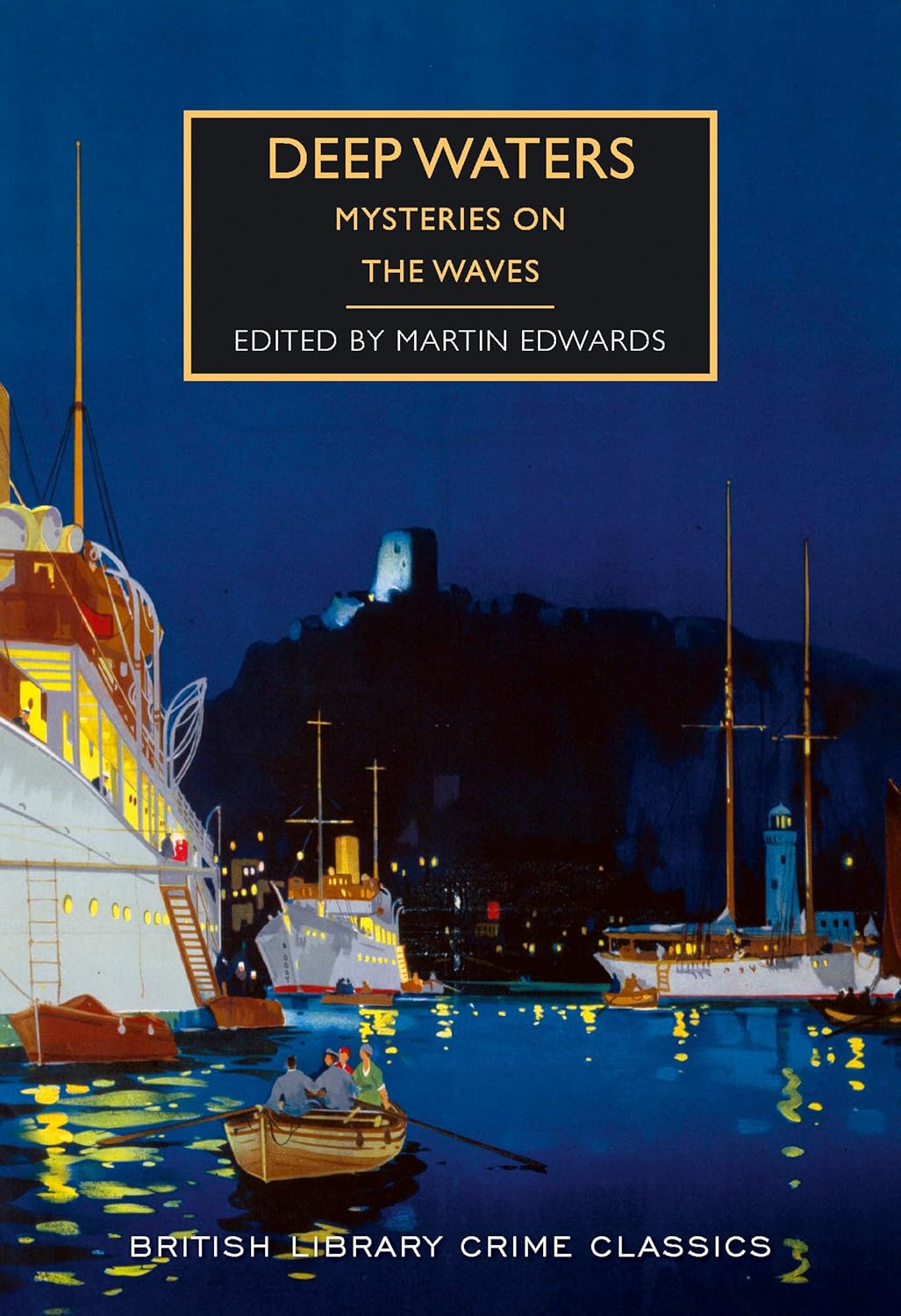
Sixteen salty seadogs sallying seaward in search of scurrilous…stuff, that’s what you’ll more or less find in Deep Waters [ss] (2019), another anthology of short fiction in the British Library Crime Classic series edited by the some-might-say-too-knowledgeable Martin Edwards.
The sea lends itself well to the classic mystery: not only are there its infinite depths to lose a body in, but the nature of cruise ships or isolated boating trips means that identity is always up for grabs and, miles from anywhere, opportunities to indulge in homicide without witnesses are ever-present.
So, how does this collection stand up to its brethren? Let’s test the waters…

I’m working my way through the Sherlock Holmes canon story-by-story on the blog, and ‘The Adventure of the “Gloria Scott”’ (1893) by Arthur Conan Doyle has already been discussed in some depth here. It’s never been one of my favourites, and as such I didn’t rerereread here and thus have nothing to add to my previous thoughts.
While the core mystery of ‘The Eight-Mile Lock’ (1897) by L.T. Meade & Robert Eustace is hardly baffling, this case for “ghost exposer” John Bell is a pleasingly eerie experience with some good nighttime scenes. I get the impression on this slight evidence that the collection A Master of Mysteries (1898) from which this is taken could be a ripping time, like Carnacki the Ghost Finder without all the weighty pontification. I’ll do my best to check it out before too long.
Another one I’d previously read, ‘The Gift of the Emperor’ (1898) by E.W. Hornung was the final story in his first collection about the gentleman thief Raffles. I enjoy Raffles for the amorality of his undertakings, but the theft here is ridiculous — not least because it can only be explained one way, and that leads directly to Raffles himself; there’s dashing conceit, and then there’s idiocy. One feels the despair of Bunny Manders in the superbly-written closing stages, but Hornung’s plotting lets him down here.
I also previously read ‘Bullion!’ (1911) by William Hope Hodgson in The Art of the Impossible [ss] (1990), and apparently thought it “a pretty dire affair, with…secret passages and poisons unknown to science”. And, yeah, that sums it up, really. Though extra intrigue at this second visit comes from the penultimate line, in which our narrator tells us that “I was both handsomely rewarded for having solved the mystery”. And…what else? Both rewarded and what else?!?!
Yet another revisit next in the shape of the inverted mystery ‘The Echo of a Mutiny’, a.k.a. ‘Death on the Girdler’ (1911) by R. Austin Freeman, met before in The Singing Bone [ss] (1912). The first half sees two men of previous acquaintance meeting again — in the most unlikely of circumstances, it must be allowed, manning an isolated lighthouse — to the delight of neither. One murders the other in an undetectable way, and all is rosy.
The second part sees Dr. John Thorndyke brought into the investigation by sheer serendipity, and that man’s applied genius being sufficient to unpick the crime. I’ve said many a time how much I love Thorndyke, and his practical intelligence is well-applied here. It’s not the greatest short to feature him, but his “law of multiple evidence” and the closing line of this tale combine to make him always the most welcome of company.
Garish pulp of the Gerald Verner school awaits us in the fun ‘The Pool of Secrets’ (1935) by Gwyn Evans, with a ghost “arrayed in a silver wedding dress and bridal veil…said to haunt the grounds when the moon is full, and…presage disaster and death”. Sure enough, the ghost is seen, and plenty of people are killed. Can the enigmatic Quentin Drex, complete with a brand on his forehead “burnt into [his] skin by a vindictive mandarin”, see through the local legends to the truth?
This is pure pulpy nonsense, and therefore hard to dislike. Drex has an automaton manservant, infinite funds and leisure to pursue his investigations, and is clearly modelled after a low-rent Sherlock Holmes (“The more bizarre and strange a crime appears to be, the easier it is to elucidate. It’s your common, featureless murder that is so difficult to solve,” he says at one point, recalling ‘A Case of Identity’ (1891) — Evans wrote a lot of Sexton Blake), but if you can get on board with how ludicrous this is — why does he drown the rat?? — it’s hard to object to as some disposable fun.
“So here we are, moored in the middle of Vigo harbour, and one of us a murderer,” pretty much sums up ‘Four Friends and Death’ (1935) by Christopher St. John Sprigg, as four friends finish a yachting excursion with one of them poisoned and dead in the saloon. This seems like a simple little crime tale until it takes a superbly clever Anthony Berkeley-esque turn in the closing stages and becomes something more. Sprigg is making much merriment with the genre’s expectations (“At that rate the more evidence you discover against him, the less guilty he is.”) and on this showing his too-short career is to be lamented.
Having thoroughly abominated the novel Payment Deferred (1926), I came to ‘The Turn of the Tide’ (1936) by C.S. Forester with, well, reservations. And it’s utterly superb, not only magnificently written as a defaulting solicitor with murder on his mind consults a friend on how to dispose of a body, but also beautifully atmospheric as bad weather closes in and the hunter tracks down his prey and commences proceedings.
While I’m not sure that the scheme our killer has in mind is quite as faultless as he imagines — vaulting ambition, etc., etc. — the closing scene of this is a copper-bottomed masterpiece. Forester writes magnificently about the sheer physical exhaustion that makes the final moments to compelling, and the note he concludes on is perfectly weighted for its irresolution and yet its complete certainty. Goddamnit, now I have to look at some of his other writing, don’t I?
‘The Swimming Pool’ (1936) is another example of the work of H.C. Bailey being so very variable. While full of glittering and delightful moments (“[H]e objects to modern tennis as a ballet without art.”) and taking as its core a pleasingly antagonistic relationship between Reggie Fortune and C.I.D. chief Lomas…
“You are the man in the street, Reginald. Blame the police, whatever happens.”
…this is waaaay too long, and for all Fortune’s brilliance there’s a key oversight that would have shortened the whole proceeding which, in overlooking, makes everyone seem exceptionally dim. Every time I read a strong Bailey story I imagine I’m going to love his wider work, then I read something like this and the doubts start to creep in.
“A month or so ago, one Thursday afternoon, I stopped a murder,” should be the opening line to ‘A Question of Timing’ (1946) by Phyllis Bentley. The fact that it’s not — it comes at the start of the second paragraph, after a meandering short paragraph about nothing in particular — tells you all you need to know about this story: the idea’s good, the writing’s good, but the focus is all off and it takes far too long to deliver on its promise.
When the solitary Mr. Harcourt is found bludgeoned to death aboard Helena II, the yacht he lives on, we have ‘The Thimble River Mystery’, a.k.a. ‘The Thimble River Murder’ (1950) by Josephine Bell. It’s faintly hilarious how easy it is for Bell’s series sleuth Dr. David Wintringham to just swan into proceedings and start poking about, and this alone lends the whole thing more of a 1930s air that very much works in its favour.
Bell was clearly up on her boating terminology — “[T]he burgee hoist is…fastened to a cleat at the foot of the mast,” we’re told at one point, and tides seem important — and it’s fun playing in this toy-box and having to figure things out from context in this way. Alas, the solution isn’t fairly clued, and the case made for the guilty party seems pretty thin to my eye; but it’s enjoyable enough, like a day operating a punt: no idea what’s going on, but difficult to object to without seeming like a sourpuss.
‘Man Overboard’ (1954) by Edmund Crispin is one of his short tales, previously collected in Fen Country [ss] (1979). I thoroughly enjoy Inspector Humbleby’s assertion of the value of blackmailers herein, and, while the trick at the core of this is a little long in the tooth, the whole thing is neatly packaged in a way that Crispin excelled at. Best short story writer of his generation? Discuss…
Kem Bennett does well to capture the small victories in the life of a dockworker in rural Cornwall in ‘The Queer Fish’ (1955), and when out main character ends up in a situation beyond his control there’s a note of aplomb in how he conducts himself that feels earned from the life that he knows. The final couple of fillips aren’t terribly surprising, but it’s a lovely little story and very hard to want to fault on any reasonable grounds. A great little find.
A man goes overboard from the cruise ship Southern Star in the first line of ‘The Man Who Was Drowned’ (1958) by James Pattinson, and we’re left in no doubt as to the impossibility of “seeking one small body in an infinity of ocean”:
[T]he Atlantic has an insatiable appetite for bodies: it had swallowed this man as easily as a whale will swallow the tiniest speck of plankton.
The plot here isn’t the most complex, and I find it hard to believe that the, er, key person wouldn’t be able to get their basic facts straight, but it’s a perfect fit for its era and difficult to object to. Erm, yeah, that’s about all I have to say here.
‘Seasprite’, a.k.a. ‘Revenge!’ (1963) by Andrew Garve is short and sweet, though the terminal surprise does require you to reinterpret one of the earlier pieces of information contrary to how it was relayed. But this passes so quickly that you’d be hard-pressed to have any grounds for complaint.
Lord help me, I’ve now enjoyed two Michael Innes stories in a row in these BL collections. ‘Death by Water’ (1975) concerns the philosopher Charles Vandervell who has “been turning increasingly melancholic” and then vanishes from his home one day. The murder that emerges and the simple way it is detected are nothing new, not even slightly, but Innes is on lightly witty form (“Vandervell had a theory about bees, but [his] bees were refusing to back it up.”), writes superbly about the sea, and casually throws in a wonderful aside about the means a country gentleman would employ were he to commit suicide.
The tale as a whole is a little verbose — this is Innes, after all — but the characters are neatly sketched (Vandervell’s heir presumptive is his artist nephew, a prospect that “was probably important to him since nobody had ever heard of [him] selling a picture”) and the overall air well-conveyed. One begins to wonder if Innes is slowly creeping up on me, and in ten years I might be the man’s biggest fan…
And so, a Top 5:
- ‘The Turn of the Tide’ (1936) by C.S. Forester
- ‘Four Friends and Death’ (1935) by Christopher St. John Sprigg
- ‘The Queer Fish’ (1955) by Kem Bennett
- ‘The Echo of a Mutiny’, a.k.a. ‘Death on the Girdler’ (1911) by R. Austin Freeman
- ‘Death by Water’ (1975) by Michael Innes
As is often the case with these selections, Martin Edwards has done superb work in uncovering a few gems for the general populace to enjoy that will also have evaded those of us slightly deeper in the genre. Those five stories would make an excelent collection on their own, and others such as ‘The Eight-Mile Lock’ and the gaudy pulp of ‘The Pool of Secrets’ and you have another excellent range of very strong offerings. Also, look at me: enjoying Innes, being completely swept away by some Forester…good grief, are these collections changing me somehow? Will I be unrecognisable in another year or so?
Lovely to leave this collection, as is so often the case, with more exploting to do. The genre — ocean metaphor incoming — is deep and wide and hugely unexplored no matter how much you’ve read in it, and it’s lovely to have a few pointers about where to head next. All told, a very good time indeed — bravo to all involved.
~
British Library Crime Classics anthologies on the Invisible Event, edited by Martin Edwards
Capital Crimes: London Mysteries (2015)
Silent Nights: Christmas Mysteries (2015)
Crimson Snow: Winter Mysteries (2016)
Continental Crimes (2017)
Foreign Bodies (2017)
The Long Arm of the Law (2017)
Blood on the Tracks: Railway Mysteries [ss] (2018)
Deep Waters: Mysteries on the Waves (2019)
Settling Scores: Sporting Mysteries (2020)
Guilty Creatures: A Menagerie of Mysteries (2021)
Murder by the Book: Mysteries for Bibliophiles (2021)
Final Acts: Theatrical Mysteries (2022)
Crimes of Cymru: Classic Mystery Tales of Wales (2023)
Who Killed Father Christmas? and Other Seasonal Mysteries (2023)
Lessons in Crime: Academic Mysteries (2024)
Cyanide in the Sun and Other Stories of Summertime Crime (2025)
As If by Magic: Locked Room Mysteries and Other Miraculous Crimes (2025)


Awfully few surprises, then, that the Sprigg (I haven’t discussed him at all on my blog, but I’m a fan) and Crispin are some of the standouts. Although I am amused by you asserting he’s “the best short story writer of the generation” and then not even placing him in the top 5! Given “Who Killed Baker?” exists, there’s precious few people who can claim to have written a more satisfying, clever, amusing mystery short story than Crispin…
Oh, but I’m getting off track. I haven’t been following these collections, instead focusing all my funds on the Penzler American Mystery Classics anthologies, but given your reviews of these compared to how almost entirely dreadful the Penzler stuff is, I’m beginning to think I made the wrong choice… Next book haul, I’ll make a beeline for these on your recommendation!
LikeLike
Well, one can be the best short story writer of their generation without every story being a banger, don’t forget…
The selections for the Penzler collections have always felt a little safe to me, so I’ve never been moved to check them out. I think perhaps because the BL put out so many more of these anthologies they’re forced to take a few more risks and those tend to pay off. Edwards has a good eye for how to provide a mixture of styles and approaches, and that goes a long way over predictable security for me.
LikeLiked by 1 person
Predictable security is maybe something you can accuse the Locked-Room Mysteries anthology of appealing to, but most of the rest of the Penzler collections are loaded with a bunch of random, mind-boggling choices — so unpredictable and insecure that even following the damn anthology theme isn’t something you can count on them for! How many of the Golden Age Christmas Mysteries stories aren’t from the Golden Age, don’t have even the vaguest relation to Christmas, and, bafflingly, aren’t even mystery stories! When I tell you that I’ve struggled with the Penzler anthologies, believe me I’ve struggled.
LikeLike
😄😄😄
LikeLike
A good collection, though I think R Austin Freeman’s ‘The Dead Hand’ would have been a much better choice. It was never included in any Thorndyke short story collection after it’s original publication in Pearson’s Magazine and, while it was later expanded in ‘The Shadow Of The Wolf’, the original has not been published since the Battered Silicon Despatch version, which now commands a high price secondhand.
LikeLike
Yes, I have hopes of one day coming across The Dead Hand collection, and not having to trade in a limb to acquire it. One can live in hope…
LikeLike
I see Josephine Bell has her “The Port of London Murders” published in the British Library crime series. Was she some sort of nautical specialist, or is that just a coincidence?
LikeLike
I’ve read one book by her — Death in Retirement — which I don’t remember having any sort of nautical element, so possibly this is just a coincidence. Don’t take me as any sort of authority on Bell and her pastimes, however (I have a feeling that Bell is a nom de plume, so maybe in her real identity she may have had some expertise).
LikeLike
No, she was not a nautical specialist. She did take up the hobby of sailing after her retirement from medical practice in 1954 and she had earlier rowed while in college but these do not make her a nautical specialist!
LikeLike