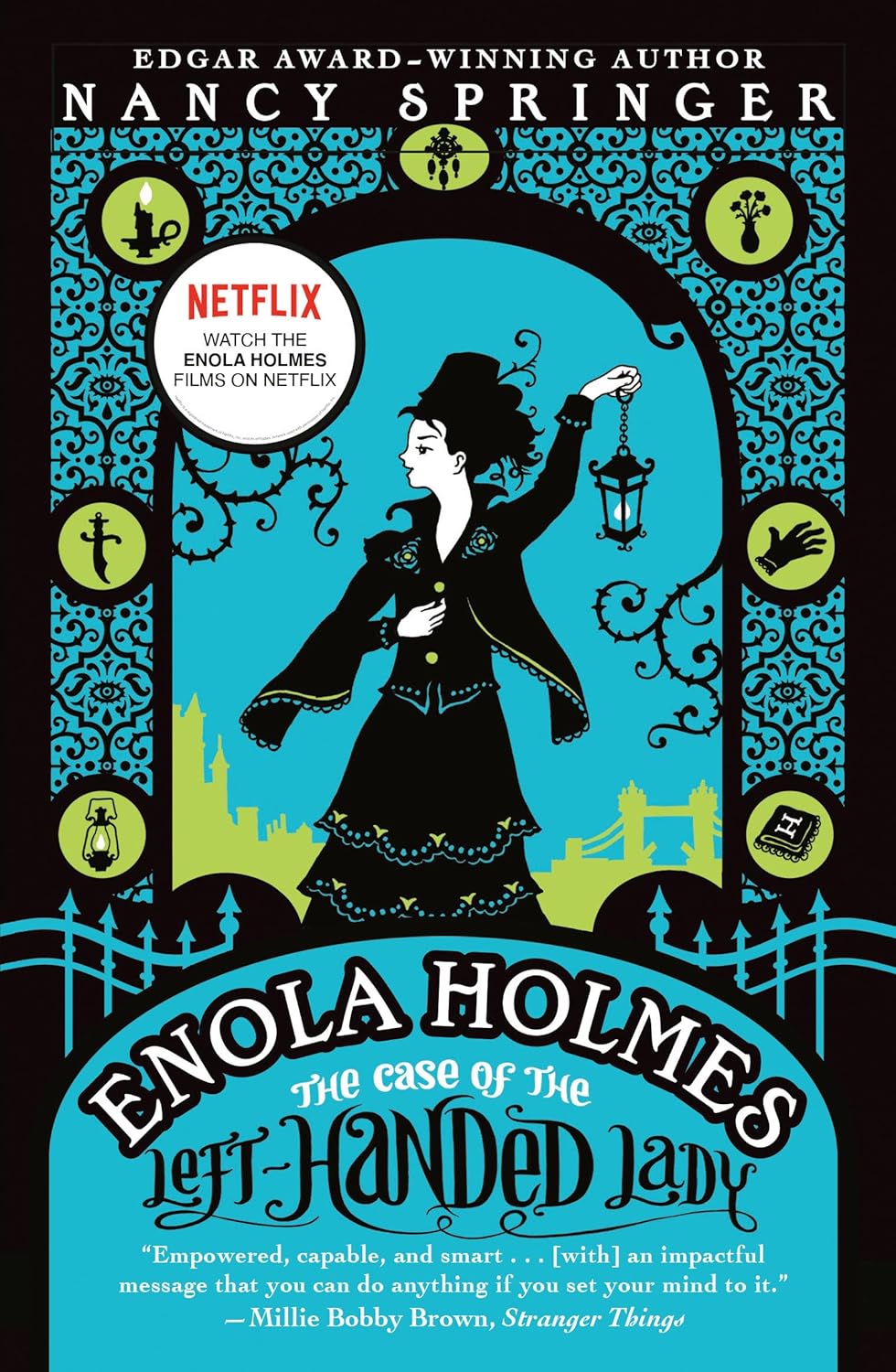
It was over three years ago that I read The Case of the Missing Marquess (2006), the first of Nancy Springer’s books featuring Sherlock Holmes’s younger sister Enola, and while I didn’t hate it I also clearly didn’t feel the need to rush back to the series. So here with are with a belated look at second title The Case of the Left-Handed Lady (2007).
Now set up in London thanks to money left to her by her mother, 14 year-old Enola is keen to establish her credentials as a detective. Here, Enola interviews clients while posing as the secretary of non-existent “Scientific Perditorian” Dr. Ragostin, and investigates scenes of crimes under the guise of the doctor’s wife. But can she, a “runaway upstart of fourteen” really succeed in the realistically unkind world in which she has placed herself? She understandably rebels against the idea of being the “singing, dancing, French-quoting, delicately-fainting decoration to any aristocratic drawing room” that the society she inhabits insists she become, but does that mean she’s cut out for a life dealing with mysteries and the people who would seek to occlude them?
It’s to the book’s credit that we get a sort of Enola Holmes: Year One story, in which her good intentions are sometimes up-ended by reality. Despite all her planning, there are times when even her most far-sighted preparations gang agley, like when she is attacked early on and — in her panic — fails to think of reaching for the dagger she has conveniently concealed about her person for such an occurrence. Still, maybe the disappearing daughter of a baronet will give her the chance to establish her — well, Dr. Ragostin’s — name and get things on a more successful keel.
We’re about a third of the way into the book before Enola begins to attach herself to the case of Lady Cecily Alistair, and the mystery here, while a little more developed than in her debut, is once again rather undercooked. Indeed, given that longer books for younger readers have contained far more involved plots, it’s to be wondered how much mystery-making the series as a whole contains: Lady Cecily has disappeared, and after a bit of looking and a few convenient jumps of what it would be too kind to call logic, Enola finds her and frees her from the rapscallion Marxists who have…hypnotised her into…standing round when their leader gives speeches in pubic, handing out leaflets? Do I have that right?

The oddest part of the whole things comes, it must be said, from the eponymous sinister tendencies of our missing teenager. Enola is staggered when she learns — over halfway through — that Lady Cecily is left-handed, but the reader is given no context as to why this is so astounding. The children of rich parents were trained out of left-handedness, we’re then told…but, so what? Springer turns it into a rather fanciful notion in the text and, at about that point, I have to say that my interest in this endeavour largely plummeted into the abyss.
Still, there are some points to capture the curiosity: “An anti-vaccination mob in the East End had threatened the district nurse,” we’re told at one point, as a reminder that stupidity manages to avoid evolution, and I’m amazed that Southwark ever had enough character to be possessed of “disreputable theatres, gaming, bear-baiting, and the like”. Have you ever been to Southwark? The most exciting thing to do there these days is leave. Equally, early on, we’re told, in learning of Enola’s talent for disguise, that:
Having failed yet to make myself plump, I kept inside my mouth, one in each cheek, a pair of rubber devices that were actually intended for filling out another, unmentionable part of the personage.
Answers on a postcard, maybe? Even disregarding that this is a book for children, I have literally no idea what that other part of the personage might be. You’re not fitting false breasts or buttocks inside your cheeks, so…knees? Ankles?? Also, due to the formatting on my Kindle edition, there’s an unintentionally hilarious moment at the start of a chapter when Enola says “DR. RAGOSTIN WILL CONTACT YOU DISCREETLY,” and it gives the impression that she’s bellowing it at the top of her lungs.
All told, I can easily see it being another three years before I pick up the third of these. They’re…fine — well, no, that’s being too generous — and I prefer to be more enthusiastic about my Minor Felonies reading, and the other series I’m reading which offers younger readers an entry into the Holmes canon has already proven more enjoyable. These books have clearly been popular — a second and third film have been made, though I understand they scoot rather widely round the source material — but they’re not for me, despite Springer’s best attempts to make them a little more interesting then this sort of Youth vs. Adults story turns out to be. More power to Enola Holmes and all that, but this version of Sherlock’s Sister feels rather inessential to my future plans.


I find it oddly telling that the only pull quote on the cover is from the star of the film adaptations. But then maybe there are others on the back.
I remember a couple of years ago chancing across a book in The Works (an odd occurrence, given that it seems more like a gift shop these days) starring Holmes’ housekeeper. I wonder how many characters both from the source material or new have been spun off by now. Next up: Holmes’ coke dealer in Three Sniff Problem…
LikeLiked by 1 person
Haha, that’s an excellent point, I hadn’t even noticed that quote. It does feel a little like it should be “Kerching! Kerching! Kerching! Kerching! Kerching-Kerching!!” — Millie Bobbie Brown
And, yes, certainly Holmes’s housekeeper, brother, biographer, sister, helpful mendicants, and villains all have series on which they’re the star. But who did his laundry? And what crimes did they solve??
LikeLiked by 1 person
I read the first book, and it was enough for me. It’s a YA adventure more than a YA mystery, and a Sherlock Holmes fanfiction for people who don’t like Sherlock Holmes.
LikeLike
Yes, of course — we all bring different things to books, and all expect slightly different things from them, and surely everything out there has its champion. Always remember that the opinions on this blog are mine; I don’t know how to give anyone else’s 🙂
And, yeah, I don’t disagree about the books being more adventures than mysteries. The original Holmes canon are arguably more adventure than mystery, so your idea of a sort of fan fiction is a good one. And, thankfully, I’ve found books in this literary stream which are proper mysteries, and so I know I can read those instead. Hopefully you’ll be interested in reading further with Enola and enjoy what you find.
LikeLike