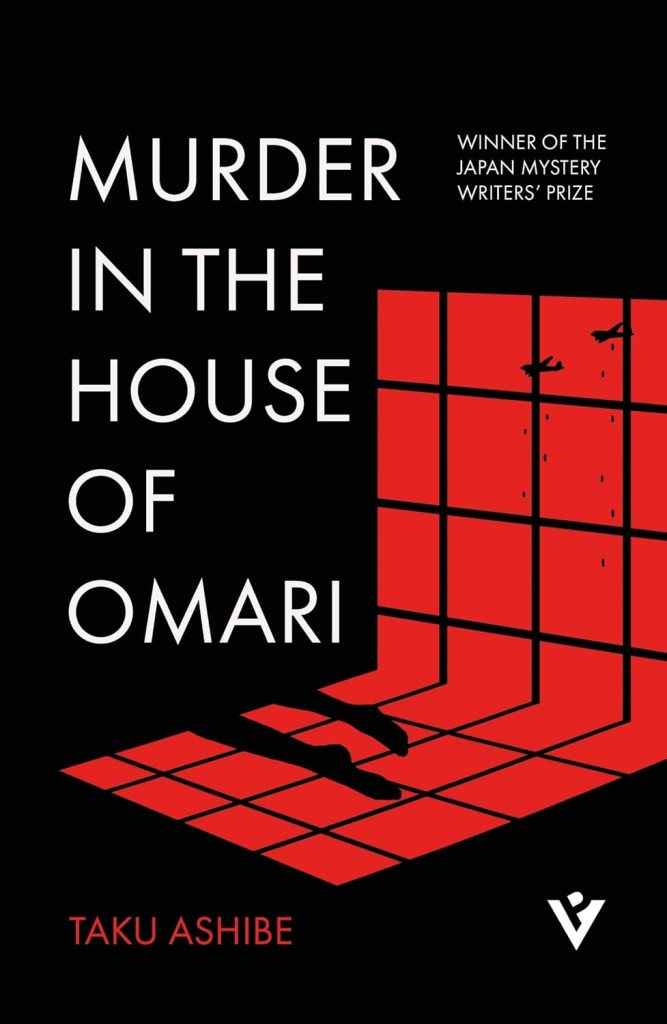


It’s fair to say that, in my reading of crime and detective fiction, I generally like my plots fast-moving, my clues brilliantly baffling, and my detection rigorous. It has been known, though, for something a little more calculated in its pacing or with an absence of well-drawn detection to scratch an itch that only manifests once every blue moon. It was absolutely the case with The Devil’s Flute Murders (1953) by Seishi Yokomizo and, returning to the Land of the Rising Sun and the fiction brought therefrom by Pushkin Vertigo, it’s proved to be the case with Murder in the House of Omari (2021) by Taku Ashibe. Another time, in a different mood, this would not have worked for me at all, but, honestly, I delighted in practically every page of this.
Established in the Nanchi traders’ district of Osaka, the House of Omari is a revered cosmetics company, trading on a reputation for excellence in its products and services. To work even as a lowly errand boy for the House of Omari is a significant position in this respected district, and the wealthy Omari family exerts a huge influence. Ashibe’s novel essentially charts the fates of the Omari clan over the latter years of the Second World War, as a series of murders occurs on the premises where they live and work, rocking a family already suffering under the strictures of the era.
But, of course, the book is also about so much more, with an unsparing eye turned upon the effect of the war on the population of Japan, and an undisguised fury turned towards the leaders who made the terrible decisions that resulted in the country as a whole losing so much of its own sense of prestige and self-worth, both in the immediately personal sense…
[I]t was the same old story for those seeing friends and relatives off to war. For a while, there had been almost daily processions through Osaka, and no matter how lavish the send-off, no matter how loud the three cheers of Banzai! — all that ever remained were feelings of heaviness and emptiness.
…and the wider, slow societal crumbling:
Of course, life at first carried on much as it did before, and one could ignore the shadow cast by the war if only one looked the other way. But then, in the blink of an eye, that shadow grew larger — so large that you couldn’t fail to notice it. And soon enough, Natsuko found herself and everything around her engulfed in an oppressive darkness from which there was no escape.
With resources become scarce and the government invoking increasing demands on what must be given up for the war effort, so the wares put out by the House of Omari suffer, and it is against this loss of prestige and, in a sense, identity that the murders play out. Indeed, the book feels to be almost entirely about identity — not just that of the killer, but of the nation as a whole, and especially the individuals who must change their name on being taken on by the House of Omari. See also grandmother of the current clan Taka, whose own birthday has been lost in the change of calendars, and who must confront a world which is increasingly unfamiliar.
A rich vein of Western detective stories — branded “hostile literature” in this era — runs through the book, with work by Freeman Wills Crofts, Ellery Queen, S.S. van Dine, Roger Scarlett, and others providing much of the background (elder sister Tsukiko doesn’t care for books, so you know she’s a wrong ‘un) and informing a great deal of what unfolds. Deliberately, echoes of these books are found in the murders that occur, with, for instance the family massacre recalling The Greene Murder Case (1928) and a piece of iconography being linked to The Cask (1920) but also seeming to me like Ashibe referencing The Inugami Curse (1951) by Seishi Yokomizo.
Structurally this is far from perfect, with the eventual solution falling to a character only introduced in the final stretch, and one feels that some of the conceits — two people have the same name, and it’s still not clear to me if they’re two different people — perhaps working better in the native Japanese. Translator Bryan Karetnyk deserves huge kudos for his work on this, though, which retains the right amount of foreign touches left unexplained (the details of the clothing are fascinating) to make it feel both a world away and very accessible. This really does feel like a Golden Age of translated work in this genre, and the men and women employed by Pushkin for this purpose are in the front rank.
As a celebration of the cultural influence of detective fiction, Murder in the House of Omari is superb, with the very cultural separation I cherish in these books forming a huge part of the overall theme and fascinating to see from the other side. As a work of historical fiction, folding real death and destruction into a blistering critique of the mishandling of resources and communications in wartime, it is a coruscating read, and one that does well to stir so much fury while remaining tightly-focussed on a close-knit group. Don’t come for fair play detection or rigorous examination of crime scenes, but instead for the cultural divide viewed through the lens of personal loss and weighed against the wider devastation of a country completely broken by the people who ran it into the ground. Sobering stuff, but rather magnificent with it.
~
See also
TomCat @ Beneath the Stains of Time: [A] more accessible title for readers who find the usual shin honkaku style with its eccentric architecture, grisly corpse-puzzles, gruesome locked room slayings and elaborate deductions heavy going. Murder in the House of Omari is a pure whodunit without any impossible crimes, unbreakable alibis or untranslatable codes…


Congratulations on your 1500th post! Here’s to 1500 more!
I’d been fully intending on reading this book by now, but I’ve had a most topsy-turvy week. I ended up being unimpressed by Edmund Crispin’s “Swan Song” (a fun read, but a threadbare mystery), madly falling in love with a Michael Innes novel, and, quite unexpectedly, hugely enjoying several Ruth Rendell books. She’d been one of those writers I always assumed weren’t my cup of tea until a few days ago. Goes to show what assumptions make of us, ey?
But, “Murder in the House of Omari” is firmly ensconced on my TBR, especially now you’ve made it sound so intriguing.
LikeLike
Many thanks! I like the posts ending in two zeroes to feel a little special, and when I finished this (about six hours after first sitting down with it) I knew that it would make a more than worthy candidate for #1500.
Sorry that Crispin didn’t work for you; I remember enjoying it greatly, but not everything is for everyone. Sounds like you’re catching my Innes Sickness, too, so be sure to lie down in a darkened room with a Gerald Verner novel until you feel better 🙂
LikeLike
I’m sure I’d have enjoyed the Crispin more if I hadn’t been lead to expect a great fair-play mystery out of it. I did find it very witty and quite enjoyable otherwise. I’ll bear these lessons in mind for my next encounter with Gervase Fen.
Unfortunately, I think I was destined to catch the Innes bug. Being myself an exasperatingly academic person with a love for interetextuality and word games, we were simply meant to be, despite all the negativity directed at him from the blogosphere 😀
LikeLike
My impression is that Crispin declines from Swan Song, so tempered expectations probably isn’t a bad idea going forward.
As to Innes, I don’t know if he gets negativity as such — Nick Fuller is a big fan for one. I feel most of the negative perceptions might come from me, and I’ve read very little by him…
LikeLike
Re: negativity, I was just being dramatic for comedic effect. In fact, it was Aidan’s review of Sonia Waverly that convinced me to pick Innes up, and one of Nick’s helpful lists which got me further into the bibliography. I do, however, find it very funny that even the most positive reviews of Innes’ books must include the obligatory nod to him being “not to everyone’s taste”, a story about how a previously read Innes book was difficult to get through, and an assurance that this is one of the good ones. I’d be lying if I said that this reputation didn’t add a little “sweet mystery” to his back catalogue. I’m kinda looking forward to the Innes novel which so annoys me I have to chuck it at the wall. So far, no luck…
LikeLike
Well, if you have any Innes highlights to recommend, I’ll take them. His short stories have been growing on me of late, so I feel I should give him another go — maybe I’ve developed the patience for him now (note: I definitely haven’t, I grow more impatient daily).
LikeLike
Have you read any Edogawa Rampo? I picked up his Beast in the Shadows at a train station book-swap knowing nothing about and, based on how modern it felt, was stunned that it released the same year as Agatha Christie’s The Mystery of the Blue Train.
LikeLike
About fifteen years ago someone gave me a double volume book containing The Beast in the Shadows and The Black Lizard, and I was pretty much blown away by them both. As you say, for their era they seem rather ahead of their time, and it’s bracing to realise what others were doing as contemporaries.
I reviewed his Japanese tales of Mystery and Imagination collection here and thoroughly enjoyed, that, too.
The Gold Mask was released in English recently, and for some reason I’ve not checked it out, so thank-you for the reminder.
LikeLiked by 1 person
Funny story: when I read that book (Beast) I lived in a house where the living room window gave directly onto the street. As I was reading the book, I reached a scene where a woman is in a house, and a man dressed as a clown is in the crawlspace above peering down at her.
I was really creeped out, then thought I heard a noise through the closed curtains beside me. I ran upstairs in a panic before realising how daft I was being.
LikeLike
Rampo’s story ‘The Human Chair’ still makes me look twice at any overstuffed furniture, so I completely understand. When the guy was good, lor’ was he good.
LikeLiked by 1 person
Congrats on your 1500th! May you have a 1500 more!
I’ve been looking forward to this book, and I’m glad you enjoyed it.
LikeLike
Thank-you, here’s hoping there’s enough left to read to get me to 3000 posts, eh?
There’s a universe wherein I picked this up at the wrong time and didn’t get nearly as much out of it, but I’m delighted that I found so much depth in its very deliberate structure. I can see it being a difficult book to get into, but I’d suggest it’s definitely worth the effort for the Golden Age fan. I hope you’re able to see what I saw in it when you get to it.
LikeLike
Good grief! Fifteen hundred posts?!? And we’ve been blogging for the same amount of time! I only have a measly 860. Clearly, I’ve been sloughing off!! And I didn’t even love the book – although, as often happens to me with honkaku, I was fascinated with all the period details. The way they got cars to go without gasoline. Seeing the post-war horrors through the eyes of a country we called our enemy . . . that boggles the mind more than any of the mysteries.
LikeLike
Kate’s been blogging the same amount of time, and she did 1500 posts in August, so don’t fret. You and I are on the same slow train.
The historical details really do make this, I agree. Strip those away and it’s still a fascinating look at the influence of murder mysteries from the ‘other’ side, as it were, but it would be harder to get immersed in were I not reading with my mouth open half the time, amazed at the historical touches.
It’s the same thing that will bring me back to Yokomizo, despite not being able to get through the last of his I tried. There’s so much cultural richness that I’ve been ignorant of, and now I’m absolutely here for it.
LikeLike
First of all, congratulations on your 1500th post! It’s amazing some of our blogs alone have now double the volume of articles and reviews than the sites, forums and groups from the pre-2010s era.
Glad you enjoyed and rated this one so highly! Yes, the historical content is sobering in its magnificence, but liked the plot a little more than you did. Either way, Murder in the House of Omari is the title to recommend to people who have struggled with the shin honkaku style.
LikeLike
Mad to think how much is now on this blog, given that I started it mainly to scratch my own itch of wanting something similar to what you had already started, just with 100% of the posts being of interest to me 😄 I wouldn’t have made it to #1500 without the likes of you inspiring me to write #1.
I was a little dubious going into this, having not fared brilliantly with the earlier Ashibe translation Murder in the Red Chamber, but they’re worlds apart and I’m so pleased to have not just had the chance to read this but also to have got to it at the right time. Makes me very eager for whatever else Pushkin might bring our way in future…
LikeLike