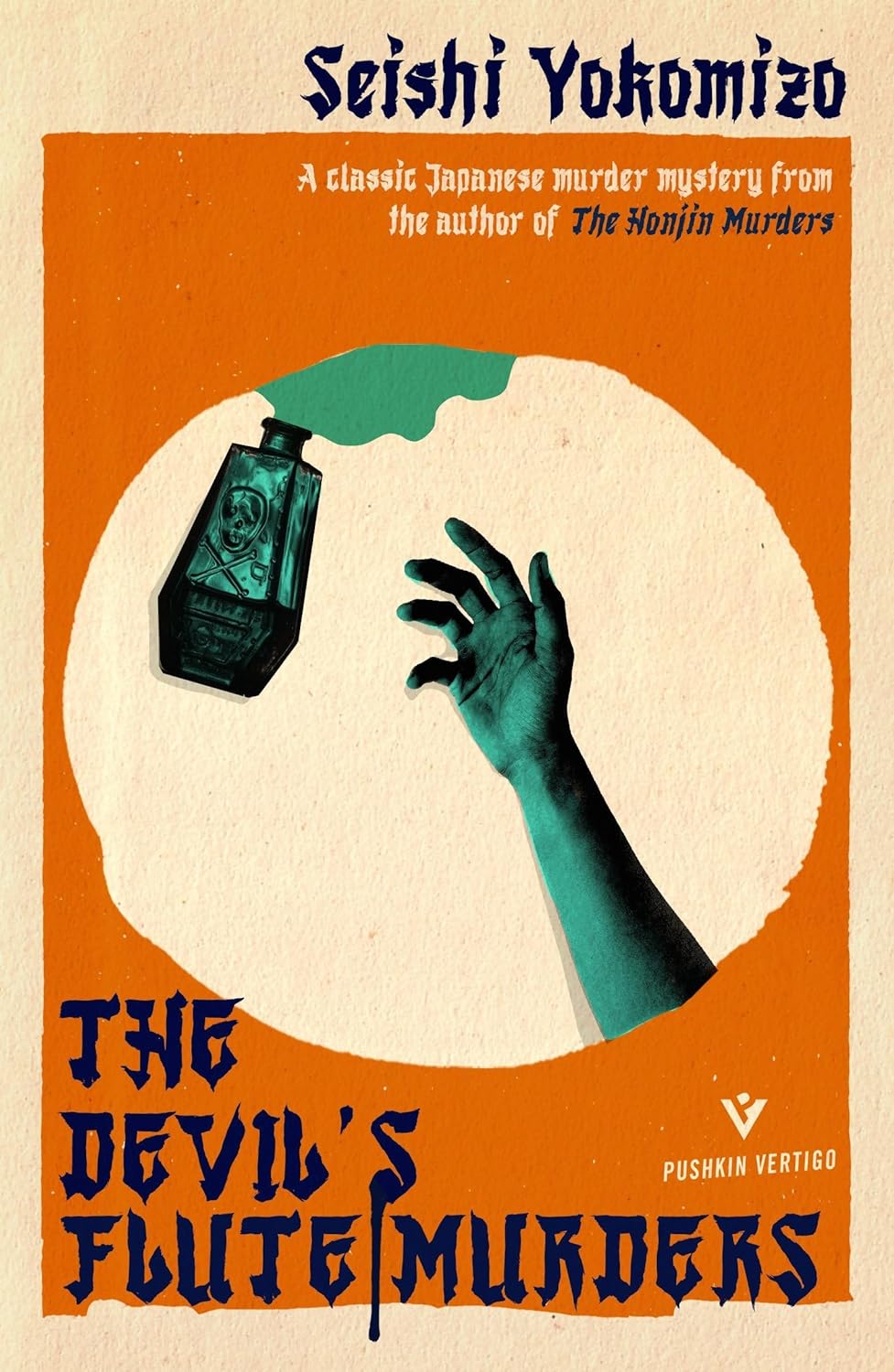


After what felt like a run of fairly light reading, I found myself in the mood for something a little denser, and boy does The Devil’s Flute Murders (1953), the fifth title by Seishi Yokomizo to be published in English by Pushkin Vertigo, deliver on that front. We start with a mass poisoning in a jewellery store, then move onto the disappearance of a member of the nobility who turns up dead…only for his family to doubt his demise and pull amateur genius detective Kosuke Kindaichi into a superbly atmospheric divining ceremony that culminates in a gruesome locked room murder. Yup, the opening third of this book is, pleasingly, something of a whirligig.
Had the novel retained this focus on the Tsubaki household and simply thrown in additional puzzle plot complications, it could well have been something of a masterpiece. The setup is unusual enough — post-war, the “sunset clan” of the Japanese aristocracy are facing the removal of their titles and privileges, and the consequent loss of their income, resulting in a mashing together of family elements — and the various people bizarre enough that time spent in this setting could easily be spun into a fabulous mansion mystery in the Roger Scarlett mould, albeit with the fascinating honkaku trappings that have made these translations so appealing to many of us experiencing them for the first time.
Instead, after establishing the facts of the murder, Kindaichi leaves the scene of the crime and heads out on a side quest for about a quarter of the book, bringing in a new set of characters and relationship dynamics. This is motivated by the original mystery, and Yokomizo’s reason for structuring his story in this way is clear — a lot of this era’s honkaku-style mystery demonstrates an understandable fixation with national identity at a time of incredible social and economic turmoil, making these books as much essential cultural documents as they are mystery novels — but it dilutes the focus, and feels like it could have been woven in more artfully, especially when this entire thread is resolved via a letter from another policeman.
What it isn’t, however, is boring. The two translations prior to this — Death on Gokumon Island (1948) and The Village of Eight Graves (1951) — felt bloated and ill-focussed at times, but here you get a strong sense of a country as much physically defaced as it is psychologically wounded:
For the next short while, they talked about the war. Osumi recalled the terror of the air raids, how they turned the whole area into a sea of flame, and then how the crowds of fleeing people were raked by machine-gun fire. The kind of stories almost anyone who had lived through those times could share.
There’s what feels like a theme of grotesquerie that carries through from the landscape to the characters, including a lady-in-waiting whose “ugliness [was] of such purity and extent” that “it becomes a kind of art at that point”, and the toad-like Dr. Mega — Yokomizo describes him as such about thirty times in the text — who hobbles in and out of scenes on his twisted legs dragging a carpet of poisonous miasma that settles effortlessly over the people already pushed to the limit of endurance:
“Everyone here is a bit twisted somehow. All they feel for each other is suspicion, resentment and fear. I couldn’t tell you why that is. It’s as if they’re all just waiting for their chance to stick the knife in. As if they think that if they don’t, then they’ll be on the other end of the blade.”
Translator Jim Rion continues the high standard of work done in bringing these books into English by capturing the air of menace and uncleanliness superbly (“Shino’s voice took a hateful tone, as thick and dark as ink.”), rendering the somewhat sombre and oppressive tone in nothing less than compelling prose that really makes this fly by very easily, even if the phonetic Western Japanese accents that play a part in proceedings do rather feel like you’re found yourself in a field outside Bristol (or perhaps a remote region of Canada) at times.
It speaks volumes about how much I enjoyed this that the closing cavalcade of preposterous revelations didn’t spoil the book overall. I mean, it’s complete nonsense — that’s not how genetics work, and some staggering coincidences and frankly ludicrously stupid behaviour must be swallowed to allow the plot, and especially that locked room murder, to have functioned as it did — but the thematic timbre of the whole piece is maintained beautifully. Hell, it even reinforces some of the key motifs of Yokomizo’s debut, The Honjin Murders (1946), an appreciation of which really helped me get more out of the somewhat gaudy and unlikely contortions that close things out here…although the final page reveal which ties it all up is magnificent.
After Death on Gokumon Island and The Village of Eight Graves I wasn’t convinced that I’d read Yokomizo much further, but The Devil’s Flute Murders has given me a new appreciation of his writing. To see Western storytelling traditions blended so seamlessly with such bold narrative choices is really rather bracing, and the cultural education that continues to bleed through these pages can’t be overstated. It is to be hoped that we get much more Yokomizo in English, as well as works by the other honkaku and shin honkaku authors Pushkin Vertigo continues to add to its roster — they represent a fascinating aspect of mystery fiction that I think I’m only just beginning to appreciate, and it’s an education I would like to continue for many years to come.
~
See also
Brad @ Ah, Sweet Mystery: I have a few caveats about its effectiveness as a mystery. My friend John Harrison mentioned a good one in his review of the book. There are also a couple of groaning coincidences, some problematic nonsense about the nature of birthmarks, and a certain wishy-washiness about the murderer’s state of mind. I wonder if my own problems with the novel stem from a serious lack of knowledge of early 20th century Japanese culture. I don’t know if it’s something an introduction or suggested reading can fix, or if I will have to accept that the pleasure of reading these books will have to include embracing a limited ability to understand them.
TomCat @ Beneath the Stains of Time: [W]here The Devil’s Flute Murders unmistakably differs from its contemporaries in the West is the driving force behind all the murders. A motive and backstory you’ll never find a Western detective story from ’40s or ’50s. Something unsettling enough to still pack a punch today. A human tragedy presented as a detective story in which a devastating truth extracts a heavy toll on a lot of people
~
Seishi Yokomizo on The Invisible Event
The Honjin Murders (1946) [trans. Louise Heal Kawai 2019]
Death on Gokumon Island (1948) [trans. Louise Heal Kawai 2022]
The Inugami Curse (1951) [trans. Yumiko Yamazaki 2003]
The Village of Eight Graves (1951) [trans. Bryan Karetnyk 2021]
The Devil’s Flute Murders (1953) [trans. Jim Rion 2023]


Glad you enjoyed this book. This is one of Yokomizo’s novel that I have not read. Also curious to see your thoughts on other recent honkaku translations: ‘The Meiji Guillotine Murders by Futaro Yamada’ and ‘The Samurai and the Prisoner by Honobu Yonezawa’. Both are two of the best honkaku translated so far in my opinion. However, the amount of Japanese historical names in both might be challenging at first. But I think it will be worth it in the end. The puzzle is integrated really well, but the historical bits is really interesting as well. Probably why both are well received even for casual readers in Japan.
LikeLike
Thanks for the heads up on those more recent translations. They’ve somehow flown under the radar.
LikeLike
Yeah, especially ‘The Samurai and the Prisoner by Honobu Yonezawa’ since it is published by Yen Press, which is not known as mystery novel publisher. Not a lot of mystery fans are aware of this book, which is a shame since it is probably one of the most critically acclaimed mystery novel in Japan in recent years. It even won Naoki Prize, which is one of the biggest literary prize in Japan. Hope it sells well enough so we can get his other award-winning mystery works, such as ‘Combustible Substances’ and ‘The Broken Keel’.
LikeLike
And I’m still hoping for more Szu-Yen Lin in English, too. Who do we speak to in order to make that happen? C’mon, Pushkin, up your work!
LikeLike
I have both of these, and am looking forward to them both — someone even mentioned The Samurai and the Prisoner to me at Bodies from the Library last weekend, so clearly it’s on people’s minds 🙂
I note we’re also getting a new Ashibe Taku translation next year from Pushkin, currently listed on Amazon under the title Murder in the House of Omari. So it seems the honkaku flood remains in full force — wonderful news.
LikeLike