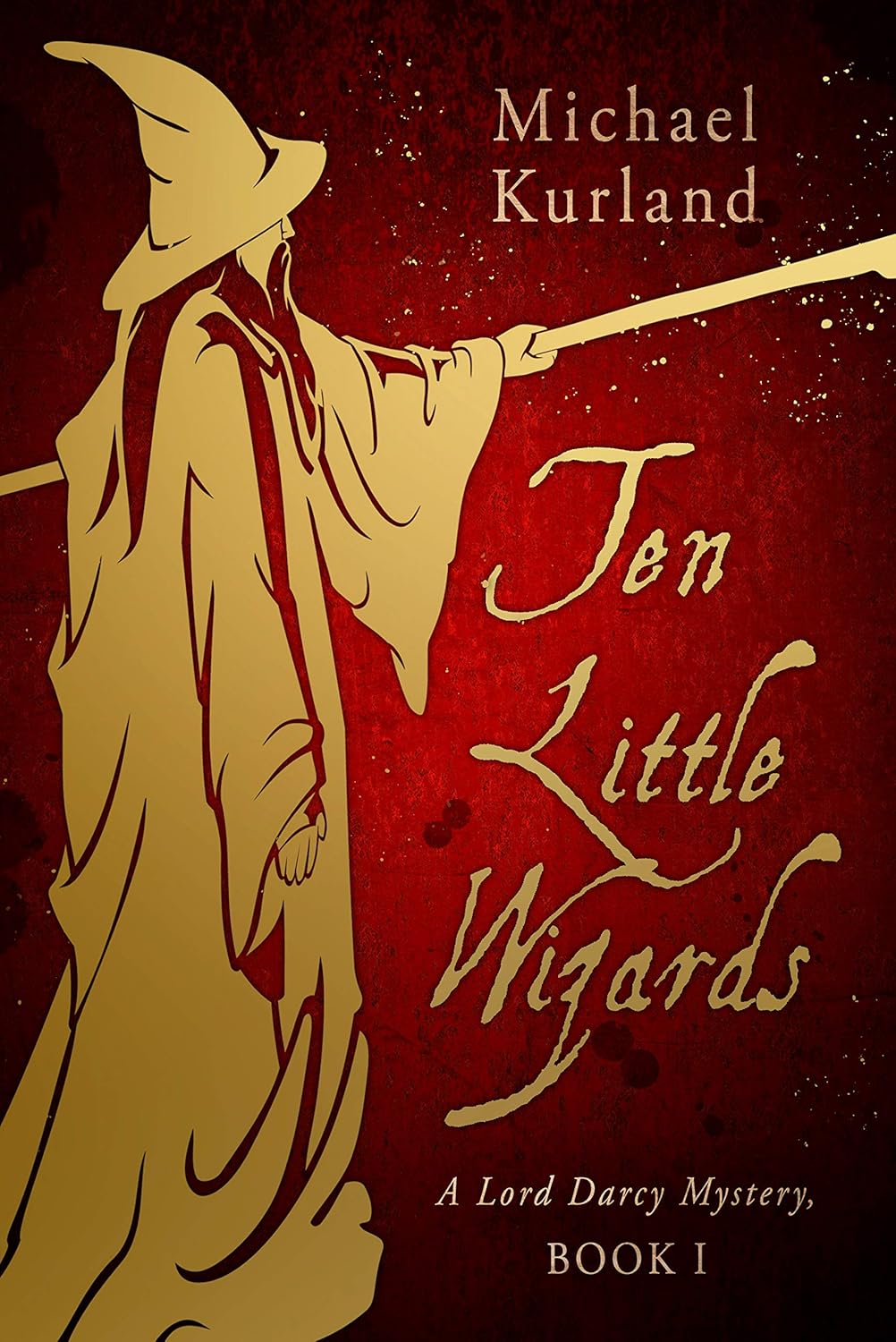
Having recently been unimpressed by both the sole novel in Randall Garrett’s Lord Darcy corpus, Too Many Magicians (1967), and a pastiche novel by Michael Kurland, The Infernal Device (1978), the obvious next step is to read a pastiche novel in the Lord Darcy universe by the author of The Infernal Device, right?
Ten little wizards sat down to dine
One wizard stuffed his face — and now there are nine.
So runs the piece of doggerel verse found clutched in the dead hand of Master Sorcerer Raiman DePlessis, who is found in a bakery “[s]tabbed through the heart with no weapon in sight, and no way in or out of the building”. And since the bakery is found between the outer walls of the Castle Cristobel, where the King’s son is about to be invested into the last rung of the ladder that will see him eventually become king when his father dies, and since a threat has also been made against the life of the King…well, this could be serious. And so Lord Darcy, on hand to oversee the security at the coronation, investigates — after all “impossible crime [is] right up [his] alley”.
It takes a little while for Ten Little Wizards (1988) to settle on this focus, with the opening chapters needing to both establish Garrett’s universe for the callow reader who might be picking this up unaware and establish various plot strands. So, by the time DePlessis dies, we’ve already had the garotting of a noble and his bedfellow in a tavern, the Sensitive DePlessis picking up on someone having violent thoughts about him while sharing a railway carriage, and the establishment of affairs at Castle Cristobel so that the main players can all be in one place. Kurland, it must be said, has not made life easy for himself.
And there’s the added complication that you’re writing a pastiche which extends an existing, beloved corpus and so solidly 80% o the people reading your book are going to be paying less attention to what you’ve written than to the way you’ve written it, so that they can prove to…someone…that they understand Garrett’s method of expression far better than you, you massive fraud.

For my money, Kurland does a good job with the stuff about Garrett that I hate: everyone has about four names and titles, so that you’re not sure how many people are included in a list, and the obsequious fealty to the King feels like either a) they’re scared they’ll be shipped off to a gulag if they appear to in any way question the One True Way, or b) there’s a competition on to see who can have the brownest nose by the end of the week. Either way, Kurland hits the nail pretty hard, and his descriptions and wider consideration of the world — the levitation spell that tubby Irish sorcerer Master Sean O Lochlainn puts on the corpse, say — feel like Kurland really does have this universe’s grit under his fingernails.
In true Garrett style, the plot advances by lots of formal discussion, lots of observation of social nicety, and the occasional person approaching Lord Darcy and murmuring something regretful about another murder having occurred. The whole thing is about as solidly okay as Too Many Magicians was, and I don’t know what else to say about the plot, if I’m honest. Most of the fun is to be derived from Kurland offering accidental commentary on the public attitude to true crime, which pours much cold water over what would become the podcasts Kurland was unlikely to have predicted at the time…
“[T]he unintended result of the popularity of these series of books [about crime] has been the writing of several other series on the same topics and the springing up of many small societies devoted to the study of crime.”
“You mean, they try to solve crimes?” Master Sean asked, his voice rising in shocked surprise. “Without professional training? What a horrible thought! Why, one of these people at a crime scene could scramble the physical evidence, not to mention the psychical and magical traces, to the point where it would be worthless!”
“No, no, Master Sean,” Lord Darcy reassured him. “As you — and as they — well know, that would be against the law. These people discuss crimes that have already been solved; alternately from the point of view of the criminal and that of the detective. They write papers about how well the criminal committed the crime — disregarding the moral questions — and how well the detectives solved it. What they seem to have done is reduced murder and other capital offenses to the status of parlor games.”
…and little knowing references to the wider genre, like the discussion about dogs which did not bark in the night. Doubtless Kurland also indulges in Garrett’s fondness for puns in naming conventions, but I’m not clever enough to pick up on that sort of thing.
Three impossible murders present themselves, and while clues are certainly provided in the case of a man found on a recently-shellacked floor with his throat slit and only his footprints in evidence on the wet surface, the other two are solved by Darcy saying in the final chapter ‘It was probably this…’ and having really no evidence to back it up. It galls slightly that Kurland took the time to say that detection is “[n]ot as thrilling a process as the novelists make it out to be. But then, they can leave out the dull parts,” and mostly what he’s provided is pretty dull and lacking in any of the imagination Garrett tried to bring to many of his own (fictional) crimes.
All told, I found Ten Little Wizards a disappointment with a few good ideas too diluted among scenes of everyone observing proper protocol, long descriptions of settings or recent history which add nothing to the plot and drag out so long they make tedium of atmosphere, and a lack of ingenuity both in the commission of its impossibilities and the reason for those impossibilities. As such, it’s a perfect continuation of the Lord Darcy novels, and I’ll go into Kurland’s sequel, A Study in Sorcery (1989) — which, don’t worry, I already own — with suitably lowered expectations.


So it actually worse than Too Many Magicians? That’s an accomplishment on its own!
LikeLike
Garrett, for all his flaws, knew how detection could be used in his universe. Kurland…muffs it a bit. But — bonus — it’s certainly shorter than Too Many Magicians…
LikeLike