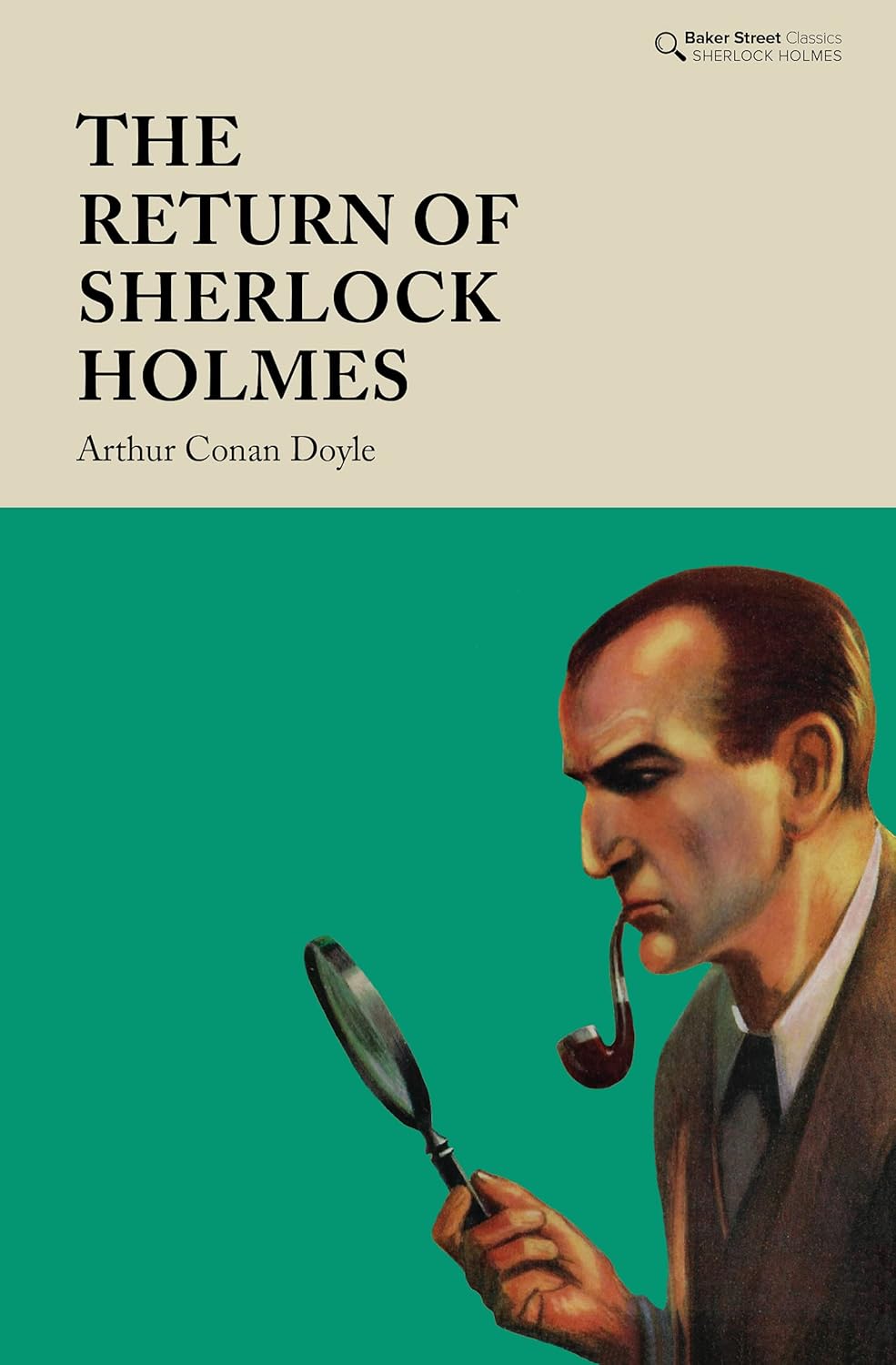
Sherlock Holmes is back, baby, back! And I bet the first proper case following his return is an absolute belter.
Could Holmes have finally backed the wrong horse? All will be revealed in…
‘The Norwood Builder’ (1903)
The Case
Several months after his return to Baker Street, Holmes is lamenting the dearth of interesting crimes now that Professor Moriarty exerts no influence (seemingly forgetting that he had a hand in only one of the 29 cases related prior to this) when John Hector MacFarlane bursts into the room. He has been accused of the murder of ex-builder Jonas Oldacre — of killing him and burning his body in the woodyard adjacent to his house — on the basis of circumstantial evidence, and he pleads with Holmes to investigate and clear his name. And when Inspector Lestrade turns up with a warrant and drags MacFarlane away, Holmes feels that the least he can do is look into matters, even though it starts to look increasingly unlikely that MacFarlane could possibly be innocent…
The Characters
Jonas Oldacre, builder; from Norwood.
John Hector McFarlane, solicitor; from Blackheath.
The Timeline
Holmes has been back in Baker Street for “some months”, so it’s 1894 still but maybe…August? Seriously, why do I do this, I have no idea, and someone somewhere will have put so much time into researching this. It’s August 17th, I say, and I defy anyone to prove otherwise…!
The Tropes
More cases we’ll never know: “Our months of partnership had not been so uneventful as he had stated, for I find, on looking over my notes, that this period includes the case of the papers of Ex-President Murillo, and also the shocking affair of the Dutch steamship Friesland, which so nearly cost us both our lives”.
And some deductions — “[B]eyond the obvious facts that you are a bachelor, a solicitor, a Freemason, and an asthmatic, I know nothing whatever about you…” — but when even Watson can figure out how these conclusions are reached, well, it stops being quite so impressive, dunnit?
Points of Interest
Does heavy breathing mean someone is asthmatic? The man is clearly under great strain, and has just forced his way in to an unfamiliar address and run up 17 stairs. I’d be breathing heavily in those circumstances. Oh, no, am I asthmatic? You can see how WebMD gets people, can’t you?
Holmes is a little less guarded since his return, eh? I love his response to MacFarlane’s situation: “This is really most grati—most interesting. On what charge do you expect to be arrested?”. Doyle’s having fun, and it shows.
We know Holmes has always poured scorn on Watson’s literary effusions, but, wow, he really doesn’t rate them, does he? “I fear that the Norwood Disappearance Case will not figure in that chronicle of our successes which I foresee that a patient public will sooner or later have to endure”. You fake your death and disappear for three years, and this is the attitude your closest friend has to put up with upon your return? I’d find a shallow puddle and hold him face down in it, frankly, since falling into water from a great height didn’t do the job.
Also, Watson comes down in the morning to find that Holmes has sat up all night and “[t]he carpet round his chair was littered with cigarette-ends”. The fireplace is right there, Sherlock. What a prick.
Maybe this is why Watson seems to be getting a little snarky. Holmes heads to Blackheath to check out MacFarlane’s family, and upon his return we’re told he “droned away upon his violin” for an hour. Drone is an interesting verb in those circumstances, is it not? Not merely that he played it, but that he did so in a manner that seems to nettle Watson. Maybe this recommencing of affairs isn’t as rosy as the surface might have us believe…
I had a moment when Holmes says Mrs. MacFarlane “produced a photograph of a woman, shamefully defaced and mutilated with a knife”, thinking it as the woman who has been mutilated — crikey, Arthur! Then I realised it was the photograph. I have been mentally rewriting that sentence ever since. The best I can do is “She produced a photograph, shamefully defaced and mutilated with a knife, and it took me a moment to realise it was of a woman,” but even that’s not great. Answers on a postcard.
This turns on a principle that R. Austin Freeman explored in greater detail in his first Dr. John Thorndyke story, the novel The Red Thumb Mark (1907). And given that I’ve long felt — well, since 2020 when I made that character’s acquaintance — that Thorndyke was the logical evolution of Holmes into actual attainable functional genius, I’d like to say that there’s no way Thorndyke would have fallen for the ol’ ‘burnt remains’ trick. I mean, Oldacre seems to have used “[a] dead dog, or rabbits, or what?”. Hell, in Thorndyke it would have been a dog, and upon discovering a tooth in the embers Thorndyke would say something about a canine and have a jolly old smirk while doing so. Seriously, if you’re not reading the John Thorndyke stories then you’re missing out.
And go and read The Return of Moriarty (2025) by Jack Anderson while you’re at it. That book is amazing and deserves far more love, and the sequel The Mark of Moriarty (2026) is out soooon…
~
The Sherlock Holmes canon by Sir Arthur Conan Doyle on The Invisible Event
A Study in Scarlet (1887)
The Sign of Four (1890)
The Adventures of Sherlock Holmes [ss] (1892):
- ‘A Scandal in Bohemia’ (1891)
- ‘A Case of Identity’ (1891)
- ‘The Red-Headed League’ (1891)
- ‘The Boscombe Valley Mystery’ (1891)
- ‘The Five Orange Pips’ (1891)
- ‘The Man with the Twisted Lip’ (1891)
- ‘The Blue Carbuncle’ (1892)
- ‘The Speckled Band’ (1892)
- ‘The Engineer’s Thumb’ (1892)
- ‘The Noble Bachelor’ (1892)
- ‘The Beryl Coronet’ (1892)
- ‘The Copper Beeches’ (1892)
The Memoirs of Sherlock Holmes [ss] (1894):
- ‘Silver Blaze’ (1892)
- ‘The Yellow Face’ (1893)
- ‘The Stockbroker’s Clerk’ (1893)
- ‘The “Gloria Scott”‘ (1893)
- ‘The Musgrave Ritual’ (1893)
- ‘The Reigate Squires’ (1893)
- ‘The Crooked Man’ (1893)
- ‘The Resident Patient’ (1893)
- ‘The Greek Interpreter’ (1893)
- ‘The Naval Treaty’ (1893)
- ‘The Final Problem’ (1893)
The Hound of the Baskervilles (1902)
The Return of Sherlock Holmes [ss] (1905):
- ‘The Empty House’ (1903)
- ‘The Norwood Builder’ (1903)

