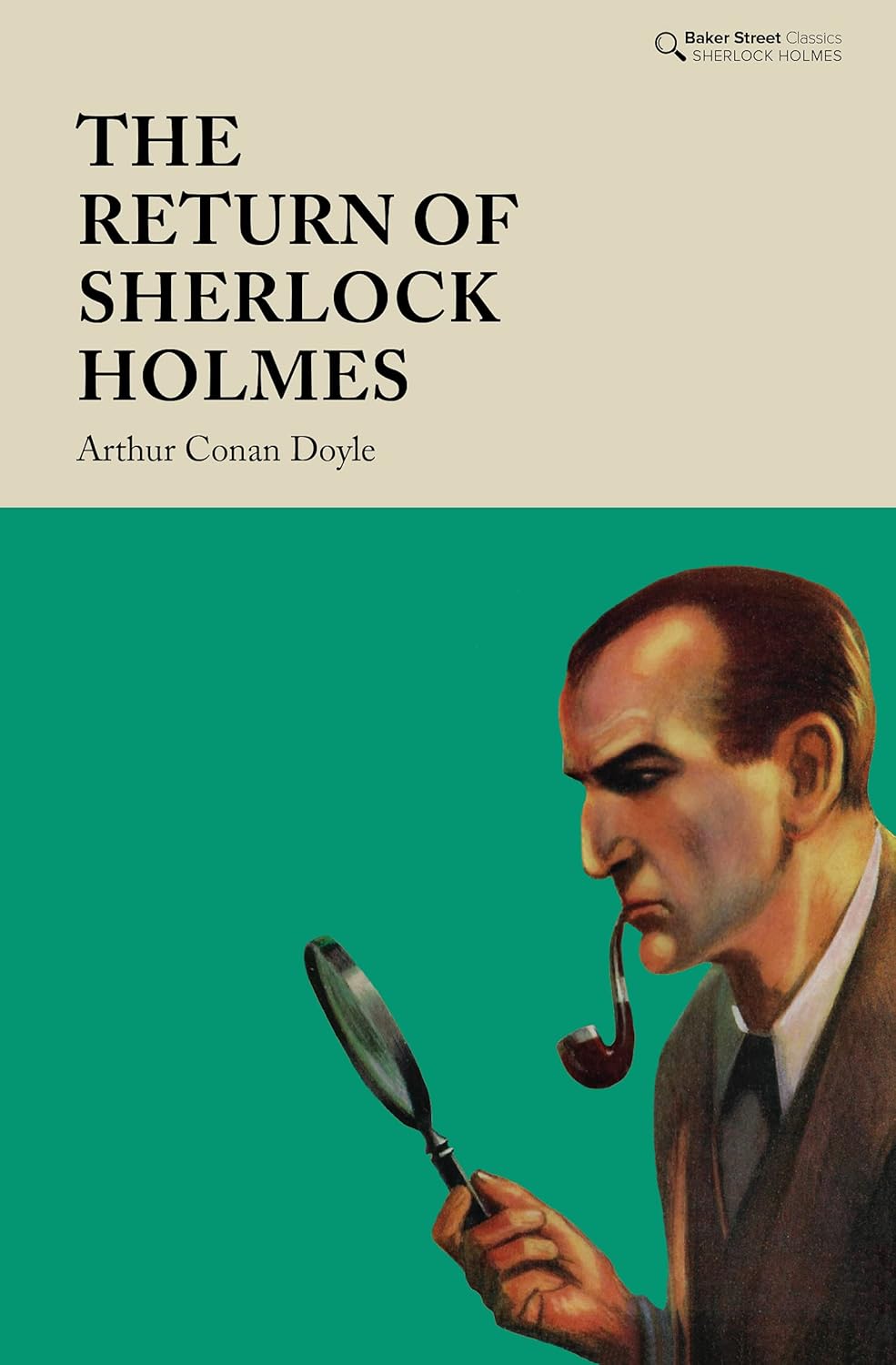
I’ve looked at this before, but I took life much more seriously back then. Let’s all just relax, shall we?
Yes, it’s the return of the return of Sherlock Holmes, back from his watery grave (er, spoilers?) in…
‘The Empty House’ (1903)
The Case
Young Ronald Adair returns one evening from his club, locks himself in his second-floor sitting room, and is found later that same evening dead from a revolver bullet to the head and no revolver in evidence in the room. Not only could no-one have achieved ingress or egress without leaving some sign, no shot was heard also…so how did he die? Dr. John Watson interests himself in the case, and an elderly bookseller might also have a word or two to say about it…
The Characters
Ronald Adair, dec’d.; he’s got a bullet in tha head.
Colonel Sebastian Moran, ret’d.; in this analogy, tellin’ lies and sellin’ products.
The Timeline
Roland Adair is murdered on the evening of 30th March 1894, a Friday. There has been time for an inquest and for details of the death to get into the paper, so this must be, what, 3rd April 1894? Holmes mentions that he has been gone for three years, and this would make it just one month short of that anniversary.
The Tropes
Surprisingly few, but then we’re more concerned with getting Holmes back into Baker Street and as such don’t need to stand on ceremony. A brief reference to a few rogues from Holmes’s past — “…here is Morgan the poisoner, and Merridew of abominable memory, and Mathews, who knocked out my left canine in the waiting-room at Charing Cross…” — will have to suffice for now.
The Persian slipper gets a mention for possibly only the second time in the canon. I don’t think that’s a frequent enough appearance to count as a trope, but if I don’t mention it someone will bring it up in the comments. I’m kidding, of course — no-one is going to comment on this post.
Points of Interest
What kind of animal keep alphabetised records but then doesn’t keep them intra-alphabetised? Morgan, Merridew, Mathews…then Moran? If Holmes has opened the book at the back and was flicking forwards through the pages this might make sense, but then Moran would follow immediately after Morgan, not Mathews. Lawks, that filing system sounds like a nightmare.
I owe Jack Anderson an apology: that clearly can’t be Sebastian Moran at the start of The Return of Moriarty (2025), and I should have realised as much. What? You’ve not read The Return of Moriarty? Dammit, it’s the best Holmes universe pastiche I’ve read — the sequel, The Mark of Moriarty (2026), is out this month and you need to be ready. Go and read The Return of Moriarty, now!
One wonders the extent to which Doyle, having doubtless heard so much about the public perception of his characters, is now consciously trying to give the people what they want. Hence Watson’s surprise when the wax effigy cast in silhouette in the window of 221B Baker Street moves, and his reflection that “[t]hree years had certainly not smoothed the asperities of [Holmes’s] temper or his impatience with a less active intelligence than his own” when Holmes is waspish in his response.
Also, poor old Lestrade is back for a kicking: “Three undetected murders in one year won’t do, Lestrade. But you handled the Molesey Mystery with less than your usual — that’s to say, you handled it fairly well.” Doubtless Holmes would file that one between Mathews and Merridew.
Sebastian Moran isn’t perhaps as domineering a figure in the canon as Professor Moriarty, but it’s interesting how much his physical description here doesn’t really tally with my expectations of him: “He was an elderly man, with a thin, projecting nose, a high, bald forehead, and a huge grizzled moustache. An opera hat was pushed to the back of his head, and an evening dress shirt-front gleamed out through his open overcoat. His face was gaunt and swarthy, scored with deep, savage lines”. I had an idea of Moran being younger, and certainly not close to “elderly” — though this could simply mean ‘older than 30’ in this era of fiction — which will probably have been informed by the character’s occurrence in popular culture in various forms.
But, that said, what occurrences of Moran in popular culture? Paul Anderson was 35 when he played him in the Guy Ritchie film Sherlock Holmes: A Game of Shadows (2011) — god, how was that film released fifteen years ago?? — but, c’mon, you don’t remember him and neither do I. I don’t know if the character was in the Jeremy Brett series as I’ve seen none of it. Is there, then, a portrayal of Moran that jumps to the public consciousness?
Also, Holmes and Watson set out at half-past nine for the empty house, and Moran enters it about midnight. I know Mrs. Hudson was turning the chair so it looked like the figure was moving, but there’s only so much one can do in changing the angle of a waxwork, no? No-one thought it odd that he didn’t go to the toilet or take a sip of tea or light a pipe in over two-and-a-half hours? Maybe they thought he was meditating after all that time spent in the Far East…
How lovely to be reading real Sherlock Holmes again, after more than a few pastiches. Doyle’s bowing to public pressure here, but he’s not just tossing off the first thing he can think of. The plot is far from the most complex — I get the impression that’s going to be a feature going forward — but his prose is so damn readable and fun. People, especially certain pastiche writers, really do seem to forget at times how fun these stories are. This is why we’re still reading them 120 years later — not just because we’re slavishly committed to reheating the same gruel, but because Doyle really knew how to string together a yarn.
~
The Sherlock Holmes canon by Sir Arthur Conan Doyle on The Invisible Event
A Study in Scarlet (1887)
The Sign of Four (1890)
The Adventures of Sherlock Holmes [ss] (1892):
- ‘A Scandal in Bohemia’ (1891)
- ‘A Case of Identity’ (1891)
- ‘The Red-Headed League’ (1891)
- ‘The Boscombe Valley Mystery’ (1891)
- ‘The Five Orange Pips’ (1891)
- ‘The Man with the Twisted Lip’ (1891)
- ‘The Blue Carbuncle’ (1892)
- ‘The Speckled Band’ (1892)
- ‘The Engineer’s Thumb’ (1892)
- ‘The Noble Bachelor’ (1892)
- ‘The Beryl Coronet’ (1892)
- ‘The Copper Beeches’ (1892)
The Memoirs of Sherlock Holmes [ss] (1894):
- ‘Silver Blaze’ (1892)
- ‘The Yellow Face’ (1893)
- ‘The Stockbroker’s Clerk’ (1893)
- ‘The “Gloria Scott”‘ (1893)
- ‘The Musgrave Ritual’ (1893)
- ‘The Reigate Squires’ (1893)
- ‘The Crooked Man’ (1893)
- ‘The Resident Patient’ (1893)
- ‘The Greek Interpreter’ (1893)
- ‘The Naval Treaty’ (1893)
- ‘The Final Problem’ (1893)
The Hound of the Baskervilles (1902)
The Return of Sherlock Holmes [ss] (1905):
- ‘The Empty House’ (1903)

