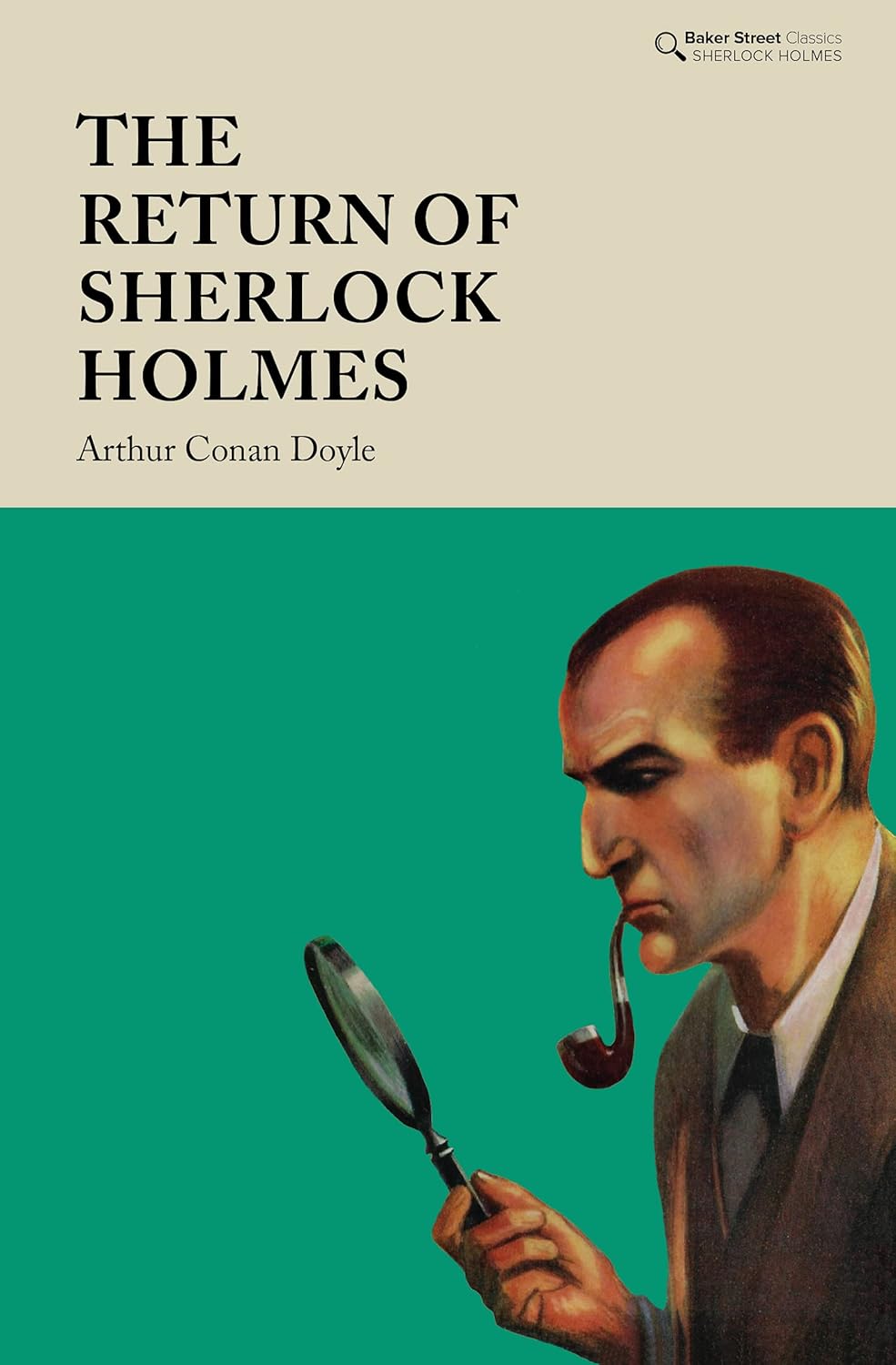
Obviously I read the Sherlock Holmes canon before I had started this blog, but — or, perhaps, so — it’s interesting how vague my recollections about so many of the stories are.
Case in point…
‘The Solitary Cyclist’ (1904)
The Case
Music teacher Miss Violet Smith is employed by older widower Mr. Carruthers at frankly very appealing rates as a music teacher for his daughter. Since Mr. Carruthers’s home is some six miles from Miss Smith’s home in Farnham, she is required to cycle out there for her appointments, and has of late become aware of a sinister figure following her on a bicycle themselves when she gets close to her destination. She has tried approaching the watcher, but they always manage to flee at her approach. Understandably concerned, she has come to Holmes to ask him to cast some light on the matter.
The Characters
Miss Violet Smith, cyclist; not your average shrinking, er, type.
Mr. Bob Carruthers, once of South Africa; don’t ask how he made his fortune, eh?
Mr. Jack Woodley, bounder; has “his hair plastered down on each side of his forehead” — Brylcreem was invented in 1928, so what’s he using?
The Timeline
Saturday 23rd April 1895, according to Watson. Though 23rd April 1895 was a Tuesday, so we can only presume that Watson has been partaking in Holmes’s 7% solution when the Great Detective is not around and was blitzed off his tits when making these notes. Proceed with caution.
The Tropes
A few references to Holmes’s busy caseload early on, and explicit mention of “[the] very abstruse and complicated problem concerning the peculiar persecution to which John Vincent Harden, the well known tobacco millionaire, had been subjected”.
And, on hearing that Miss Smith lives in Farnham: “A beautiful neighbourhood, and full of the most interesting associations. You remember, Watson, that it was near there that we took Archie Stamford, the forger.” Though the phrasing of this makes it sound like they took him there for a lovely day out in the country to improve his spirits. Who’s to say?
Holmes also deduces that Miss Smith is “a bicyclist”, but again we’re in an era where Watson is able to follow the reasoning (“She glanced down in surprise at her own feet, and I observed the slight roughening of the side of the sole caused by the friction of the edge of the pedal.”) and thus well past the point where these ingenious revelations amaze. Indeed, Doyle seems to be going out of his way to make these deductions as ordinary as possible, perhaps with an eye on demystifying his Great Detective in the eyes of the public.
Points of Interest
Let’s get this out the way first: there are two cyclists. The title, therefore, is complete nonsense.
“Many startling successes and a few unavoidable failures were the outcome of this long period of continuous work” — further exploding the myth that Holmes was faultless in his cases. Hell, one of my very favourite stories documents a failure, so the Great Detective was already prone to errors long before now.
“It is true that the circumstances did not admit of any striking illustration of those powers for which my friend was famous…” — is this just Conan Doyle admitting up front that the story isn’t very good? Because it’s not, is it? Someone is followed on a bike, and Holmes and Watson wait until a kidnap occurs and a woman has been forced into a sham marriage…in short, they don’t achieve anything. Had Holmes and Watson not been involved, Carruthers would equally likely have just shot Woodley dead in a rage when he found out anyway. Er, spoilers.
“[My report] did not elicit that word of curt praise which I had hoped for and should have valued”. I love this. It’s a magnificently human moment on the part of both characters where one reflects off the other so perfectly. Holmes is so used to Watson’s competence that he does not feel the need to praise him, but Watson is gentle enough to still want praising. Then Holmes criticises him and Watson replies “with some heat”…Doyle’s not recognised enough for his little character beats, but this exchange is mini perfection.
I love, too, Holmes appearing one evening with “a cut lip and a discoloured lump upon his forehead, besides a general air of dissipation which would have made his own person the fitting object of a Scotland Yard investigation”. Again, the demystification: Earlier Doyle would have had Holmes linger in the public house and learn everything he needed by eavesdropping. Now, he makes a dog’s breakfast out of his investigatory approaches and gets bashed up for his troubles.
See also, Holmes missing the significance of the second cyclist — the follower? — putting on his tie in the bushes. God, if only people would talk to each other Holmes would be saved a lot of work.
Right, that’s the last I’ll be writing about the Holmes canon until February 2027. If you want more Holmes-adjacent writing in your life, for land’s sake read the amazing The Return of Moriarty (2025) by Jack Anderson. The sequel, The Mark of Moriarty (2026), is out in a few days, and you’ll need to get caught up because I have no doubt it’s going to be brilliant. You have been (gently) warned…
~
The Sherlock Holmes canon by Sir Arthur Conan Doyle on The Invisible Event
A Study in Scarlet (1887)
The Sign of Four (1890)
The Adventures of Sherlock Holmes [ss] (1892):
- ‘A Scandal in Bohemia’ (1891)
- ‘A Case of Identity’ (1891)
- ‘The Red-Headed League’ (1891)
- ‘The Boscombe Valley Mystery’ (1891)
- ‘The Five Orange Pips’ (1891)
- ‘The Man with the Twisted Lip’ (1891)
- ‘The Blue Carbuncle’ (1892)
- ‘The Speckled Band’ (1892)
- ‘The Engineer’s Thumb’ (1892)
- ‘The Noble Bachelor’ (1892)
- ‘The Beryl Coronet’ (1892)
- ‘The Copper Beeches’ (1892)
The Memoirs of Sherlock Holmes [ss] (1894):
- ‘Silver Blaze’ (1892)
- ‘The Yellow Face’ (1893)
- ‘The Stockbroker’s Clerk’ (1893)
- ‘The “Gloria Scott”‘ (1893)
- ‘The Musgrave Ritual’ (1893)
- ‘The Reigate Squires’ (1893)
- ‘The Crooked Man’ (1893)
- ‘The Resident Patient’ (1893)
- ‘The Greek Interpreter’ (1893)
- ‘The Naval Treaty’ (1893)
- ‘The Final Problem’ (1893)
The Hound of the Baskervilles (1902)
The Return of Sherlock Holmes [ss] (1905):
- ‘The Empty House’ (1903)
- ‘The Norwood Builder’ (1903)
- ‘The Dancing Men’ (1903)
- ‘The Solitary Cyclist’ (1904)

