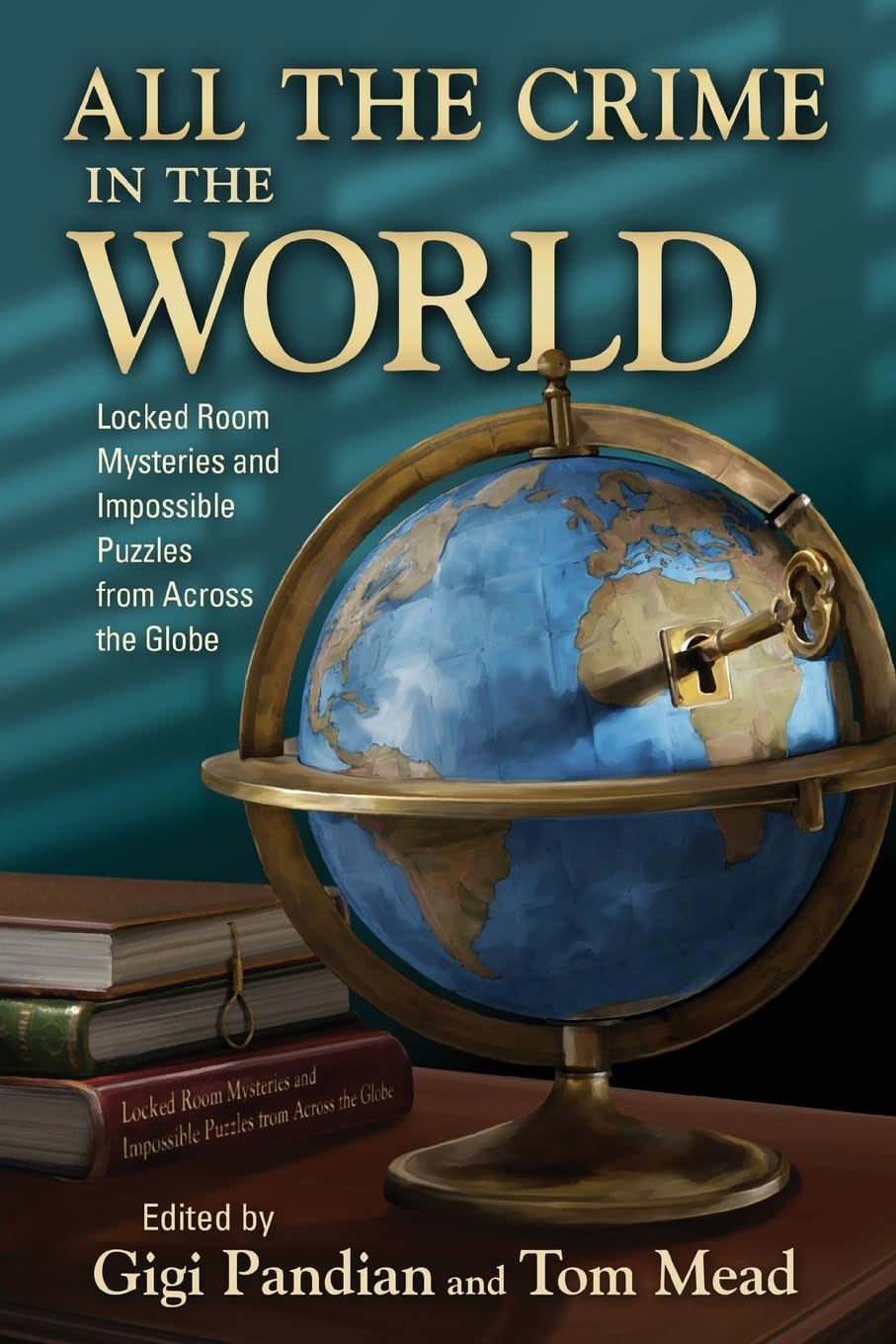
The prospect of a collection of completely new impossible crime short stories is an exciting one, because I’m pretty sure we haven’t had a new multi-author collection since The Book of Extraordinary Impossible Crimes and Puzzling Deaths [ss] (2020) over which we shall pass quickly.
Collected by Tom Mead and Gigi Pandian, All the Crime in the World [ss] (2026) is another Crippen & Landru publication, and contains 14 stories — some of which showcase the impossible nonetheless done — either newly-written or newly-translated for this collection. And since I’ve been known to read an impossible crime every now and then, I thought I’d see how this new tranche acquits itself to the Grandest Game in the World.

We begin with ‘The Body on the Rooftop’ by Victor Bonini, in which a, er, body appears on a, uhm, rooftop of an apartment building in New York — the complication being that no-one had the key to get through the door to the roof, and none of the functioning cameras in the building show the killer or victim heading up there.
Bonini writes well, and passionately, about the gentrification of the city and the way born and bred New Yorkers are being priced out of their homes by dodgy business practices, and his small cast are well-embroiled in each other’s lives, with their interactions feeling genuine, motivated by friendship and familiarity rather than plot convenience.
The impossibility is…fine, but for all its insistence on certain methods being ruled out due to medical evidence, there’s a principle here that wouldn’t have fooled Dr. John Thorndyke over a century ago which goes unmentioned. And I’m really not sure why it needs to be an impossible crime — surely the, er, original crime would have sufficed? But, if you’re not hung up on this sort of thing, it’s a fun start.
Sulari Gentil‘s ‘The Legacy’ moves effortlessly between two time periods, as a couple renovate their new house and, a hundred years before, a man is forced by the terms of a will to spend every night in one particular room — a room in which one person has already taken their life and in which he will be found dead.
This isn’t hard to call, but Gentil writes well and is to be commended for not seeking excess verbiage that would have done no-one any favours. I read one of her Rowland Sinclair books a little while ago and couldn’t get on with it, but this effort makes me suspect that I should revisit her work at some point.
I’ve benefitted from some of Josh Pachter‘s editorial work down the years, but ‘The Allegory of the Five Senses’ is my first exposure to his writing. And for all that the telling here is again superb, he utilises a narrative trick I hate in basically using someone else’s idea and then implying that it was his fictional characters who gave the idea to that real person, who then later recycled it into a famous example.
I don’t know why this bothers me so much, but it feels so very disrespectful to the nature of a creative medium to steal someone’s idea and essentially feed it back to them as if nourishing their creative soul — Ed Hoch did it with Erskine Childers in one of his Sherlock Holmes pastiches and I still don’t understand why. Plus, in this case, it’s such a frustrating solution to an impossible vanishing; surely we’ve moved well and truly past this sort of thing.
I feel like I ask this sort of question at least once per themed collection, but is ‘The Man Who Tried to Fly’ by Anne van Doorn an impossible crime? This story of a man who dies after a fall from a great height has, after all, only the say-so of two people to go on, and I feel the physical impossibility isn’t really established as fully as it might be.
I’m also a little uncertain on the precise physical geography of things, and that ends up being important. And can rain not drum on a pitched roof? Honestly, I feel like I’m asking too many questions, and that’s probably not the effect Van Doorn was going for.
Also, while I’m aware of the trope being explored, as discussed in the final line, it’s a bit cheeky to deploy it in this way here. The conceit can be used well, but I’m not sure this shows it off in the best light. It’s likely to irritate more people than it pleases, and I was definitely in that first camp.
‘The Wabi Locked Room’ by Yamaguchi Masaya is a section from his book The Japan Murder Case (1994), newly-translated here by Steve Steinbock. And, as with a lot of stuff carried over into English from Japan, there’s a fascinating cultural milieu to wallow in, with the importance of tea ceremonies forming the backbone of this impossible stabbing: the body found in a room with both doors locked on the inside, and the victim having been dead for several hours, since before a time when they were seen by witnesses performing one such ceremony.
Neither of the answers given to the impossibilities is especially satisfying: the first is an old trick, the second will most likely — two stories in a row…! — vex more people than it delights. The cultural richness of this commends it, but I do wish it was told with a little more efficiency, especially given how that ‘He was alive when he was dead’ thread plays out.
Okay, ‘Knock and Run’ by Ovidia Yu definitely isn’t an impossible crime: a woman is found dead in her hotel room, clearly having been the victim of a poisoning, so it’s just a matter of figuring out where the poison came from. Yes, the hotel room is locked; no, that’s not enough to make it a locked room mystery. Where, aftere all, would the mystery come from?
There’s an element of this which is sort of heartbreaking, but the characters feel a little confused — the dead woman either neglected her daughters horribly or was close enough with them to involve them in a complicated plan, and how old the kids are seems to vacillate with every action they perform — and what’s a very simple idea seems to get very complicated in the telling. Some great background culture (vapes are illegal in Singapore, for one), but overall this one didn’t work for me.
I was convinced I had read something by S.A. Cosby in a previous collection, but nothing shows up on the blog, so who knows? ‘The Price of Money’ sees an unpopular businessman shoot himself in his locked study on the same evening he was throwing a party to celebrate his birthday. But, of course, we know better…
Again, not hard to call, but Cosby is doing an interesting thing here in matching the tone of a more flint-nosed thriller with the concept of an impossible crime in a way that recalls, among others, Murder Among Children (1967). There’s also a genius idea at work in this — (rot13) hfvat gur zrygvat pnaqyr gb uvqr gur ohyyrg — which is so good that I can’t believe I haven’t seen it before.
Friend of the blog James Scott Byrnside is up next, with ‘The Fourth Guest’ taking a semi-inverted route: hack mystery writer Teddy Rose is approached by the far more successful Rachel Thorndyke to play the killer in a murder party she wishes to stage. The one wrinkle? Rachel will be the victim, and so Rose kills her for real and intends to use the plan written for him to get away with it.
Like Cosby, Byrnside is great at marrying to tone of a different type of novel — the American P.I. — with the intricacies of the impossible crime and, while the key clue can’t quite be fair on account of its visual nature, it’s always a joy to watch him work.
‘Don’t Look Back’ by Martin Edwards also isn’t an impossible crime, but this reverse-chronology story is so neatly structured and contains such an expertly-sprinkled series of reveals that it’s difficult to mind. When a lowlife criminal disappears without a trace, well, it would be telling to reveal too much, but there are some lovely turns in this as the picture is filled in backwards.
Edwards is, of course, an old hand at this, and is also engaging in something a little more playful in a way that I won’t spoil for anyone who is able to spot it (Hint: A wife of Boaz’s confused about “no lid off” pens [7]). Good fun; surely it’s about time we had a collection of Edwards’ short fiction made available — the only one I’m aware of came out 25 years ago and is tricky to track down.
Another historical mystery, this one from Christopher Huang, sees a groom shot at his wedding ‘In Broad Daylight, with Witnesses’. And when a suspect is arrested, the calibre of the bullet which killed the victim doesn’t match the gun the man is carrying and fired at the reception.
I’m not fully convinced this method would work, and would actually have preferred this is if it didn’t come off as the killer intended. Being able to say ‘Everyone in a crowd would always [do action X]’ is risky as a strategy for misdirection — and it’s much more interesting if someone doesn’t, not least because it could motivate a second murder.
‘The Hanged Man’s Bride’ sees a return to English for the always-enjoyable Paul Halter, translated here by Mead. When a famous judge is found shot in his locked study, the problems are only just beginning: threatening messages, impossible fingerprints, and more will all add to the stew of inexplicable behaviour…but can any sense be made of it?
It’s no secret that I’m a big fan of Halter’s, and when he’s on form, as here, he’s great company. There is perhaps a page or two too much dialogue, but this is an excellent example of how to use your word count to multiply the problems faced, and the locked room trick in particular is very clever and well-described. Wonderful to have some new work from the French maestro in a language my simple brain can understand…more, and soon, please!
Shelly Dickson Carr, granddaughter of someone you might have heard of, continues the family tradition with ‘Murder in Harvard Yard’. This sees a student at the university found dead in a locked room, outside of which three people were standing at the time the man died. Even stranger, they heard the man shouting that one of those three was trying to kill him — a certain British exchange student called Henry Merrivale.
This is too long in the telling, the middle section restating a lot of information already covered at the start, and the change of narrators back and forth is a little odd. I’m also not sure the method of death deployed would have resulted in the victim shouting imprecations against Merrivale. But the dead man is a pleasingly unpleasant bastard, there’s a good piece of misdirection, and the ending note is pleasingly wry, so it’s not a complete bust.
I must say, though, that Carr here makes the young Merrivale (“God’s teeth!”, “God’s knees!”, etc.) come across rather more like Gideon Fell — hell, if anything he’s more Simon Gale — than I think is intended.
When a man with a fatal almond allergy is found dead in his hotel room, the cause is not in doubt: ground almonds are found in the carpet and on the bedsheets. The problem is that the room was cleaned and the bedsheets changed that morning, and no-one would have had the opportunity to enter the room, so how did the nuts get in there? This is the problem in ‘A Distinctive Man’ by Vaseem Khan.
Again, I’m not convinced this is an impossible crime, for reasons I’ll leave others to disagree with, but the old-world hotel setting has its charms, and any investigation in which the detective is followed around by an eighteen month-old elephant is okay by me.
A pair of baffling deaths confront us in ‘The Problem of the Poison Garden’ by Tom Mead & Gigi Pandian, but the death by strangling of a man alone in the garden is the impossible coup. Seen to enter by the only, guarded, entrance and heard to scream out a few minutes later, if no-one else was in there, how did he die?
This is a long and complex story that benefits from the time spent setting it up, and Mead and Pandian deserve credit for not just the clever trick pulled but also the effort taken to clue the whole thing well. The time spent discussing the various poisons in the eponymous stretch of ground is interesting, especially given the first, older death which lingers in the background, and the use of modern technology to justify part of the plot is neatly done. Good work, a nice concoction to finish up with.
A top 5? Why not?
- ‘The Hanged Man’s Bride’ by Paul Halter
- ‘The Problem of the Poison Garden’ Tom Mead & Gigi Pandian
- ‘The Fourth Guest’ by James Scott Byrnside
- ‘Don’t Look Back’ by Martin Edwards
- ‘The Legacy’ by Sulari Gentil
As a fan of the impossible crime, I’m heartened to see that there’s sufficient interest in the subgenre for something like this to exist, and it’s pleasing that so many authors are still willing to take on the brief (and a bit of a shame that the few who misunderstood it couldn’t be convinced otherwise). Pleasing, too, is that we’re not always relying on old tricks — which can be repurposed well, of course — but also starting to venture into new technology in a way that wouldn’t have been possible a decade ago.
While it’s true that the term ‘locked room mystery’ is now being horribly abused, the likes of this and the recent British Library collection provide hope for those of us to whom these things matter. Lovely to see such good work in here from people whose work I have enjoyed elsewhere, and in searching up more by Cosby I learned that he’s part of a collection of new Sherlock Holmes stories coming out this autumn, which has now jumped onto my TBB. So if not quite a success all round, there’s at least enough here to have made it more than worthwhile; here’s hoping the impossible crime remains well-represented in the years to come.

