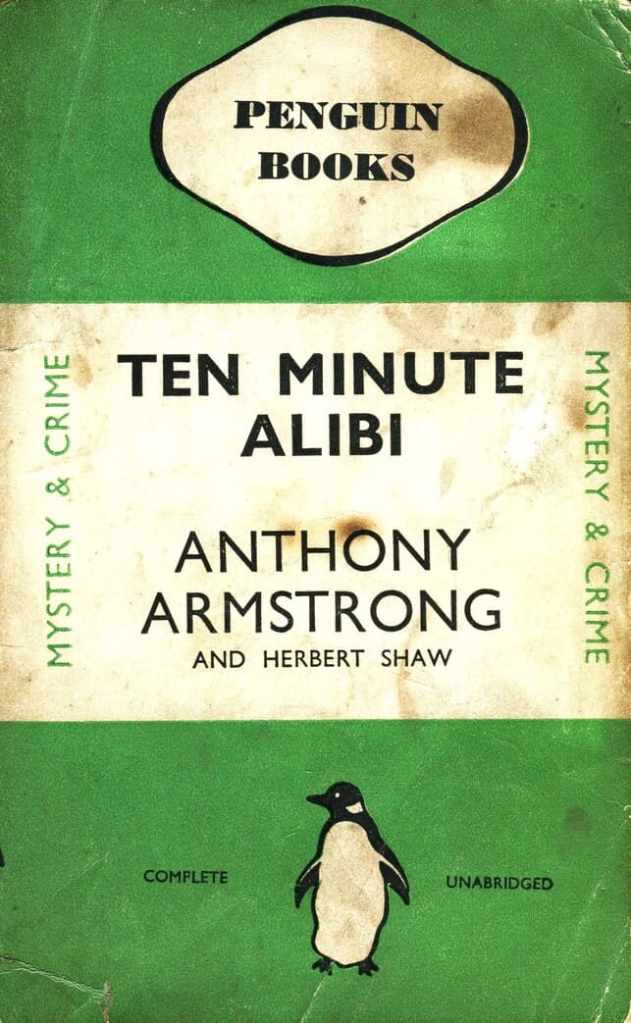


I very much enjoyed Anthony Armstrong’s contribution to the collaborative novel Double Death (1939), and so a friend kindly lent me the novel Ten Minute Alibi (1934), adapted — with help from Herbert Shaw — from Armstrong’s stage play of the same name, which was published the year before. I’ve not yet read the play, so have no idea how closely the two coincide, but I suspect that it was Shaw who did most of the writing of this novel if only because the rather functional prose lacks so much of the character that made me curious to check out more of Armstrong’s writing. I am, however, getting ahead of myself, so let’s (appropriately) back up a bit…
Philip Sevilla — credited herein in the title of the first chapter as a “professional lover” — is, no, not a member of the Oldest Profession, but instead a sort of philanderer by trade: making young and impressionable women fall in love with him before, essentially, then involving them in a human trafficking scheme which sees them stranded in a foreign country and pressed into unappealing work (best not dwell on it). Over the first few chapters, we watch as he does exactly this to Muriel Cartney, taking her to Paris with promises of a life together ringing in her ears before manufacturing a quarrel and leaving her in the care of a confederate. For this, he will be paid several thousand pounds, and Muriel Cartney is absolutely not the first of his victims.
When young Betty Findon then falls into Sevilla’s clutches, in her wake comes Colin Derwent, who is in love with Betty and understands that something about Sevilla’s dealings isn’t on the up and up. Alas, Betty is determined that she loves Sevilla and that Derwent is just jealous, and the more Derwent warns her the more obstinately she clings to the belief that Derwent is merely jealous.
“Sevilla, I warn you, you’re making me mad. I would sooner kill you than let you take Betty out of the country.”
“How the lad talks!” mocked Sevilla. “You’ve got too much common sense to commit murder. Murderers get caught so easily.”
When Derwent dreams up — literally, as in it comes to him in a dream, which is probably a diversion from the play since I can’t imagine how they’d show that on stage — a way to murder Sevilla, well, he does that, puts surely the flimsiest alibi in history in place, and then sits back as Detective-Inspector Pember and Detective-Sergeant Brace begin to investigate.
There’s not a lot of plot here, with Pember and Brace first appearing on page 106 of 174, but the functional prose and the simple lines along which things are drawn make it an easy read. Derwent has, for all the apparent ingenuity of his alibi, done little more than commit an obvious murder and wind back the hands of a clock, but there’s a rigour to some of the investigation here that’s pleasing to see, as a series of very stagey interviews gradually grope their way towards some sort of reckoning, and the book is to be credited with the outcome not being immediately obvious with the investigation edging ever-closer to the truth.
What else to say?
It’s very interesting to have the background of this otherwise fairly standard novel of detection be something as modern-feeling as human trafficking, and rather bracing to realise that these principles existed — albeit on a smaller scale — all these years ago. It’s a privilege of fiction that the characters do what they’re told, but Armstrong’s essential plot has a ring of the authentic about it: it’s possible to believe that young women this proud existed, especially in a time like this which would have frowned upon some of the manipulations said young women are subjected to, and it’s to be wondered how this was viewed at the time. Was it seen as a sort of Edgar Wallace OTT plot, or were people drawn to it by the thrill of verisimilitude?
The book rattles along, aided by some nicely wry asides between our policemen, and to be honest I’d be inclined to rate it a star higher if the terminal shocking event was explained. I’ve asked a handful of people — none of them alive in the 1930s, which is inconsiderate of them — and none of us can work out why the thing that happens would cause someone to come to the conclusion that’s reached. If you’ve read the book, or seen the play, and you have insight to share on this point, it would be greatly appreciated by me and several of my associates. Especially as I’m going to forget what it was in a week or two.
All told, then, this second encounter with Armstrong’s work wasn’t quite satisfying, mainly because I’m pretty sure it’s not Armstrong’s work: it’s Shaw’s interpretation of Armstrong’s work. I’ll certainly keep an eye out for the play if there’s the chance to read it, and, honestly, I don’t discourage you from reading this is if you get the chance. With enough of us on the case, we’re bound to figure out why…that thing happens, and then we can insert some explanation into later editions of this, or something. I’m getting ahead of myself, of course, but this is a fast an engaging read that would please a great many people…I just feel they’d like it even more if they were able to understand it.

