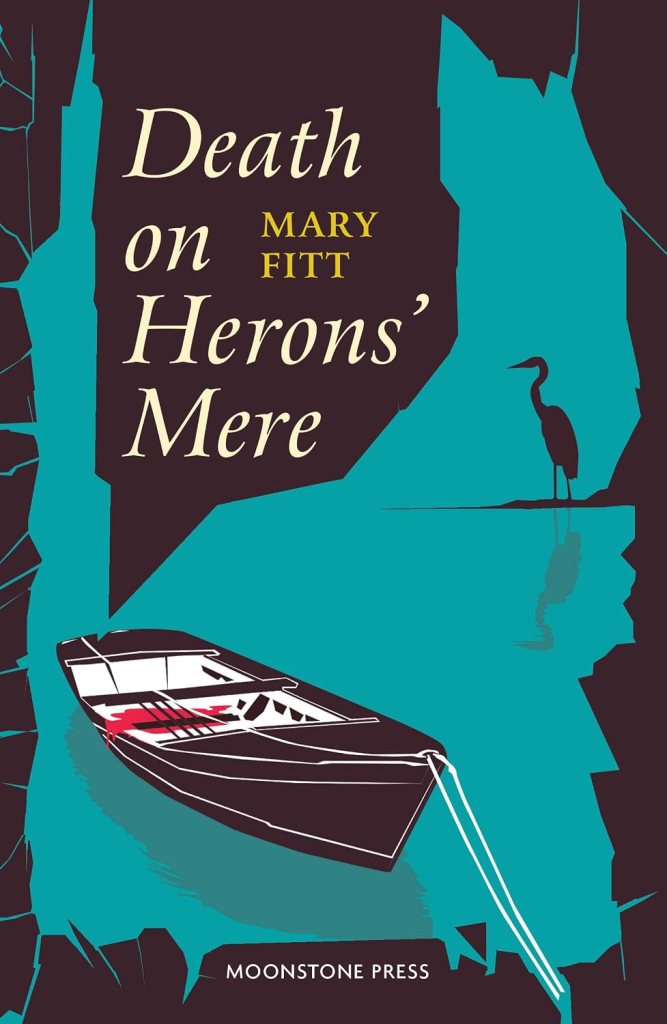


What is happening to me? For years now I’ve been prioritising plot and detection over character and setting almost to the point of unhelpfulness. And yet — now twice in only a few weeks, following Murder in the House of Omari (2021) by Taku Ashibe — I’ve found myself positively relishing a family saga which is slow-moving, clearly lacking in obscure clues and exciting reversals, and almost entirely devoid of detection. The culprit this time around is Death on Herons’ Mere (1941) by Mary Fitt, who came to my attention via Guilty Creatures [ss] (2021) and proves just as delightful in long form. I should not like this book, and yet it completely charmed me. Am I maturing? Am I…cheese?
Industrialist Simon Gabb has bought the stately Herons’ Hall from the impoverished Charleroy family, and has moved his own flock in: wife Polly, adult children Giles, Jessica, and Basil along with Basil’s wife Pauline and their newborn child, and — I think, they might just be weekend guests — Simon’s brother James, his wife Janet, and their adult children Harry and Lucy. He has also rented out the South Lodge to Helen Charleroy and her son Royce, as well as Royce’s cousins Arden and Billy. And already trouble is afoot: eldest son Giles has taken quite a shine to the youthful and beautiful Arden, ignoring his apparently crucial work on behalf of the British Government to spend time with her and throwing over plans already cooked up that he should marry Lucy (yes, bloody inter-cousin marriage again in a Golden Age novel).
When one of the Gabb clan is found shot dead in the boathouse on the edge of the mere that comes as part of the property, we’re thrown into the usual maelstrom of culprit and motive. Enter the stolid, slightly uncommon Superintendent Mallett — “a good man — a dangerous customer, because he’s unorthodox in his approach; and yet he looks so much like a policeman that people are apt to underrate him” — to dig around and get to the bottom of things.
Don’t, however, come to Death on Herons’ Mere for the detection. While Fitt does a superb job of working in naturalistic reasons for seemingly every person in Christendom to be at or around the site of the murder on the fateful morning, giving this the veneer of the puzzle plot and doing a good job with the innocent explanations, the eventual unpicking of the murderer is tamely meek come the final stages, and could have been achieved much sooner if someone had, basically, searched a room a bit more carefully.
Come instead for the superb minor characters — like family retainer Morgan who “had been for twenty years with the late Colonel Sir Charles Laforte; and this family so far, except for the old man, Simon Gabb himself, had hardly impinged on his consciousness” — and perfect tiny moments that speak effortlessly of so much more: c.f. Pauline and Basil on the first page sat in silence, “Basil because he was thinking of her, Pauline because there was no one near enough to talk to except him”, or the younger Charleroys invited into the house by Giles feeling “like ghosts who come back to their old haunts and may be harmless or may turn malevolent”.
Fitt has a very light touch when it comes to folding these people into the necessary patterns to make the plot work: a vanishing and reappearing car, say, plays an important role but also turns out to inject an emotional burden into the plot which is keenly necessary to make the people involved feel real. The way little moments of unease stir in via shared history (“But you at least have some material to go upon.”) is adroitly handled, as are private moments, such as one member of the family reflecting on suicide — as the death is believed at the time — as a “supremely wicked act” but aware that such a sentiment should go unvoiced (god, remember when people used to have opinions and keep them to themselves?).
The casual pacing of this won’t be to everyone’s taste, but Fitt does such a canny job of making you feel these people as people that I couldn’t help but get caught up in it all. I suspected I was going to enjoy this when she did something I completely deride in novels — dropping all the characters on you in the first chapter, before you’ve had a chance to get your bearings — and yet I was so caught up in the various undercurrents that I went back and read the chapter a second time to ensure I had everyone straight. And Mallett, while it’s not rammed down your throat, is somewhat more interesting that his initial bland persona might at first appear, but I’ll leave that to the reader to discover.
Had I overlooked a clever piece of misdirection amidst all this fraternising, I’d be tempted to add a star to the above, not least because this would have been a perfect bridge between the clue-based detection of the Golden Age and the more character-driven novels of crime that were coming down the way. Fitt’s sympathies are neatly balanced between the two schools, since she moves her characters around with the precision of a chess master, with such care that it wouldn’t be unfair to expect just a little more foundation for the terminal destination. As a first exposure to her longer writing, however, this proved very positive indeed; more will follow.

