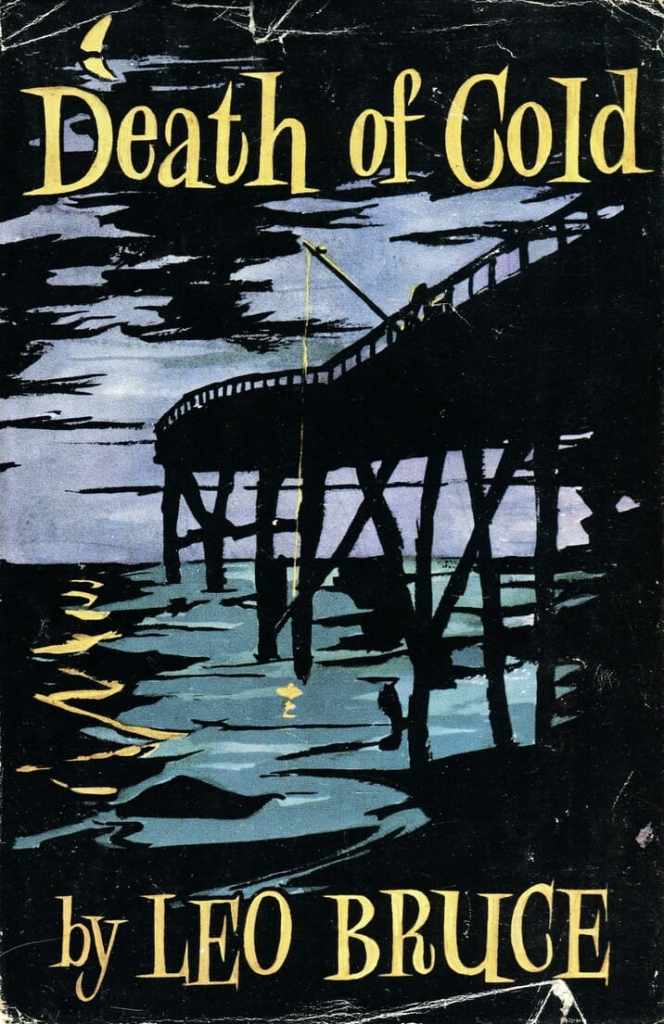


When the mayor of Oldhaven apparently leaves the local pier one evening without gathering in his fishing paraphernalia, initially it seems like he may have just been forgetful: his daughter was due to give birth, after all, so he had other things on his mind. Then his body is discovered the following day “sprawl[ed] hideously across the beach…a bloated and gruesome sight” and it looks like something might be afoot. He was, after all, visited by six different people while fishing, so could one of them have had motive to push him into the water? Luckily crime-solving History teacher Carolus Deene is in town, and is prepared to investigate…
Death of Cold (1956) — a nonsense title, he dies by drowning — is the second book from the typewriter of Leo Bruce to feature Deene, and evinces many of the facets that make him enjoyable alongside many of the flaws which make him hard to love. As would seem to be the case with this series, the setting is spectacularly observed, and people with characters who have relationships and understandings that live far beyond the events on the page. The Chief Constable complaining early on that news of the death will likely affect visitor numbers in the run-up to Christmas really does feel as if it comes from a place of concern, with the holidaymakers so important to the town that everyone seems to just want the thing to disappear.
“If it wasn’t suicide,” he said, “it was of course one of two things, accident or murder.”
It was the first time the word had been used, and it dropped with a thud, like a soft, heavy thing, among them.
Alas, for all that Deene begins to investigate and find little points of interest, Bruce falls into the trap that would regularly assail this series and has the whole thing boil down to interview after interview after interview. When Deene’s student Rupert Priggley asserts that his History master will “have a delirious time sleuthing” you wonder what he thinks there is to get excited about. “I had interviewed so many people whose information was all more or less irrelevant,” Deene says late on and, wow, thanks for that, Leo. You didn’t maybe consider going back and making some of what occurred a little more…compelling and important?
Some of the local characters are fun — ex-publican Mr. Grool is captured magnificently early on — and Bruce, nom de plume of Rupert Croft-Cooke, is of course still smarting from his own experiences with the police when he has two local coppers more or less threaten Deene to drop his examination of events. And Deene, too, feels slightly more sketched in here than he would become, with a superb early reflection on trying to recreate the youthful glee of a holiday ribbing shoulders with preoccupations that feel rather more those of his author than our protagonist:
Carolus had made some study of prisons and prisoners in England, and knew how a sense of injustice could fester and grow in a man till he became murderous.
I enjoyed the first half of this book much more than the second, where the repetitious nature of the conversations began to gall and I just wished we’d get it over with. Bruce isn’t quite as bad as late-era J.J. Connington at lampshading his murderers early, but if you get halfway through and still don’t know whodunnit then you have a delightfully surprising series of reads ahead of you, wherever you head in the genre. Honestly, the thing I’m going to remember most about this book is that it features a bathtub which doubles as a kitchen table — has anyone come across that before?
~
See also
Nick Fuller @ GADetection wiki: Probably the best Carolus Deene I’ve read so far. It starts slowly, in a sordid, dreary, seaside town in autumn… The second half is engrossing, with a second murder. Although the murderer become obvious as soon as the third corpse is discovered (one of Bruce’s problems is that his books lack impact, because there’s too long a gap between the reader becoming aware of who the culprit is, and the detective revealing the solution…), the solution is full of Christiean cleverness, particularly the use of the telephone box.
~
The Carolus Deene novels by Leo Bruce
- At Death’s Door (1955)
- Death of Cold (1956)
- Dead for a Ducat (1956)
- Dead Man’s Shoes (1958)
- A Louse for the Hangman (1958)
- Our Jubilee is Death (1959)
- Furious Old Women (1960)
- Jack on the Gallows Tree (1960)
- Die All, Die Merrily (1961)
- A Bone and a Hank of Hair (1961)
- Nothing Like Blood (1962)
- Crack of Doom, a.k.a. Such Is Death (1963)
- Death in Albert Park (1964)
- Death at Hallows End (1965)
- Death on the Black Sands (1966)
- Death of a Commuter (1967)
- Death at St. Asprey’s School (1967)
- Death on Romney Marsh (1968)
- Death with Blue Ribbon (1969)
- Death on Allhallowe’en (1970)
- Death by the Lake (1971)
- Death in the Middle Watch (1974)
- Death of a Bovver Boy (1974)


In the movie, Butterflies are Free — with Goldie Hawn, Edward Albert, and Eileen Heckart — I believe there was a bathtub that doubled as a kitchen table. However, due to health and plumbing codes, this likely never existed outside of movies or fiction.
LikeLike
That is some frankly outstandingly niche movie knowledge, and I commend you on it. Many thanks for sharing 🙂
LikeLike
Based on the list at the end, are you going to review all of these? Brave man, if so…
LikeLike
I’ve read another…four, I think, which was preparation for my talk at Bodies in June this year. I have little to say about them that I haven’t already said about the Carolus Deene books elsewhere, so at the moment I don’t feel an overpowering urge to sink more time and money into these.
Never say never, but I certainly consider it astoundingly unlikely indeed that I’d want to read every one of these. Perhaps when I’ve read every other book ever I might return here…
LikeLike
“However, due to health and plumbing codes, this likely never existed outside of movies or fiction. “
*Ahem* I lived in a studio apartment in midtown NYC that had a bathtub in the same space as the stove. There was a metal plank to cover over the tub so it could be also used as a table. Was this room a kitchen? A bathroom? Well, the toilet facility — and nothing but — was completely separate at the other end of the apartment behind a door.
Lived there from 1990 to 1992.
LikeLiked by 1 person
OMG! I think I was in that apartment!! The walls were all brick; I. Fact the window looked out on a brick wall. But the guy who lived there could boast that it was a SOHO apartment and that Isabella Rossellini lived across the street. (I imagine the tub was not in the kitchen in HER apartment!)
LikeLike
The walls were all brick!
But the location was West 49th St. and Ninth Avenue, nowhere near SOHO.
The window looked out over a pretty decent backyard space that was exclusively available to the first floor tenants.
I never saw Isabella Rosellini. Saw some hookers. But no Italian movie stars.
LikeLiked by 1 person
Definitely not the same place then. Your’s sounds much nicer than this guy’s, but he was VERY proud of his space!
LikeLike
This is genuinely the first I’ve heard of this in real life, thanks so much for chipping in.
The plot, it acquires the thickness…!
LikeLike
My gosh — who knew that a bathtub doubling as a kitchen table would get so much traction on this website! And, yes, I stand corrected — as I was the original poster regarding Butterflies are Free and who thought that this would not have existed in real life. But, of course, it if was going to exist IRL anywhere, it would have to be NYC!
LikeLike
I’m as delighted as anyone that this throwaway comment has generated any discussion at all. Clearly I’ve been asking the wrong questions before now…!
LikeLike