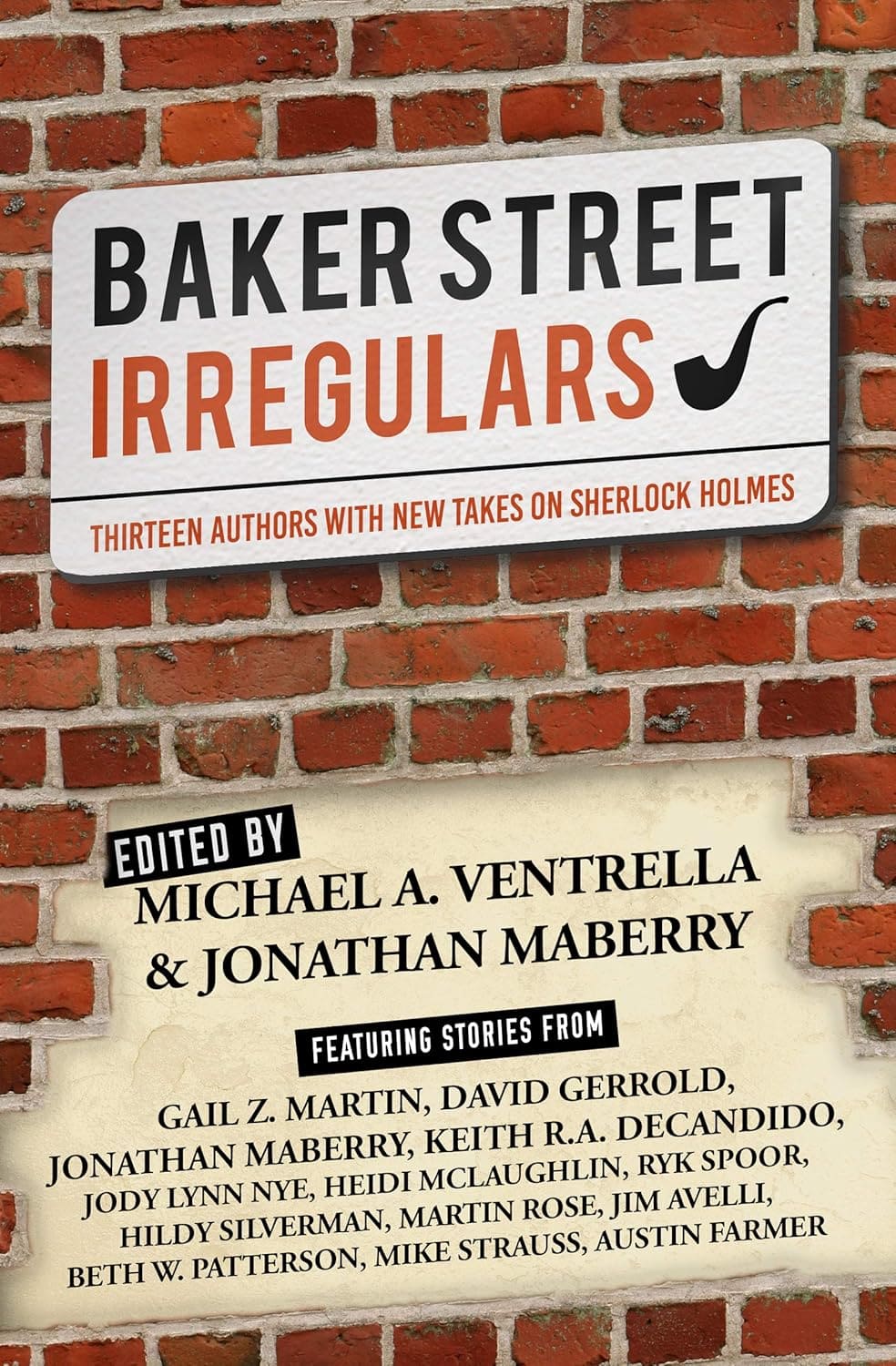
I thoroughly enjoyed the very readable set of stories collected in Baker Street Irregulars: The Game is Afoot [ss] (2018), which gave a variety of almost crossover mystery interpretations to the Sherlock Holmes/Dr. Watson pastiche. So I’m back for the original volume in this brace to see what other twists have been put on that classic and enduring setup.
That second collection was an intriguing baker(street)’s dozen of sometimes highly imaginative takes on the Holmes myth, and it will be intriguing to see if this first collection was able to embrace the wackiness of the possibilities as well as the second tranche. And so, the game’s afoot…

We start with ‘’Locked’ by Mike Strauss, in which Holmes is “the star of the highest-rated reality shows on cable television”, solving, it seems, real crimes with cameras recording his every move. The twist here is that Watson is the real brains, who has to “make sure that idiot Sherlock discover[s] the various clues that would eventually lead him to solve the crime”. And when the crime is murder — and actual murder, it seems, plotted and paid for by the network — well, things get interesting.
There’s some cynical swiping at TV here (“Our corporate sponsors at Apple would be thrilled that he name-checked their product.”), but I feel the really interesting concept is a little overlooked, with the success of the show seemingly justifying the murder in everyone’s eyes and we just breeze past that. But it sets up the collection well, making it very clear that we’re in for some uncommon takes, and I can’t really fault it on any meaningful grounds.
Keith R.A. DeCandido‘s contribution to the second collection was just an update of ‘The Six Napoleons’ (1904) with a female Holmes and no other changes, and his offering here — ‘Identity: An Adventure of Shirley Holmes and Jack Watson’ — is the prequel to that, and proves to be essentially a rewrite of ‘A Case of Identity’ (1891) with the exact same plot, workings, motive, and villain…and I’m a little confused. It’s within the brief of the collection, of course, and very well written, but you’ve got the world’s most famous detective in your sights…wouldn’t you want to do a little more with that possibility?
Jody Lynn Nye embraces the madness of possibility by giving us a scent-focussed canine-adjacent master detective creature called Baskur in the SF mystery ‘The Scent of Truth’. Following the murder of a diplomat in his sealed chambers in a way that has the semi-retired Baskur willing to give up his self-imposed exile (“A true locked room mystery! It will be my last and greatest case.”) it’s a bit of a shame that the detection comes down to smelling the corpse and then smelling someone who smells like the murder weapon that could be scented in the wounds, but there’s undoubtedly something Holmesian about the creature, recognisable despite the trappings which add so much enjoyment to this little tale.
That locked room mystery element gets forgotten, alas, with it never explained how “[the victim] was alone when he died, and the door locked with his own code” (come to think of it, he’s not alone…). That should bother me more, but this is weird and playful in the best way, and — while I’m not sure this version of Holmes could stretch to many more stories — I enjoyed this and its SF bagatelles a great deal.
Written as if one of Watson’s narratives from the 19th century, it soon becomes apparent that all might not be what it seems in ‘The Adventure of the Reluctant Detective’ by Ryk Spoor. I don’t want to say too much about this one, because it’s a pleasingly ephemeral sort of idea — Holmes pastiche by way of Philip K. Dick — that, while not really answering any of its own questions, still manages to give you the answers you require. Difficult to describe without spoiling, but I will say that the final line is perfect.
Hildy Silverman’s ‘A Scandal in the Bloodline’ sees a vampiric Holmes (turned by Irene Adler following his plunge from the Reichenbach Falls) and a Hell hound-cum-werewolf Watson (bitten by the Baskerville beast, which was in actuality more supernatural than in the tale he wrote about it) swept up in the abduction of a powerful vampire, whose death would threaten Holmes’s own existence.
This is ludicrous in the best way, with the ennui Holmes feels between cases transferred to the boredom of immortality, and a fun caste system implied in the way various immortal beings bicker and throw shade at each other. Not much detection again, with the awareness of an answerphone being the sole piece of intelligence required, but I enjoyed this far more than Silverman’s contribution to the second collection.
I’m not sure how Holmesian ‘The Fabulous Marble’ by David Gerrold is (“The more logic I inserted into the discussion, the more annoyed [Holmes] became.”), but this story of a computer program Watson assisting an augmented humanoid Holmes in a far-flung future is marvellously written. The investigation into the mutilation of the most highly-advanced sexbots ever made is very witty at times…
Spanglish has over 350,000 words in common usage… The average user will never look up all 350,000 of those words, but the dictionary has to contain them all to guarantee that the words that the user does look up will be there. It’s the same with the [sexbots]. The average user will never explore all the options available, but the options have to be available for those users who are so specifically motivated.
…but, if I’m perfectly honest, I finished this without really understanding what had happened and why. I did, though, thoroughly enjoy it.
There’s a delightfully Noir-infused fatalism to the semi-dystopian future described in ‘The Scarlet Study’ by Jim Avelli. Like the previous story, the precise details of how this society works are lightly-drawn and so it can be fun at times getting to understand by watching events play out. Here we have a menial labourer Holmes nowhere near the genius we’re used to, and how that characterisation comes about, and what it means for the world herein at large, is told like some sort of private eye tale strained through the imagination of William Gibson. Cynical as anything, and all the better for it.
‘Delta Phi’ by Heidi McLaughlin reimagines Sherlock as a female college freshman and Watson as a third year medical student with a crush on her. While the mystery that brings them together is far from baffling, there’s unarguably a point to that — though it’s a bit confused, I feel — as the focus here is much more on nervous butterflies in the stomach when trying to talk to someone you have the hots for. I…wasn’t looking for that, if I’m honest.
Another historical take on an alternative Holmes, ‘Beethoven’s Baton’ by Austin Farmer sees our detective and his sidekick as members of the string section of the Vienna orchestra who are about to perform Beethoven’s Ninth Symphony for the very first time. Under the direction of the eponymous genius himself, there is tension in the orchestra, and when Holmes finds evidence that suggests the maestro’s life is at risk he feels compelled to act.
This is a perfectly enjoyable time, and it whips along at a good pace, but the denouement of the story needs an extra ingredient to make it feel more intelligent and Holmesian, and I have the feeling that, if you look back from the end to the beginning, the clues don’t really make any sense. I have a habit of overthinking things, however, and if you’re able to just relax into this it’s a swift and fun alternate universe.
A magical doohickey sees a collector who is “part of a covert alliance of mortals and immortals dedicated to shutting down dangerous supernatural objects with extreme prejudice” consult a possibly transgender Holmes (called Sheryl, “formerly Sherlock”, so she might just have changed her name) for help in ‘The Adventure of the Melted Saint’ by Gail Z. Martin. I’m not sure this really needs the magical framing, and it would be a pretty good pastiche without it, but here it just proved a distraction; added to the variety of clues we don’t see — photographs, handwriting — it feels like this hasn’t quite worked out what it wants to be.
We find ourselves in a slightly dilapidated Russia, with Watson a semi-drunkard college professor and “the Sherlock” an android originally designed to be an untiring surgeon in ‘Automatic Sherlock’ by Martin Rose. When a member of the public wanders in to Watson’s college and dies, it turns out someone has reprogrammed Sherlock as an investigator and so the two begin to look into it. Some good reasoning presents itself, which at least leans into the genius of Holmes — a facet sorely absent in certain other stories — but this feels a little convenient and I don’t really buy it as a Holmes alternative.
Lest we forget, it was Jonathan Maberry‘s contribution to an Auguste Dupin collection which brought this Holmes brace to my attention, and so the G.K. Chesterton-evoking ‘The Hammer of God’ had much hope on its shoulders. And it lives up to these expectations, with this story of an old and a young nun from the Office of Miracles leaning well into deductions and intelligent reasoning, and being superbly written.
It was always a marvel to me how nature continued to move forward and to be about its work of growth and beauty even in the presence of gruesome human death. I have walked through battlefields and picked flowers on the sides of mounds beneath which are the buried hundreds of butchered dead.
This clues well, too, presenting a borderline-impossible murder or four with era-appropriate confusions in a way that hints at the Holmes canon, all building to an excellent finale. Primarily known for his horror/SF fiction, Maberry really needs to write more mystery stories — he’s quite excellent at them.
Finally — and you sort of wonder why no-one else thought of this — we get an animal Sherlock in ‘Code Cracker’ by Beth W. Patterson: an African grey parrot who has an eidetic memory but can only communicate in speech using words she has already heard elsewhere. This makes the narration a little confused (how does she know what a clown is, yet not know to use the word ‘clown’ to tell the humans that it’s the the clown that’s suspicious?), but Patterson seems more interested in wordplay…which is a shame, because there are some good ideas here, which if used a little more rigorously could have been excellent.
So, a top five? You know my methods…
- ‘The Hammer of God’ by Jonathan Maberry
- ‘The Scarlet Study’ by Jim Avelli
- ‘The Adventure of the Reluctant Detective’ by Ryk Spoor
- ‘A Scandal in the Bloodline’ by Hildy Silverman
- ‘Beethoven’s Baton’ by Austin Farmer
What’s good here is very enjoyable, and even the few times the stories don’t quite gel there’s still something to admire in their commitment to their various tropes. I can’t shake the impression that the second volume in this too-short series was more successful, however, as if the liberties taken with such a revered setup here emboldened the authors who would write for the second collection of stories. But this is still entertaining if you’re prepared to sit through a few variations that don’t quite hit the mark (and what doesn’t hit for me won’t necessarily miss for you).
This raises the prospect of more non-traditional Holmes reading in my future, which isn’t a bad thing. I’d definitely read another few takes on the Holmes/Watson dynamic, and will keep an eye out for any other updates or reimaginings for future reading. My preference is still very much for a traditional pastiche, but mixing it up with some of this sort of thing every so often isn’t an unappealing prospect. So, good job, everyone; look at me widening my horizons and stuff.
~
The checklist of extra-canonical Sherlock Holmes works on The Invisible Event can be found here.

