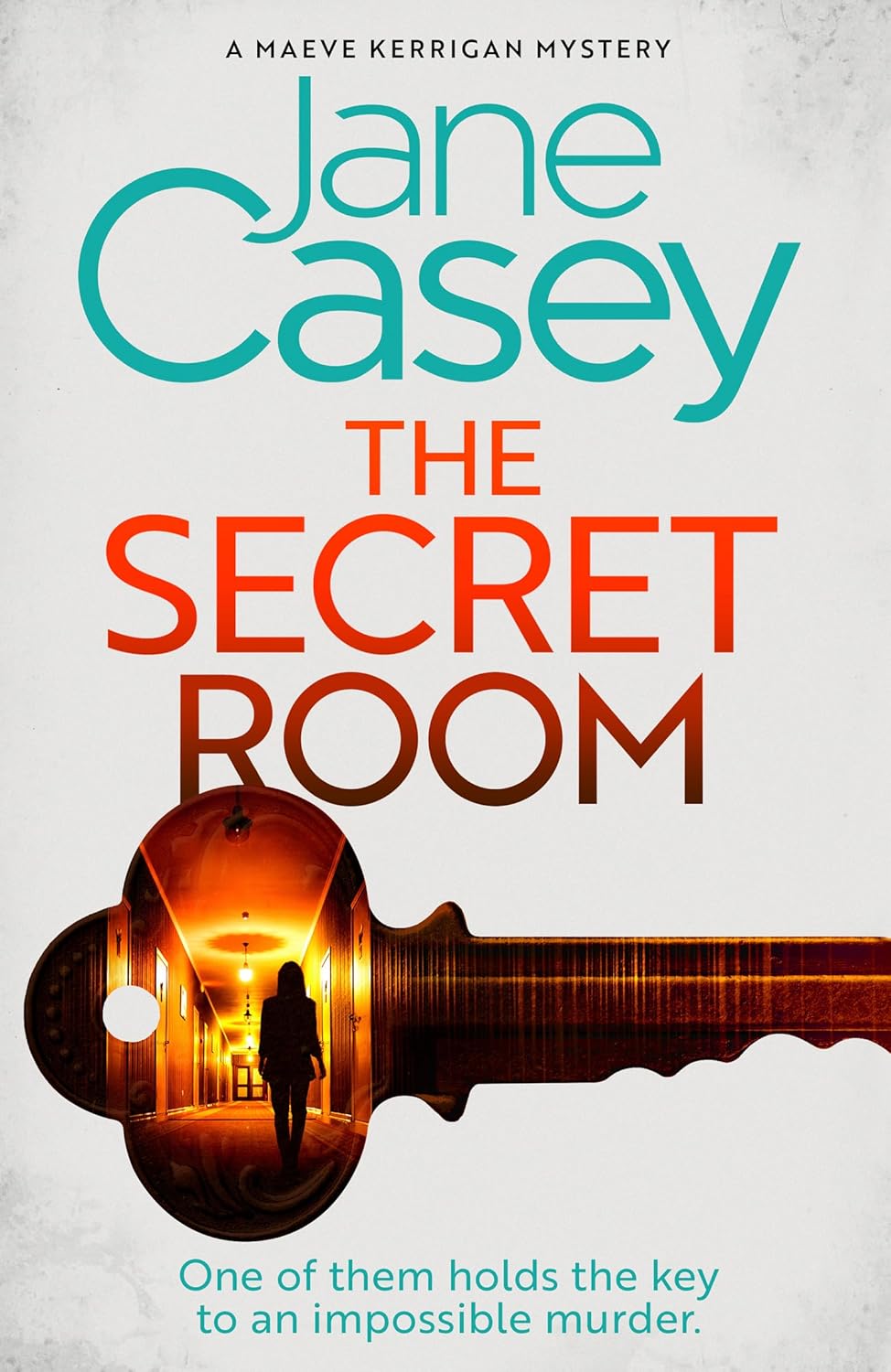
Another modern novel which sounds like it might have an impossible crime at its core, sufficient reason for me to grab a copy — from the library, dear boy, I’m not made of money — and see if it’s worthy of TomCat‘s attention. I get no enjoyment from this whatsoever, you understand. And I do it for free!
The woman known as Anne Pusey has booked room 412 at the upmarket Governor Hotel for a single night every Wednesday for the last ten months. She arrives in the afternoon, meets a man there, and the two have — not to put too fine a point on it — never actually stayed the night. So when she arrives at the Governor one Wednesday in November, goes to the room, and orders a bottle of champagne, no-one thinks any more than the usual. But when her paramour arrives a short while later, he goes up the room and finds Anne Pusey strangled to death and dumped in a bathtub full to the brim with scalding water. And, since the CCTV shows no-one except the waiter who took up the champagne going into the room, and only then for a couple of minutes, and since investigating officers conclude that Sam Blundell could not have killed his lover and set up the scene in the time which he was in the room unobserved…howdunnit?
The Secret Room (2025) by Jane Casey is most successful in the opening 80 pages, setting up this murder which we’re left in no doubt can’t be as simple as it seems:
“It feels impossible but there’s no doubt about the timings — we have her on CCTV all the way through the hotel, as far as her room. I checked with the hotel, and after the chambermaid left the room this morning they have no record of anyone going into that room until [Anne] let herself in at 2.13 p.m. The room has an electronic lock that records every single time it’s opened, and it was securely closed all day. The waiter couldn’t have killed her in a couple of minutes, which is roughly how much time he spent in the room — he was pretty efficient. Apart from him, Sam Blundell is the only person who was in there, so logically it must be him, and he must have managed to do everything in a very short space of time somehow, but I can’t make it work.”

Assigned to the case is DS Maeve Kerrigan and, this being the twelfth book about the character, she comes with a certain amount of baggage that is neatly and organically communicated to new readers across the opening handful of chapters: for one thing, she has a mutual-but-unrequited love for her boss, DI Josh Derwent, who is trapped in a relationship himself with a woman who has a mysteriously ill young son, adding to the complications. Kerrigan is an interesting character, nicely drawn when we first meet her:
Death had arrived just ahead of me, and it greeted me like an old friend, which was fortunate because the welcome from the staff downstairs had been distinctly chilly.
Maeve is intelligent, perceptive, and resourceful in her investigations, and as baffled as everyone else about this murder, and just as these dual threads of impossible bafflement and the horrible situation Derwent is stuck in — his relationship seems pretty loveless, but his partner has sworn he’ll not be allowed to see her son if he ever leaves her — run the risk of becoming intriguing, the book swerves to avoid these elements and gets gummed up in a series of increasingly soapy revelations which cause it to lose focus, purpose, and, for this reader, interest.
Firstly, Derwent — and Maeve almost always thinks of him as ‘Derwent’, rarely ‘Josh’, despite being in love with him — is accused of serious assault on his partner Melissa, who is found beaten and bloody at the bottom of the stars in the house they share. And so the book forgets about the hotel murder and becomes about how this is affecting everyone personally, causing much hand-wringing and people saying things like ‘But do you really know what someone is like?’ until the top is blown off the whole thing and it’s resolved at the halfway point with an answer that was so unconvincing I fully expected it to be a false solution (mind you, I’ve never — rot13 — znavchyngrq fbzrbar vagb orngvat zr jvgu n ont bs benatrf, qrfcvgr gur snpg gung gurl jbhyqa’g yrnir gur fbeg bs znexf gung gur erpvcvrag jnagrq, so what do I know?)
Then everyone remembers that there’s a murder to solve, so they go back to that, and about five-eights of the way through the how of the murder is revealed in a way that, again, I just didn’t believe was going to be the answer. The idea that no-one thought to ask about this or check it seems incredible to me…and, yes, I’ve never run a murder investigation, but c’mon. Then things take a turn into ‘Well, *shrug* suburban marriages’ ground, and eventually it all gets tied up with people knowing things they couldn’t possibly have known if they actually had the sorts of conversations that real people have. Is it normal for a woman to know that (rot13) ure fvfgre’f oblsevarq vf npgvat nf n phpxbyq sbe uvf zvfgerff’ uhfonaq, jub unf fvtarq n cer-ahc juvpu zrnaf fur trgf phg bss sebz ure jrnygul uhfonaq vs fur trgf certanag? Am I just bad at getting people to open up to me? Wow, I have clearly failed at small talk.
At one point, in a development that I’m not sure has anything to do with anything else (I’ll admit to some skipping ahead at this point) one of the police officers gets stabbed. Then we sort of move past it and I don’t think it’s ever referenced again. See what I mean? Soapy.
Despite some occasionally well-written passages, The Secret Room is built more around a sort of pearl-clutching middle class revulsion — Will someone think of the children?!?! — than anything approaching the construction and rigour I’d like in my novels of impossible doings done. Rather like Ian Rankin, the preceding author discussed in this undertaking on this blog, it feels as if Casey is very caught up in the lives of her characters and yet struggles a bit to come up with plots to explore what she wishes them to experience. And, look, I’m full of respect for someone who has written as many books as Casey has, and I never claim to be the final word on anything, so you might read this and get caught up in the undeniably well-drawn dynamics of it all. I, however, shall be looking elsewhere for my modern crime fiction fix.
~
Finding a Modern Locked Room Mystery ‘for TomCat’ attempts:
The Secret Room (2025) by Jane Casey
The Botanist (2022) by M.W. Craven
Hard Tack (1991) by Barbara D’Amato
The Darker Arts (2019) by Oscar de Muriel
Mr. Monk is Cleaned Out (2010) by Lee Goldberg
Death on the Lusitania (2024) by R.L. Graham
The Dog Sitter Detective Plays Dead (2025) by Antony Johnston
Impolitic Corpses (2019) by Paul Johnston
The Secrets of Gaslight Lane (2016) by M.R.C. Kasasian
Murder at Black Oaks (2022) by Phillip Margolin
Murder by Candlelight (2024) by Faith Martin
Rose/House (2023) by Arkady Martine
Murder Most Haunted (2025) by Emma Mason
Angel Killer (2014) by Andrew Mayne
The Magic Bullet (2011) by Larry Millett
The Murder at World’s End (2025) by Ross Montgomery
Black Lake Manor (2022) by Guy Morpuss
The Direction of Murder (2020) by John Nightingale
Holmes, Margaret and Poe (2024) by James Patterson and Brian Sitts
The Paris Librarian (2016) by Mark Pryor
Midnight and Blue (2024) by Ian Rankin
Lost in Time (2022) by A.G. Riddle
The Real-Town Murders (2017) by Adam Roberts
By the Pricking of Her Thumb (2018) by Adam Roberts
Murder in the Oval Office (1989) by Elliott Roosevelt
Murder at the Castle (2021) by David Safier [trans. Jamie Bulloch 2024]
With a Vengeance (2025) by Riley Sager
Red Snow (2010) by Michael Slade
Ghost of the Bamboo Road (2019) by Susan Spann


A lot of modern crime fiction feels soapy to me. That was my complaint about The Embalmer, which I bought for its ancient Egypt-themed serial killer and ended up struggling through what felt like scripts for The Bill.
LikeLike
I think this is a consequence of long-running characters, especially as modern crime fiction leans into this element of things in a way that Golden Age never did. And I have no problem with it per se, but it draws the eye too much here, to the extent that I feel Casey herself was more interested in the ancillary matters than the core idea of the plot.
LikeLiked by 1 person
run the risk of becoming intriguing
lovely
LikeLike
There’s a real lack of focus to this, which I sort of get — there’s clearly a desire to stir in interest from a character perspective, this being a late entry in the series — but it really does dilute the focus. For new readers like this one, I was much more interested in the other plot. It’s a big swing to try to pull new people into this, and for me it unfortunately didn’t work.
LikeLike
Maybe I’m juvenile at heart, but Anne Pusey is not a good name for a character. Especially one whose death comes under the circumstances outlined above.
It’s almost as bad as when Carr had Dick slip into Ashe Hall through the back entrance in “Till Death Do Us Part”. If I were Lesley Grant, I’d be livid.
LikeLike
I laughed at that far more than I should have; I’m an adult, for pity’s sake.
LikeLike
I’m planning on trying this as I met Jane at Stockport Noir so I’ll let you know what I think when I get round to it.
In the meantime, another new locked room release in Vaseem Khan’s The Edge Of Darkness. Not sure if it will tick the boxes that you’d be looking for, but it’s a great book.
LikeLike
If it’s got an impossible crime, it’s what I’m looking for — many thanks 🙂
LikeLiked by 1 person
Headless body found inside a hotel room with the chain on the door – the head is missing as well. But there are a lot of other plotlines that distract from the central mystery…
LikeLike
I would expect nothing less…!
LikeLiked by 1 person
All the soap opera aspects in many contemporary crime fiction titles is what drove me back to Golden Age detective stories awhile back. When the focus was on the crime, how it was done and who did it, I was content with the occasional comment about the character’s personal life. But now the line between crime fiction and romance or psychology is too blurred and I have had to go back in time for my reading. I appreciate the warning about this one.
LikeLike
It’s to be wondered if crime fiction will return to the plot-focussed fixation of the Golden Age — usually things go in cycles (how, after all, has the mullet hairstyle come back into fashion??), so when does this soapy element fall by the wayside? And what does the second plot-fixated age look like? Is there anything new to do? It’s an exciting prospect…
LikeLike
“And what does the second plot-fixated age look like? Is there anything new to do? It’s an exciting prospect…”
You know my answer. I can see the hybrid mystery becoming an off-shoot, like the historical mystery and police procedural before it, where innovative plotters can break new ground to their hearts content. More conservatively are the Golden Age recreations from writers like Tom Mead and James Scott Byrnside taking place during the 1920s, ’30s and eventually the ’40s.
I’ll be giving this soapy mystery a pass, but thanks for taking another bullet.
LikeLike
Yes, it’s an interesting period of transition for the genre at the moment, with more of this sort of hybridisation coming through — see also Black Lake Manor by Guy Morpuss. When do we get the first great time travel detective story??
LikeLike
Sorry to butt into this expert conversation, however, as TomCat will doubtless tell you, we already have one! “The Time Traveler’s Hourglass” by Kie Houjou is quite marvelous and does an awfully impressive job of using time travel as a scrupulously fair element of a particularly devious plot. Just don’t make the mistake I made and try reading the finale in the public. This bloody little speck of dust flew out of the book, into my eye, and made me tear up! How I hate dusty books…
LikeLike
Butt in, please — any news of this nature is always welcome. I shall keep an eye out for it.
LikeLike
I read several of the earlier Maeve Kerrigan books and had the impression that she wasn’t lucky in love. Derwent seemed so unsuitable that I figured she was bound to fall for him. Glad I stopped reading the books when I did and missed the complications of their relationship. But if their love was mutual, how could it be unrequited?
LikeLike
Hahaha, you’ve got me there — “she fancies him but can’t do anything about it, and he fancies her and can’t do anything about it” was a bit clunky, so I opted, arguably, for inaccuracy 🙂
Although — spoilers for a series you no longer read — it gets very much requited in this book, with them falling into bed in the soapiest way possible, so where does it go from here, eh?
LikeLike