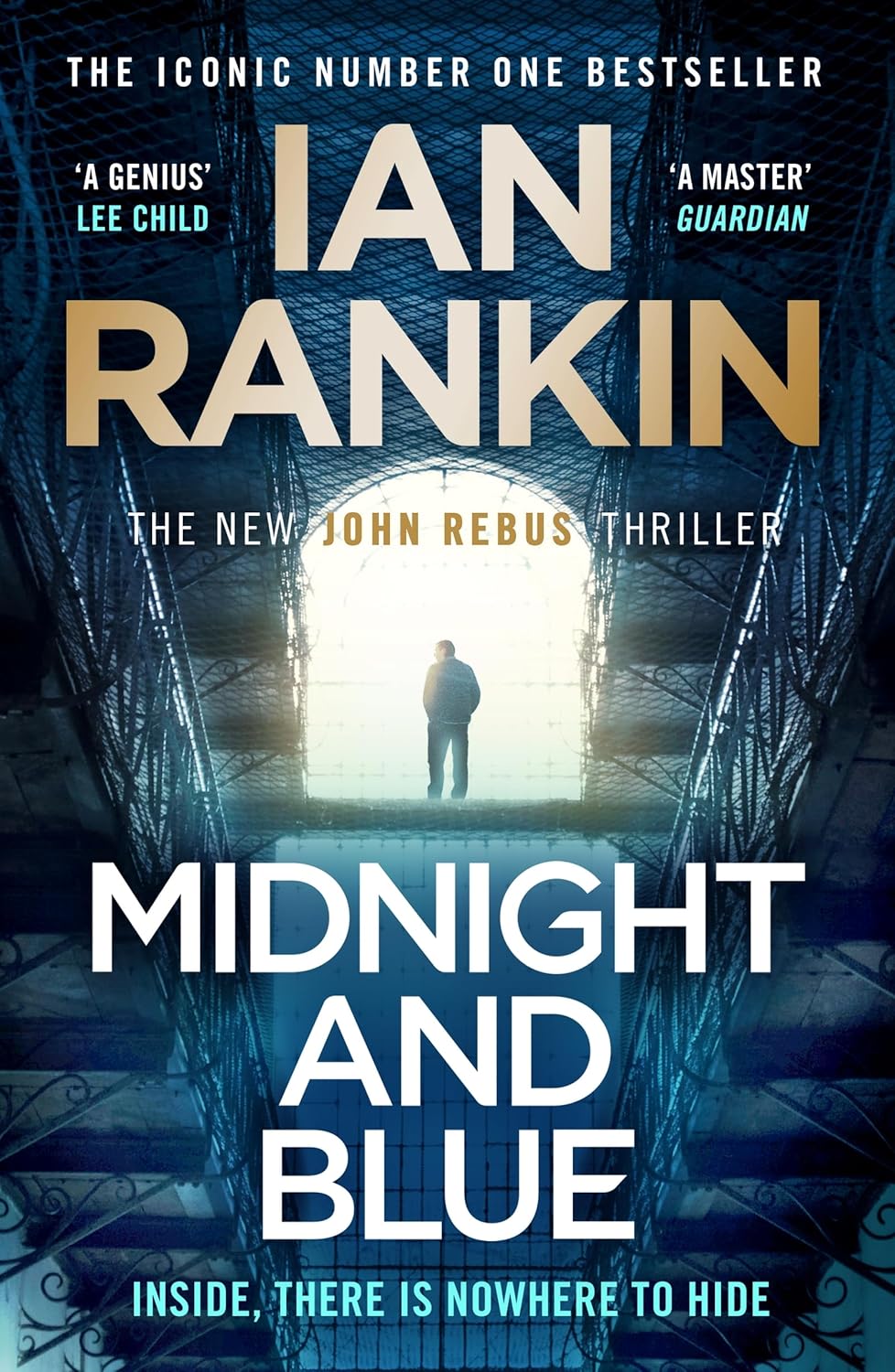
I’ve written before about my experience with the DI John Rebus books by Ian Rankin, a series my changing tastes saw me vacate somewhere in the early 2000s, having read about fifteen of them. Well, I recently discovered that twenty-fifth entry Midnight and Blue (2024) contains an impossible crime, so let’s saddle up one more time and see how things play out. Purely for TomCat‘s benefit, you understand.
The book opens with Rebus as an inmate at HMP Edinburgh, having been given a life sentence for his part in the death of Edinburgh gangster Maurice ‘Big Ger’ Cafferty, who played the role of Rebus’s nemesis in previous books.
Rebus had been convicted of attempted murder rather than murder proper. Even so, the judge had handed down the mandatory life sentence, despite Rebus’s protestations that he’d only meant to scare Big Ger by putting a cushion over his face. The prosecution hadn’t liked that, presenting Cafferty as a wheelchair-bound Mother Teresa rather than a thuggish career criminal. Rebus’s past run-ins with the man had been dusted off and held up to the jury for their consideration and condemnation.
Having spent most of his career putting criminals behind bars, it’s clear that an ex-policeman won’t be the most popular member of the prison, but, in part for his role — however unintentional — in the removal of Cafferty, Rebus finds himself under the protection of gangster Darryl Christie, another inmate, whose word in the prison is tantamount to law. Thus Rebus is allowed a slightly uneasy existence alongside men who might otherwise not be so understanding, and it’s an existence that gets only more uneasy when the cells are opened one morning and one of the prisoners is found with his throat cut — a situation which only has difficulties piled upon it when it turns out the man’s cellmate had been potentially drugged and beaten unconscious so as to keep him out of the way while murder was done.
The chief difficulty: howdunnit?

Whether this qualifies as an impossible crime is, frustratingly, up in the air for pretty much the entire book. Maybe a guard did it, maybe a prisoner did, and the notion of how being potentially impossible isn’t something Rankin is willing to commit to, and that makes this potentially intriguing setup a little vexing. Additionally, it’s not exactly the engine of the plot, either, with the prison scenes largely concerning people wanting Rebus to investigate, Rebus refusing because it will be obvious he’s helping Person X, and then Rebus going about asking questions and obviously working for/with Person X — including demanding to see the prison governor at zero notice and being given exclusive access to Christie when he is moved to solitary confinement.
The solution to the murder, too, makes it equally uncertain if the setup was ever meant to be seen as impossible, There’s perhaps two-thirds of a short story here of actual plot in this thread, and the intriguing ideas — the lack of blood at the scene of the murder, the apparent vanishment of the serrated knife that must have been used in slitting Jackie Simpson’s throat — turn out to be dimly realised at best. Stuart MacBride is quoted in the front of my paperback edition saying that this “puts a Golden Age twist on a modern-day tale”, and if there ever was a Golden Age locked room stabbing which was resolved in this way (I’m sorry, Ian, but there would be blood at the scene, and lots of it)…well, there probably was and we’ve forgotten about it for a reason.
The locked room murder being a small part of the book, I’m sorry to say that the surrounding book was no more to my liking, either. There are essentially three threads — the murder in the prison, the disappearance of a 14 year-old girl who might then turn up on a pornographic website, and ex-internal affairs man Malcolm Fox sort of drifting around and trying to move around and get some leverage for his own career or…something. At one point, the various police officers involved in these various investigations all meet and have a set-to about the various cases becoming one, and I realised that I had no idea who was who and who had been investigating which case or, indeed, what the outcome of that parley meant. And, god, the whole thing crawls along, too, with very little progress on each chapter and a wafer thin plot that comes down once again to guesswork, incorrect assumptions just happening to be right, and three or four coincidences to pull the whole thing together.
Away from the meandering plot and interchangeable characters, there’s some good writing here on life in the prison service, struggling with low staffing and recruiting pretty much anyone it can get its hands on just to be able to keep prisons open and barely functional. Alongside this, there’s plenty of heavy-handed reflection on the nature of justice and how policing was different in the 1980s compared to now, and the occasional sentence that just utterly baffled me:
The door to the house was being opened by PC Galvin, who didn’t yet look out of his teens. His partner was the same age and only half an inch taller.
Midnight and Blue is difficult to recommend for fans of the impossible crime, and certainly doesn’t contain anything like the detection which might appeal to Golden Age aficionados. It also makes me feel better about moving on from Rankin, since I get the impression that it’s fairly representative of what he’s written in the two decades since we last crossed paths (other reviews online seem to like it, at least). I know he’s been hugely successful, and good luck to the guy, frankly, for maintaining a series for this long, but if this is being at the front of the modern pack of crime writing, well, I’m going to hunt for something else.
~
Finding a Modern Locked Room Mystery ‘for TomCat’ attempts:
The Secret Room (2025) by Jane Casey
The Botanist (2022) by M.W. Craven
Hard Tack (1991) by Barbara D’Amato
The Darker Arts (2019) by Oscar de Muriel
Mr. Monk is Cleaned Out (2010) by Lee Goldberg
Death on the Lusitania (2024) by R.L. Graham
The Dog Sitter Detective Plays Dead (2025) by Antony Johnston
Impolitic Corpses (2019) by Paul Johnston
The Secrets of Gaslight Lane (2016) by M.R.C. Kasasian
Murder at Black Oaks (2022) by Phillip Margolin
Murder by Candlelight (2024) by Faith Martin
Murder Most Haunted (2025) by Emma Mason
Angel Killer (2014) by Andrew Mayne
The Magic Bullet (2011) by Larry Millett
The Murder at World’s End (2025) by Ross Montgomery
Black Lake Manor (2022) by Guy Morpuss
The Direction of Murder (2020) by John Nightingale
Holmes, Margaret and Poe (2024) by James Patterson and Brian Sitts
The Paris Librarian (2016) by Mark Pryor
Midnight and Blue (2024) by Ian Rankin
Lost in Time (2022) by A.G. Riddle
The Real-Town Murders (2017) by Adam Roberts
By the Pricking of Her Thumb (2018) by Adam Roberts
Murder in the Oval Office (1989) by Elliott Roosevelt
Murder at the Castle (2021) by David Safier [trans. Jamie Bulloch 2024]
With a Vengeance (2025) by Riley Sager
Red Snow (2010) by Michael Slade
Ghost of the Bamboo Road (2019) by Susan Spann


I’ve only read THE FALLS by him. The boozy detective atmosphere was great (particularly as I read it on a plane after airport drinking heheh) but the actual mystery mechanics weren’t anything to speak of.
LikeLike
I can’t begin to imagine how hard it is to keep coming up with criminous plots year after year, but, yes, part of the reason I moved on from Rankin was that he always seemed much more interested in his characters than the schemes they were wrapped up in. There are some huge leaps of logic and coincidence to make parts of the likes of Resurrection Men and A Question of Blood join up, and it’s one of the reasons I’ve never quite been convinced by claims that he’s the Best There Ever Was or similar.
But his characters are very clearly his focus, and that’s absolutely still the case here. And good luck to him, because people really do bloody love these books.
LikeLike
I’ve only read the first Rebus book, and didn’t much like it. But I still took Rankin’s advice and checked out William McIlvanney, which is not an advice he should give out so freely since McIlvanney does everything Rankin seems to be doing, he just does it better.
Have you ever read McIlvanney? They all say he’s the father of Tartan Noir, and that’s definitely a capital N. He’s not one to read for the whodunit plots, but the world he creates is positively tangible, his characters are complex and memorable, and the atmosphere he weaves is second to none. He was a poet, and his ability to mould the Glaswegian dialect into beat poetry is superbly impressive. His language is like a deep, dark, turbulent ocean of urban rage meant to overwhelm the reader. If you haven’t already, read the first page of “Laidlaw” on Amazon. I’ve never read writing like that in a crime novel. Again, his novels are absolutely nothing like GAD, but he’s definitely worth reading.
LikeLike
I’ve not read McIlvanney, no — the name rings a bell from reading Rankin back in the day, but that’s all. I shall check out the opening of Laidlaw as you suggest.
I’m becoming more and more a fan of good writing as the fireworks of good plotting get increasingly distant: usually a compelling plot would get me through the most turgid prose — how else could I have once been such an advocate of The Plague Court Murders…? — but now good writing will more than support me through a diluted plot (c.f. my newfound Celia Fremlin fandom).
Many thanks.
LikeLike