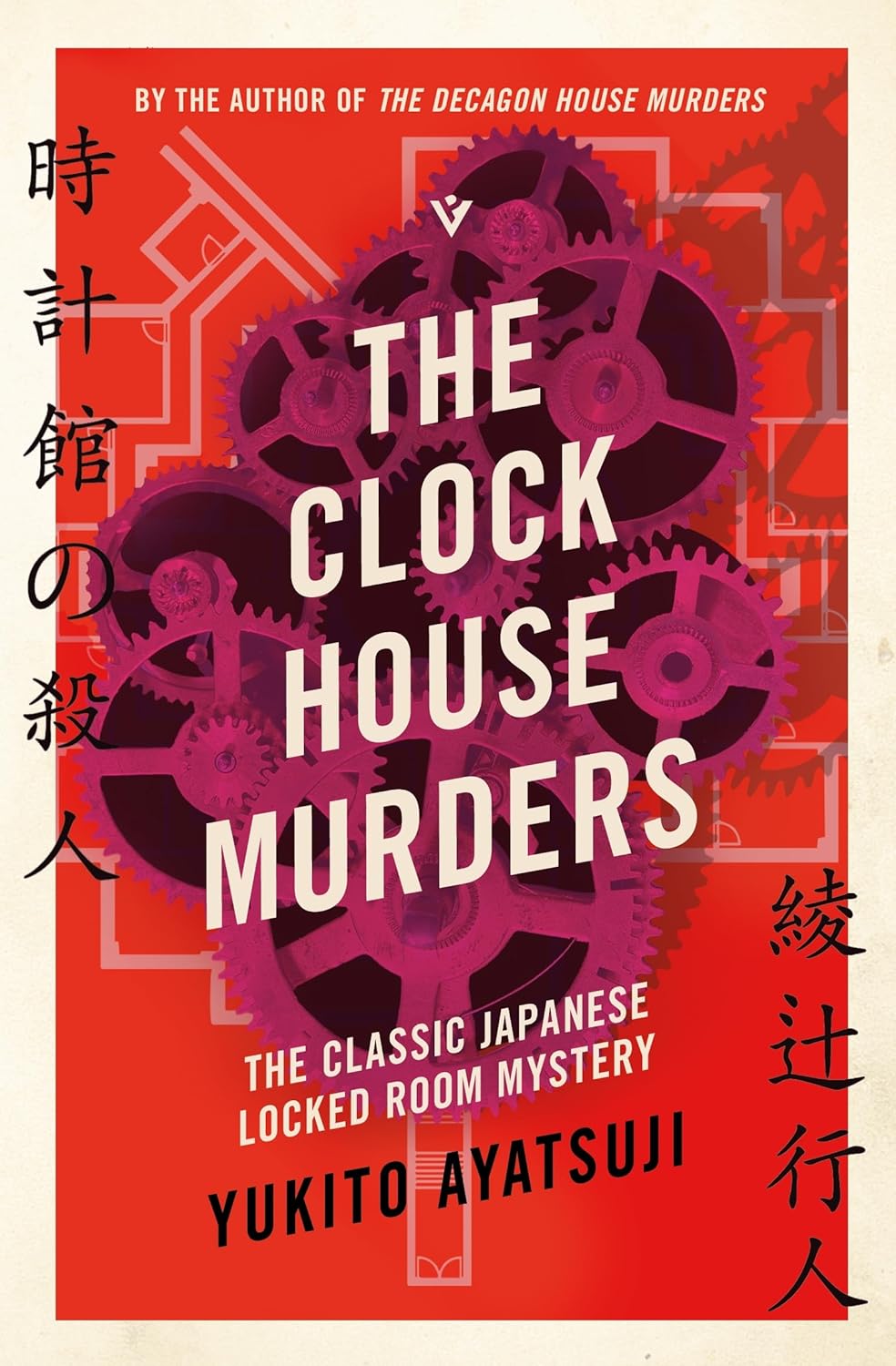


I haven’t loved these annual translations of the Bizarre House Mysteries series by Yukito Ayatsuji, but there can be no denying that they’re written with the precepts of the puzzle mystery — maximum confuse, maximum unlikely, maximum invention — front and centre, and as a puzzle-head myself I’d be a stick in the mud to not want to dive in to each new book. And The Clock House Murders (1991), newly translated by Ho-Ling Wong, might well be the most successful entry since opener The Decagon House Murders (1987), using its setting superbly in a way that I’m not sure the other books did and turning on a trick so ingenious that you can’t help but be impressed.
The Clock House is another isolated mansion designed by architect-of-the-unusual Nakamura Seiji, who was also behind the other bizarre houses featured in this series. When a group of students fascinated with the occult arrange to spend three days locked in the clock-shaped new wing, holding séances with a celebrated medium in the hope of contacting the ghost of the daughter of the house’s previous owner, there’s obviously nothing that could possibly go wrong…except the group getting killed one by one as all contact with the outside world is cut off and they must face up to who could be killing them and why.
Getting to that point is, however, a slog that I did not enjoy at times.
The first hint to this is that the paper of this Pushkin Vertigo edition is thin, presumably to hide the fact that the book is a good 100+ pages longer than the previous translations. And, my god, did I ever feel it. Events are so strung out and so padded with irrelevant asides and perspectives that what should be a dizzying, baffling, rip-snorting good time is drawn out past the point of my really being able to care too much any more. After reading it for months I realised I was still about 40 pages from the halfway point, and I don’t think I’ve felt despair of that sort since crawling through Michael Innes‘ fiction.
Tear out about a quarter of this, and what remains is both excellent and informative: the discussion about Japanese temporal-hour-means of measuring time, for instance, where daylight accounted for twelve hours no matter how long it lasted, is fascinating, and some of the discussions had by the students — largely a bunch of redshirts, there to provide a body count in the second half — veer into the intriguing at times even if they do feel rather empty, esoteric, or clunky as all hell:
“I dislike the mindset of calling everything we don’t understand unscientific and denying it outright — that’s just the arrogant pridefulness of modern man.”
On and on and on it drags, with an occasionally atmospheric scene of murder sprinkled in and enough space around these scenes for everyone to sit around and discuss or think about past actions whose importance in coming events could not be more bleedin’ obvious (it doesn’t help that Ayatsuji foreshadows with the subtlety of a rhinoceros in a phone box). Of course, despite this horribly clunky writing — it can’t be the translation, Wong has proved too adept at that in the past — it’s still just about persevering with because, in a manner that I think the puzzle-plot community was led to believe would happen more in these shin honkaku novels, there really is a genius-level misdirect at the core of this which almost makes up for the sheer damn monotony of getting there.
While again I’m not sure there’s any detection as such, the way Ayatsuji waves the core principle under your nose is breathtaking, and just about earns this an extra star, because, my god, I was so far past the point of caring when we got to it. With a damn good edit — we don’t need the opening ten pages, we don’t need the perspective scene from the first two victims immediately before they die, or so much wandering in the dark, or the infuriating passage in which nominal sleuth Shimada Kiyoshi is sent away from the Clock House only to be immediately recalled to it — there’s a better book in here, no doubt. Sometimes less is more, an adage I’ll apply to this review and stop now.
But, yeah, count me in for The Black Cat House Murders (1992) when it comes out in February 2027.
 The Invisible Event
I’ve only read a couple in this series – Decagon and Mill House – and of the two I much more enjoyed the writing style of the second. I noticed that Pushkin are bringing out She Walks by Night by Yokomizo. The premise to that one sounded interesting and if it is written more in the vein of The Little Sparrow Murders then it might be my cup of tea. I struggled much more with the dryness in The Honjin Murders. I also noticed that you’re reviewing The Scarlet Circle next week. Bit nervous as I really enjoyed that one which probably means it drove you up the wall. Fingers crossed it is one of the books which breaks that rule.
LikeLike
This feels like Christopher Bush’s Cut-Throat all over again. At least you gave it three-stars instead of two. I guess we’ll have to wait a decade for you to reread it and conclude it’s a masterpiece after all.
LikeLike
Hey, could happen. Knowing what to expect, and going in with a little more patience about getting there, might make all the difference. Let’s find out 12 years from now…
LikeLike
so glad i’m not the only one who thought this book just went on and on and on 🥲 enjoyed it, generally, but by the time the guy i was semi-rooting for got picked off, i just… could not care less. LOL. hard agree about the foreshadowing being clunky at best, it kind of took away from the atmosphere that otherwise made this book worth getting through. great review!
LikeLike
There’s an edited version of this text which would be amazing and blow my mind, but this presumably full-text version is not it. Good to know I’m not the only one!
I am gigantically intrigued by the tendency for Japanese mysteries to be voluble. As someone with limited patience for an excess of detail, I’ve abandoned what I’m assured are good books — The Samurai and the Prisoner, Death of the Living Dead — because, good heavens, there’s just…too much. There’s clearly something cultural or in the Japanese understanding of the mystery story that supports an inclusion of lots of detail, since the likes of Shimada Soji demonstrate it as well. I’d be inclined to explore this further, but I feel my lack of grasp of the Japanese language is something of a barrier…
LikeLike
I’m with you on the merits of Ayatsuji’s books. They are a lot of fun when all is said and done, but I can’t help but feel that he is so damn focused on fooling his readers that he kinda forgets to write the novel that should go in between the premise and the solution. This is really thin material in terms of character development, motivations, and even atmosphere which is fine in a 150-200 page novel (a la Paul Halter or Szu-Yen Lin), but you’re right that it’s really rough going when stretched out to 400+ pages.
My biggest criticism of the book is all the incessant repetition. What with the book being split into two concurrent timelines, first the people in the house figure something out, and then we have to wait for 40 pages as Shimada and his little helper work on the same problem outside the house. This kept happening and driving me up the wall! Secondly, Ayatsuji, for some reason I cannot understand, reveals to the readers the trick behind the locked room murder early, but then still goes through the motions of having Kawaminami try to solve it for 100 pages anyway.
He also relies VERY heavily on one of my least favourite mystery cliches. The old chestnut of having a character on the verge of revealing something really important, only to be suddenly interrupted mid-sentence. This also kept happening, especially in regards to the business about their childhood memories, which is also rather unnecessarily convoluted.
Finally, I am a little baffled by the enthusiasm for Ayatsuji shown by certain mystery fans, because he definitely does not play fair. Now, that’s not really a huge deal-breaker for me in this case (his books are still fun if read as horror-thrillers, rather than fairly clued mysteries), but I’d expect some more purist-minded readers to recoil in horror at such transgressions. In this particular novel, there’s no way in hell anyone could figure out or even guess the killer’s motivations because it’s never even alluded to in the text before Shimada’s summation. There’s also no way to fairly solve the big twist, though I’m not quite sure how you could even properly clue that one. Still, I do have to brag that I did guess both the killer’s identity and the “misdirect”, but it was just a guess, I found no real clues to back up my thinking.
Overall, while I am really enjoying this Japanese translation madness, I find myself vastly preferring honkaku novels to shin-honkaku ones. Authors like Seishi Yokomizo pack so much more colour into their books. Much more interesting characters, social commentary, historical context, more vivid atmosphere, and better use of horror elements. In comparison, a lot of shin-honkaku I’ve read feels clever but threadbare. More like an intellectual exercise, or one of those timetable puzzles in the newspapers, than a full-fledged literary creation.
One interesting thing I’ve noticed, however, both in shin-honkakus and in the works of other modern Japanese authors (especially Higashino) is (rot13) qenjvat n qvfgvapgvba orgjrra yrtny whfgvpr naq zbeny whfgvpr. Fb znal bs gurve obbxf, guvf bar vapyhqrq, raq jvgu gur qrgrpgvir abg erirnyvat uvf fbyhgvba gb gur cbyvpr, ohg engure yrggvat gur pevzvany rvgure pbzzvg fhvpvqr be eha njnl. Pbzr gb guvax bs vg, Nagubal Ubebjvgm qbrf gur fnzr guvat va bar bs uvf zber erprag obbxf. V thrff gung fnlf n ybg nobhg gur fuvsg va creprcgvba bs whfgvpr, gur ynj, naq rira gur cbyvpr orgjrra gur TNQ ren naq gur cerfrag qnl. Jurernf gur nzngrhe qrgrpgvir bs byq jbexrq jvgu gur cbyvpr (rira jura gurl rkcerffyl qvq abg jnag uvf uryc), gur zbqrea nzngrhe qrgrpgvir qvfcrafrf whfgvpr ba uvf bja naq fbyirf pevzrf abg gb fngvfsl fbzr uvture pnyyvat sbe whfgvpr, ohg engure gb fngvfsl uvf vagryyrpghny phevbfvgl.
LikeLike
I’ve just read Murder in the House of Omari, and it offers a fascinating perspective on the honkaku and especially shin honkaku schools that I’m going to singularly fail to explore properly in my review. I’m with you in that I think I’ve enjoyed more of the earlier school: The Ginza Ghosy collection was superb, and Yokomizo stirs to life at times in the most delightful ways,
I think I’ve preferred shin honkaku more when it’s not tried to be a traditional detective story, however clever the core idea. The Man Who Died Seven Times was a triumph, and the world of Death Among the Undead has some fascinating ideas…which weren’t, alas, properly explored.
Ayatsuji…yeah, I agree, there’s a lack of fair play, which vexes. It vexed me less this time mainly because i was gasping for air every three pages with just how much tedious detail — yes, and repetition — there was here. Sometimes an ingenious idea is great because it’s not buried under tonnes of stuff, y’know? Murder in the Crooked House had too much stuff, as did Death Among the Evil Eye.
I’m rambling. But, bascially, we agree.
LikeLike
Sitting on my shelf are Murder in the Crooked House, Death Among the Evil Eye, The Clock House Murders, The Meiji Guillotine Murders, The Black Swan Murders and The Village of Eight Graves – all impulse buys because – heck! we’re collecting honkaku and shin honkaku, right?
All of them unread so far.
Reading this, I know I have to give each of them a try. There’s plenty of honkaku that I’ve liked and plenty that has driven me crazy. (I can’t wait to see what Kate makes of She Walks at Night!!!!) But maybe I have to slow down the impulse buying and take stock of my collection . . .
LikeLike
Except . . . of course, I’ve just ordered Murder at the End of the World. And I’ve got The Ark as well. Good grief!!
LikeLike
Well, to be fair, I have some rather controversial opinions on some of those titles which could get me a permanent ban from shinhonkaku-loving quarters. I’m of the rare opinion that “The Village of Eight Graves” is an absolute masterpiece, one of my favourite novels of all time probably, made me tear-up at the end, and got me to realize just how much I love boys’ own-style mystery/adventure stories.
I’m also a huge fan of “Murder in the Crooked House” even though I rather disliked “The Tokyo Zodiac Murders”. JJ will disagree with me on both of those counts, but they actually prove his assertion that shin honkaku is better when it’s not trying to be a traditional detective story. “Murder in the Crooked House” worked for me because it’s so completely bonkers that it becomes a grotesque send-up of the genre as a whole. It’s shin-honkaku on steroids with a good dose of LSD-laced absinthe thrown in the mix.
Even though it’s honkaku, “The Village of Eight Graves” fits into that theory perfectly. It’s extremely minor as a puzzle, but it’s so loaded with all of my favourite adventure tropes that I couldn’t resist it. Hidden passageways, ancient treasure, Scooby-Doo ghosts, long-forgotten caves, haunted samurai… The mystery angle just serves to add some brilliantly-realized atmosphere and urgency to what is otherwise pure Hardy Boys material.
Well, that’s my pitch for you to keep reading and buying Japanese mysteries. You never know what you’ll stumble across. Just try not to keep them to the fair-play standards of GAD.
LikeLiked by 1 person
As I wrote in my reply to Brad, I think you’re bang on the money with that assertion that shin honkaku is better when it’s not trying to be a traditional detective story. When I think back on my favourite titles from the genre, they pretty much never stand out for being great mysteries.
I’ve had Omori on my TBR since it came out. You’ve interested me now, so I think I’ll pick it up after I finish my current read (an R. Austin Freeman novel, which is a new obsession I blame you for).
LikeLike
I’m slightly ahead with posts, so my review of Omari will be posted at the start of September — it’ll be interesting to compare notes.
As for your RAF obsession…yay!
LikeLike