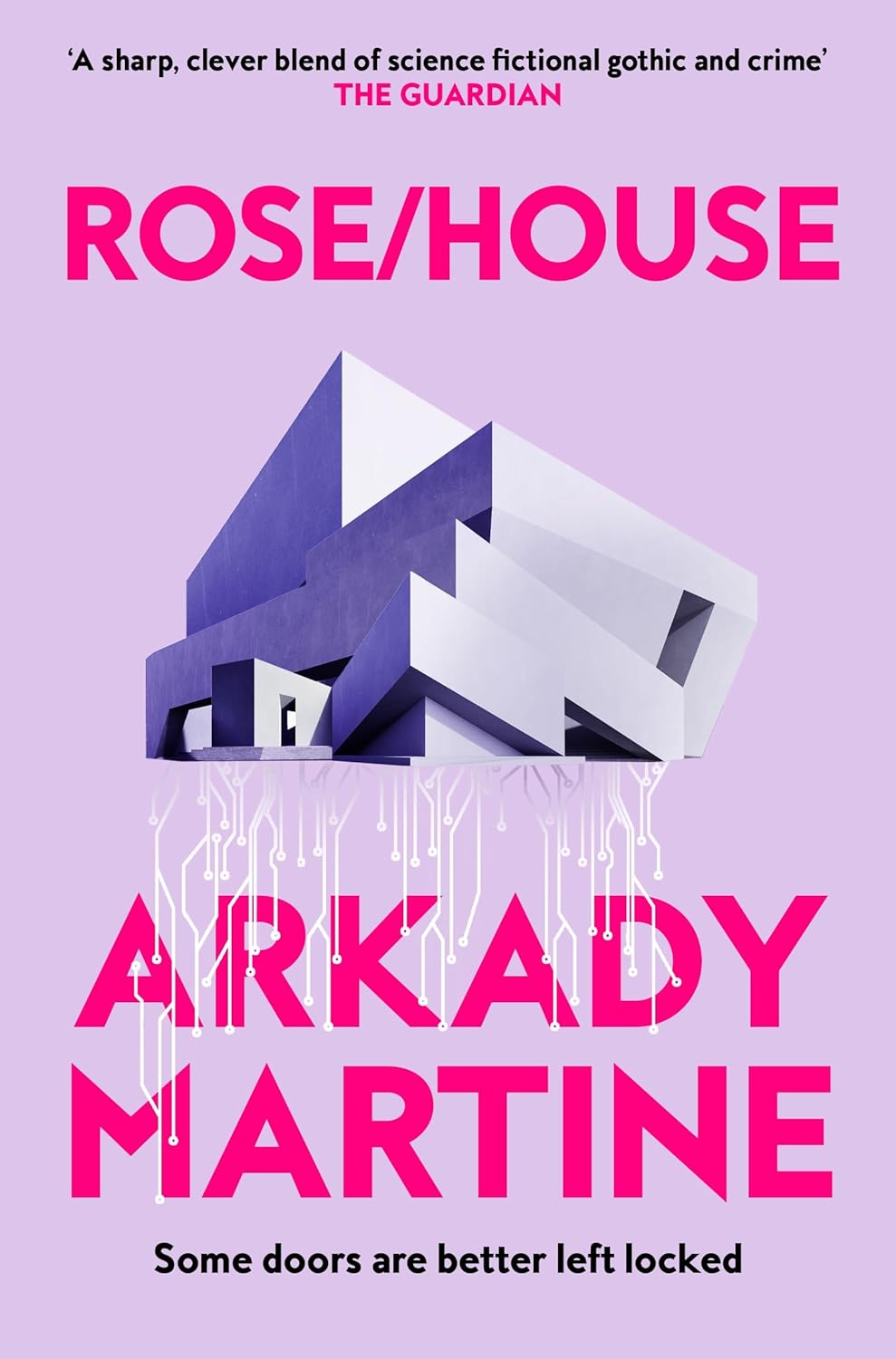
There are many reasons to visit the Cotswolds, and if you find yourself in Burford be sure to visit the exquisite Madhatter Bookshop, the back room of which resembles the study of my dreams: a beautifully comfortable sofa surrounded by crowded bookshelves. It was in this very room that I stumbled upon Rose/House (2023) by Arkady Martine and was intrigued by its impossible crime-sounding premise.
The architect Basit Deniau has been dead for a number of years, but leaves behind him a legacy of buildings that have made his name legend. Arguably the one under most scrutiny is his Rose House, an entirely self-sufficient, A.I.-augmented building outside the town of China Lake in Nevada with its own version of consciousness cut off from the rest of any neural networks — known by sceptics as a “haunt” for the way the ghost-like awareness is locked inside its walls. The house is of interest for two further reasons: firstly, it contains the body of Deniau, compressed down to a form so compact that it has literally become a diamond, and secondly the archives of the house contain all Deniau’s unpublished designs which the world he has left behind is possibly too eager to see for itself.
There is, however a catch.
Deniau’s will stipulated that only one person is ever allowed to enter Rose House — his one-time protégée Selene Gisil — and only then for the sum total of one calendar week per year. That Selene had renounced Deniau before his death makes this both a baffling choice and a bitter pill for her to swallow — she is one of the people who is disturbed by Rose House rather than fascinated by it, and yet she is the only means anyone will ever have to see those designs and to study Deniau’s genius. And so an uneasy truce of sorts has been reached: Selene goes to the house every so often to fulfil the requirements of the will, but the last couple of times has found herself unable to stay there for more than a couple of days before fleeing back to Turkey, where she has made her home.

So Detective Maritza Smith is more than a little disconcerted when Rose House contacts the China Lake P.D. to inform them that there is a dead man within the walls of the house.
The AI had fulfilled its duty of care. It was maybe a little freaky, and more than a little creepy — it was Basit Deniau’s AI, how could it not be creepy — but it was also legally bound to report. And legally bound to only report, not to allow investigative law enforcement inside itself.
It’s clear that the house is not talking about Basit Deniau, and Selene Gisil is on the other side of the world…so who is the dead person inside a place no-one can enter? And how did they get inside?
This novella — 115 pages divided into six chapters — does a frankly exceptional job of painting the future world (sometime after 2200) that we’re placed in, not least because Martine, pen name of AnnaLinden Weller, has a superb eye for both the lyrical possibilities of her universe and the undeniably human little touches that stop the characters feeling like just placeholder names in a sleekly-designed edifice who are there to do little more than spout dialogue to move the polished developments a little further forward.
Torres drank his coffee black, like he didn’t notice how the hot plate burnt it immediately, and he drank it like it might drain out the bottom of his mug if he didn’t hurry up.
The precise purpose behind Rose House is left obscure, as it the science which made it possible, and instead Martine finds an amazing space which enables a sort of sand-blasted poetry to speak through the uncertainties offered up by her prose, always managing to turn around and offer something mundanely and brilliantly human as you start to fear that this whole thing is simply a writing project that got out of hand.
“You ready to not be arrested, Ms. Gisil?”
“Dr. Gisil,” said Dr. Gisil.
There’s an unhurried pacing and space to this narrative that speaks of huge confidence, and the way the tone shifts to unease as Selene and Smith enter Rose House is superb, with the house’s A.I. needing to be treated in a certain way to enable Smith to enter, say, and Smith then needing to tread carefully in the questions she asks as she tries to get to the heart of the crime.
She’d been an okay interrogator, back in the world where she’d interrogated the small and awful crimes of China Lake’s people instead of dancing with artificial intelligences. She knew some of the ground rules. Like this one: if you don’t understand, make them explain without ever letting them know you didn’t have a fucking clue what they’d meant the first time around.
The investigation is much more Noir than rigorous detection, and there’s a fascinating point made here about the unreliable narrator that should have vexed me immensely, obfuscating as it does the core question at the heart of the book, but which works so perfectly in the world Martine has brilliantly conjured to life here. To be honest, I think it would have felt false if anything of greater certainty were offered up, so neatly does the elliptical prose and open space within the narrative assert itself. The smooth-yet-discomfiting architecture of Rose House, its detached voice and questioning attitude as much a hindrance to the investigation as a help, does not form part of a universe of concrete answers. The mood piece that this book represents is something more refined than that, and as such will frustrate even as it delights.
For all the lightly-laid SF conceits on display, the book is as successful as it is for the fine writing of its human characters — c.f. someone with “a laugh that sounded like she’d assembled it from a kit” or bestowing an “owlish and aggressively neutral” look on someone. If a prime concern about the unstoppable march of technology is that we might lose our humanity along the way, Martine has excelled in ensuring her world so beholden to such advances remains unequivocally human.
Come not, then, for the detection — it’s Noirish heritage means that the proceedings are not fair play (two different types of futuristic technology would have to exist to allow the core developments of the plot, and we have no idea they do exist until we’re told that they’re the answer to some important questions) even if the core idea is very clever — nor for the certainty of every box ticked and every stone overturned. Instead you should read Rose/House to see a fascinating melding of the possibilities that exist in the space the crossover mystery inhabits. If I read twenty of these a year I think I would be fairly inured to its charms, but I’m delighted to think that my fixation on the impossible crime in fiction had resulted in crossing paths with this perfect little glass ornament of a book: each tiny detail finely balanced, the overall purpose perhaps a little obscure but nonetheless loving intended.
And, look, if — in the style of Yukito Ayatsuji — Martine were to write a series about dead bodies turning up in Basit Deniau’s houses, I’d sign up for Book 2 in a heartbeat.
~
Finding a Modern Locked Room Mystery ‘for TomCat’ attempts:
The Secret Room (2025) by Jane Casey
The Botanist (2022) by M.W. Craven
Hard Tack (1991) by Barbara D’Amato
The Darker Arts (2019) by Oscar de Muriel
Mr. Monk is Cleaned Out (2010) by Lee Goldberg
Death on the Lusitania (2024) by R.L. Graham
The Dog Sitter Detective Plays Dead (2025) by Antony Johnston
Impolitic Corpses (2019) by Paul Johnston
The Secrets of Gaslight Lane (2016) by M.R.C. Kasasian
Murder at Black Oaks (2022) by Phillip Margolin
Murder by Candlelight (2024) by Faith Martin
Rose/House (2023) by Arkady Martine
Murder Most Haunted (2025) by Emma Mason
Angel Killer (2014) by Andrew Mayne
The Magic Bullet (2011) by Larry Millett
The Murder at World’s End (2025) by Ross Montgomery
Black Lake Manor (2022) by Guy Morpuss
The Direction of Murder (2020) by John Nightingale
Holmes, Margaret and Poe (2024) by James Patterson and Brian Sitts
The Paris Librarian (2016) by Mark Pryor
Midnight and Blue (2024) by Ian Rankin
Lost in Time (2022) by A.G. Riddle
The Real-Town Murders (2017) by Adam Roberts
By the Pricking of Her Thumb (2018) by Adam Roberts
Murder in the Oval Office (1989) by Elliott Roosevelt
Murder at the Castle (2021) by David Safier [trans. Jamie Bulloch 2024]
With a Vengeance (2025) by Riley Sager
Red Snow (2010) by Michael Slade
Ghost of the Bamboo Road (2019) by Susan Spann


Yukito Ayatsuji’s “Bizarre House” series was the first thing that sprang to mind, but sounds actually closer to something like Guy Morpuss’ Black Lake Manor. I’m intrigued enough to place this noir-ish hybrid mystery on the wishlist. Thanks for the recommendation!
LikeLike
I would love another one of these, impossible or not, if only because Martine’s ability to conjure unease alongside perfectly human moments is so neatly displayed here. It’s a universe I’d return to in a heartbeat, though I sincerely doubt we’ll get a second visit.
LikeLike