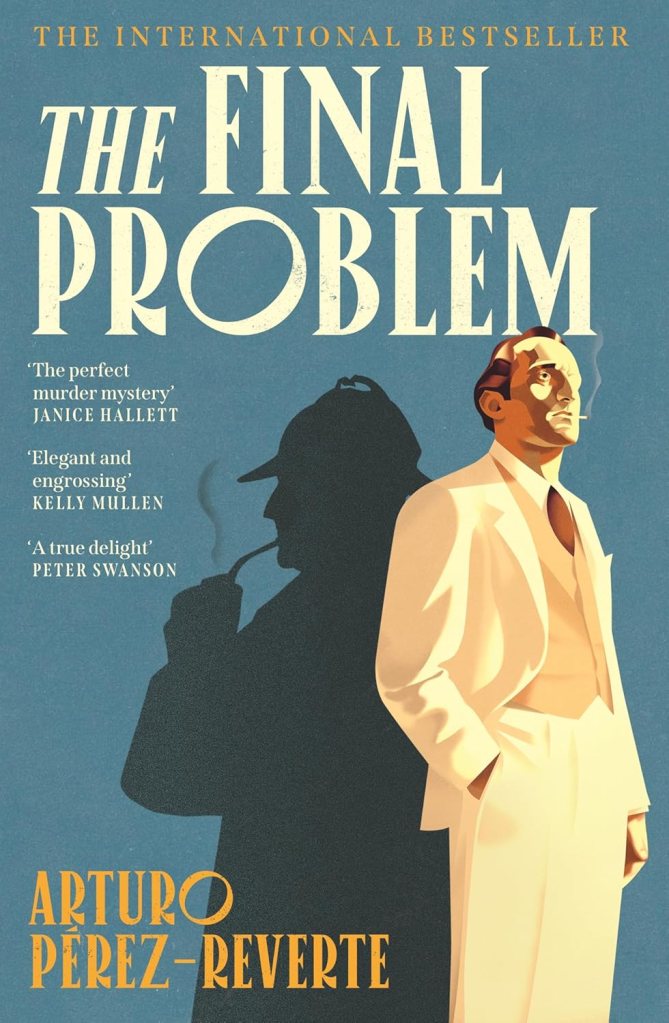


A storm strands nine guests on a small Greek island — “[l]ike in some Agatha Christie novel” — and everyone is shocked when one of the group is found dead in a hut on the beach. Thankfully, one of those present is the actor Ormond ‘Hopalong’ Basil, now an ageing and fading presence, but best known for what is seen as the representation of Sherlock Holmes on the screen in 15 films. With the police unable to reach the island until the storm dies down, might Basil be convinced to investigate the crime? Given “the powerful force that fiction can exert on the human psyche”, it would certainly make everyone feel a bit happier to know that something is being done…
The core principle at the heart of The Final Problem (2023) by Arturo Pérez-Reverte would seem to be the blurring of fact and fiction, as Basil — slowly drifting to the curb himself, and full of stories of the Hollywood greats of yesteryear who have been kicked there — tries to put his reading of Arthur Conan Doyle’s stories to use, adopting Spanish writer of potboilers Paco Foxá as his Watson (though, missing a trick, the book is told in the first person from Basil’s perspective, not Foxá’s). So the two of them investigate the crime scene, discuss the nature of detective fiction, call each other Holmes and Watson, and generally have a jolly old time as the murders stack up around them.
God, it gets boring.
There’s a genuine opportunity here to pay homage to the importance of Holmes in popular culture and in detective fiction. Those stories were the entry-point into the genre for millions of people, I’ll wager, and remain popular today because of their accessible storytelling and universal themes. Here, the characters sit around discussing detective stories and one of them quotes Holmes and the other one goes ‘Ohmygod, that’s from [insert Holmes title]!’ and that’s about it. Rinse and repeat, alongside some depressing reflections on just how far the detective novel has fallen which will give you an idea of what to expect from this as a mystery.
“You cheat [the reader] out of essential details. Remember, Basil, what we talked about this morning: If a novelist is too honest, they risk the reader solving the mystery before the detective.”
This attempt to examine detective fiction through the lens of literary artifice is probably thrilling if you’ve read maybe four books, but it has to strain too hard to make its points. “I was the first to know that most of the deductions made by [fictional detectives] would not stand up to a logical analysis” Pérez-Reverte has Basil claim at one point, as if the entire edifice of detective fiction was so smugly blind to its own faults, that only now, in 2026, is someone finally perceptive enough to pull the wool away from the eyes of our collective delusion. Then someone says something like ‘Well, we’re not in a book, you know…’ and someone quotes Sherlock Holmes and the first someone goes ‘Ohmygod, that’s from [insert Holmes title]!’.
Some of the character beats are nice — Foxá is first introduced as “look[ing] like a man who knew the difference between a samba and a mambo”, and hotel proprietress and Auschwitz survivor Raquel Auslander is full of potential for complexity (mind you, take a drink every time you’re told she’s wearing two wedding rings for a jolly time) — but if you’re unable to see through the core misdirection of this, well, you’re probably the exact person this as written for and have no complaints about how much navel-gazing it does.
“The public is less demanding these days. It was different before, when the mystery novels had more reflection than action…”
A couple of impossible crimes present themselves, and there’s undeniably one good moment of misdirection, but the book overall contains waaaay too much reflection for how half-hearted the mystery and detection is. Positive acres of information are withheld from the reader, and for all the promising early talk of covering the reader’s ears and eyes to misdirect, Pérez-Reverte simply doesn’t include the information at all, and when he does he’s so vague as to be infuriatingly useless (those footprints in the sand are never resolve satisfactorily, for one). It’s one thing to point out how undemanding the public is and how difficult good mysteries are to write, but to do that within a mystery that’s undemanding and isn’t written along the lines of a competent example of the genre takes a degree of chutzpah — practically a PhD in it, if we’re honest — that it seems only hiding behind the curtain of Literary Examination can allow.
It’s a particular shame because the first half is great, and Frances Riddle’s translation is never less than magnificently readable. The guilty party here is Pérez-Reverte, who spends half the book setting up one thing and then the second half mired in tedious interviews, pretentious pontificating, and homage so weak it couldn’t muster a good analogy, and doesn’t even know that he’s writing a plot used so many times before that it — like Basil — has already lost its appeal to those in the know. That sense of unintended irony hangs heavy here, and weighs down what should have been something spry and loving to the point that, if thrown over a waterfall, it would probably fail to resurface.
~
Yes, I know there’s been a screen adaptation. Yes, I know it’s been well-received. No, I’m not bloody watching it.

