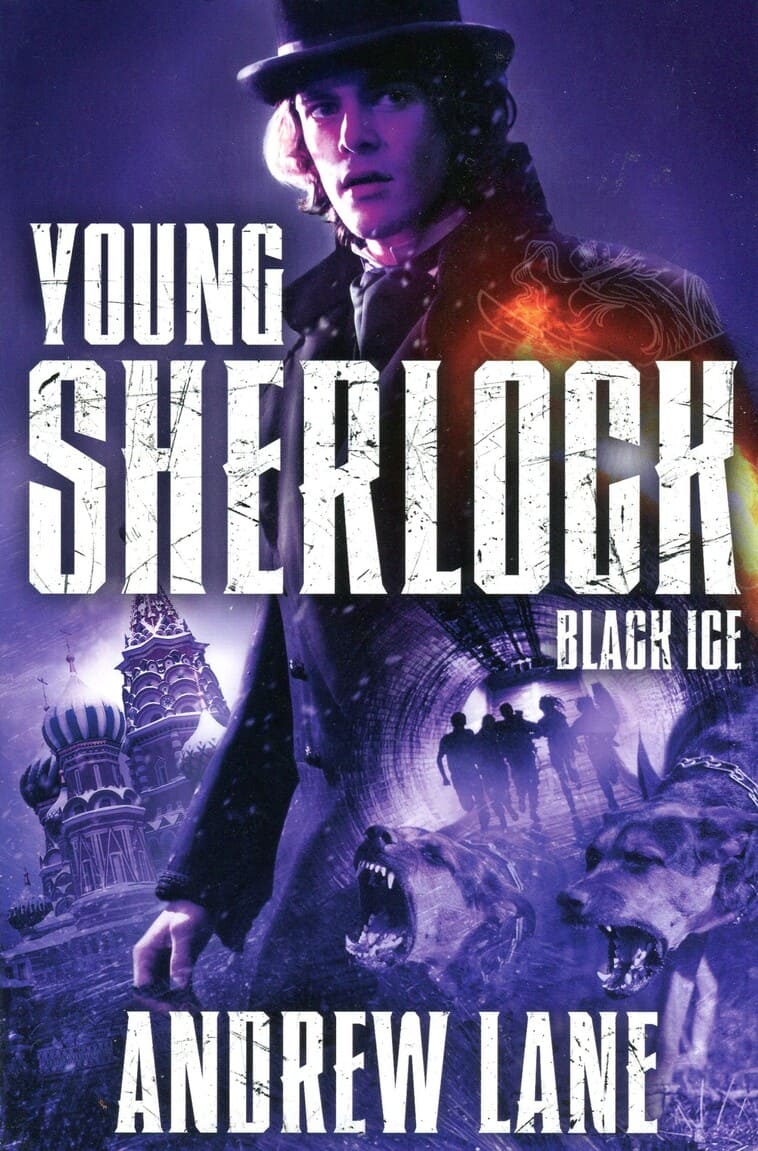
We started this month of Minor Felonies Tuesdays with one Sherlock Holmes pastiche, so let’s wrap it up with another before next month takes us back into Arthur Conan Doyle’s original stories. Thus, Black Ice (2011), the third entry in Andrew Lane’s series charting the development of a teenage Holmes into the resident of 221B Baker Street we all know and love.
14 year-old Sherlock, still receiving tutelage from American bounty hunter Amyus Crowe, a man who demonstrates all the skills of the adult Sherlock…
“The man has been married before, but his wife died. His current marriage is childless, which causes his wife some distress. Oh, and I believe he is pilfering money from the railway company, but that is a stretch.”
Sherlock couldn’t help laughing. “How can you tell all that?”
“Practice,” Crowe said, smiling. “That and natural talent. One day you’ll be able to do it too.”
…is summoned to London by his older brother Mycroft, with Crowe invited along as they all have something to discuss. Arriving at the Diogenes Club, Sherlock and Crowe are taken to the Strangers’ Lounge only to find the door locked. Making themselves unpopular in that realm of silence by hammering on said door, they eventually rouse Mycroft, who opens the door in a daze, a dagger clutched in his hand. And behind him in the room is the body of a man recently stabbed to death.

From here it’s a pretty wild chase, with Mycroft arrested and the police clearly unwilling to look elsewhere for their murderer.
“Why isn’t there someone we can go to?” Sherlock exploded. “Why isn’t there someone who can investigate things that the police won’t or can’t investigate? Some kind of independent, consulting force of detectives who can set things straight…?”
And so Sherlock and Crowe set about trying to solve the mystery, learning as they do that dark forces are allied against them, and that some clearly very powerful and very influential people want Mycroft Holmes arrested and tried for murder.
Given that Lane wrote eight books in this series, the impressive thing is the restraint he shows in how he is slowly building up the facets of the personality of the adult Sherlock. Tying certain principles to such an emotive occasion as trying to keep his brother from the gallows means that I, at least, believe that the teenage Sherlock learns the impact of these lessons at a heightened time which means that their impact is felt. Crowe’s comely daughter Virginia can tell him “Emotions ain’t logical…they don’t follow rules”, but when Mycroft is being hauled off and Crowe himself says…
“Ah understand you’re emotional. That’s to be expected. Trouble is, if we’re to clear your brother’s name and save him from jail then we need to move fast, and we need to move with complete precision and accuracy. Emotion, right now, will slow us down an’ cloud our judgement.”
…the lesson goes a little deeper because of the situation, and because Crowe’s calm and calculated approach gets results very quickly indeed.
Equally, travelling with a troupe of actors into the story’s second half, Sherlock learns first-hand how stage make-up can be used to so effectively disguise one’s identity. Once more, this is not simply told to him, but demonstrated in a truly chilling scene that really underlines the power of obscuring one’s features, and as such this impulsive teenager really will, you feel, sit up and take notice.
Lane also provides a pleasingly pulse-pounding couple of set pieces to keep the interest of the book’s intended audience — some number of decades younger than me — engaged. The attack in the museum is a solid demonstration of both panic and the need to keep a clear head when panic hits, and the extended chase through the tunnels under Waterloo station is one of the most brilliantly affecting pieces of horror-adjacent writing I’ve encountered for quite some time — you feel the grime, you grope blindly in the dark, the grit gets under your nails, the insects drop down your collar, and the pursuers seem unevadable. It’s brilliant stuff, magnificent sustained, and pays off superbly.
Oh, and, hey, does the ABC in the tearooms Polly Burton hangs out in stand for Aerated Bread Company? The things you learn, eh?
To be honest, there’s so much going on in this book, a marked increase in complexity over the brace of titles preceding this one, that with 40 pages to go, when another awful development befalls our sleuth in training, I honestly couldn’t see how Lane was going to wrap everything up in the time that remained. If these books have one fault, it’s that the endings sort of squeeze in on themselves to suddenly resolve everything…and yet here Lane does a highly skilful job in linking his threads and working in a gripping denouement, even if it does seem a little bonkers when first explained (“Are all your plans this complicated?” Sherlock asks, and…he has a point). Surprisingly, though, when you give it a little thought…yeah, I think it hangs together, even if it is nuts.
As well-wrangled as the big picture is, Lane really is to be commended for the small moments that are starting to embed the character of Holmes. A superb example of this is when Sherlock visits three printers’ establishments one after another and begins to see similarities that the men he speaks to share, the indelible marks their lives and professions make upon them. Someone who hadn’t thought this through would simply dump realisations on our protagonist and then wave their hands when it came to why the lesson was learned or taken to heart, but Lane clearly has a plan and, three books into his project, I’m immensely keen to see how it develops from here.
~
The Young Sherlock series by Andrew Lane
- Death Cloud (2010)
- Red Leech, a.k.a. Rebel Fire (2010)
- Black Ice (2011)
- Fire Storm (2011)
- Snake Bite (2012)
- Knife Edge (2013)
- Stone Cold (2014)
- Night Break (2015)

