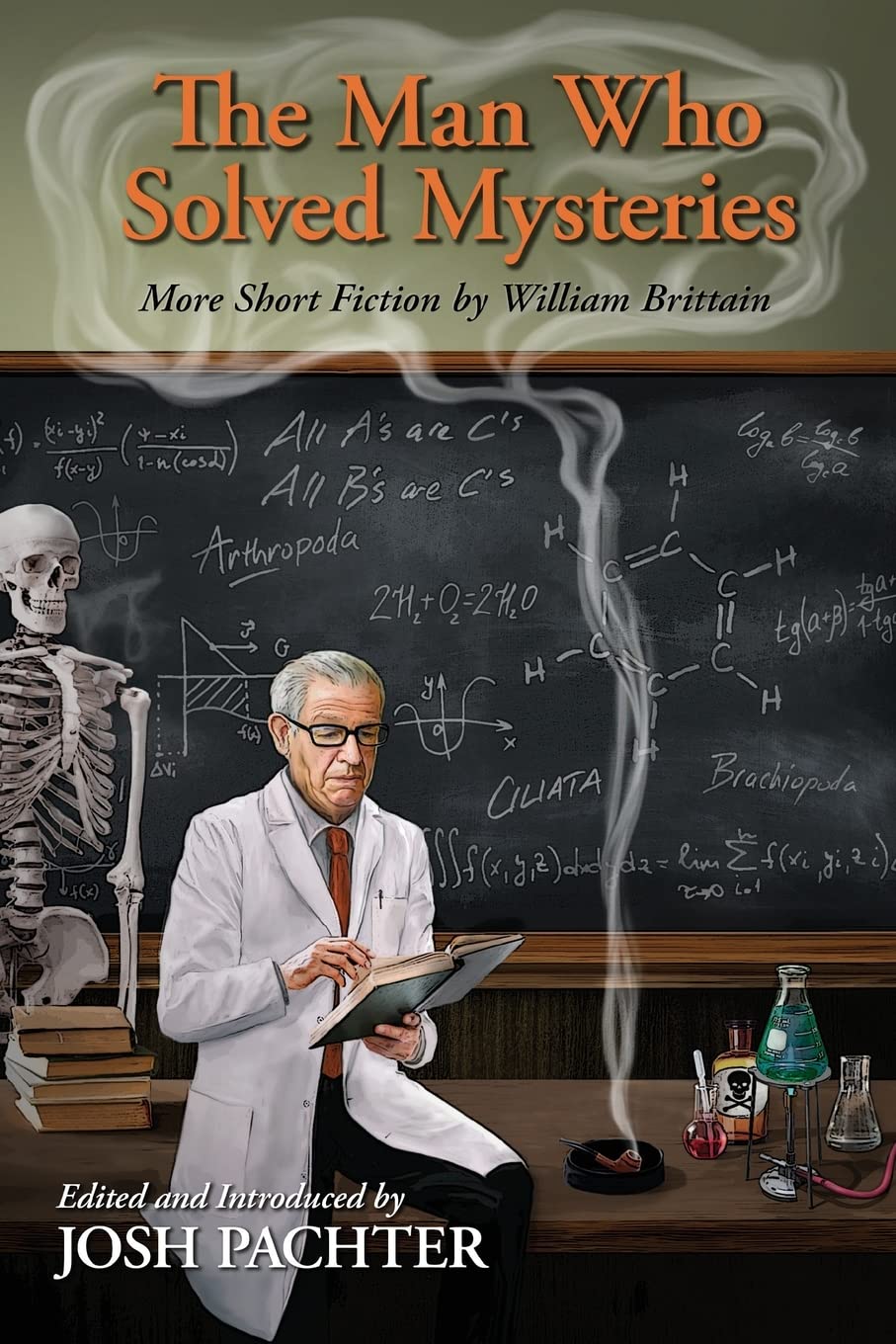
A second collection of the detective short stories of William Brittain from Crippen & Landru, The Man Who Solved Mysteries [ss] (2022) follows The Man Who Read Mysteries [ss] (2018), this time with all 24 stories featuring high school science teacher Leonard Strang.
Indeed, this second volume means that all the Strang stories have now been reprinted, with editor Josh Patcher promising that the remaining standalone stories Brittain wrote would get a third volume if this one does well enough. So, four years late to the party, let’s see if a third volume is indeed something worth getting excited about.

Opener ‘Mr. Strang Finds the Answers’ (1967) once again sees some questionable behaviour on behalf of our high school teacher: making three boys strip down to their underwear when the answer key to an upcoming test is stolen (“There would be telephone calls from irate parents.” — y’think?).
The concept involved here is pretty clever, but it does beg a question: if the student was clever enough to use that chemical principle, would they really be failing a test? Anyway, this underlines the intelligence the Strang stories can employ and — largely naked teenage boys aside — gets us off to a firm start.
The school production of Macbeth forms the background to ‘Mr. Strang Sees a Play’ (1968), which reads like the sort of idea Isaac Asimov would dismiss as too simple. As Strang notes in the story, thank heavens that Johnny Fein wasn’t called Pipsissewa Frackenbush, but on the whole this is difficult to object to. Except that once again Brittain has a weird interaction between Strang and a student to cap the whole thing off; why write stories that will involve teachers and students if you’re going to put in weird shit like this? I don’t get it.
“[O]ne minute Mike was in his room with the door locked, and the next minute he was gone,” sums up the puzzle in ‘Mr. Strang Pulls a Switch’ (1969). When a train-obsessed student vanishes from his locked, watched bedroom at home, the terrified parents…phone the boy’s science teacher to resolve the issue…? Anyway, this is again minor and enjoyable; I feel like there’s a whole realm of this sort of thing possible in the space the mystery was occupying in this era, so it’ll be interesting to see how many variations on this sort of thing Brittain can dream up in the remainder of this collection.
A brewing student protest results in a policeman being beaten unconscious in ‘Mr. Strang Takes a Hand’ (1970), with a mumbled dying message — “Sawhorse…” — (well, okay, he’s not dying…) perhaps providing the clue to the whole thing.
This is very good, and ties its various threads together with some agreeable clewing and a solid chain of reasoning in the final stretch. I love this sort of thing, where obscure happenings coalesce to make perfect sense once expounded intelligently, and Brittain provides it very neatly herein.
In order to get funding for a school project, Mr. Strang appeals to an old student who is now a successful businessman in the town and finds himself needing to commit theft in ‘Mr. Strang Lifts a Glass’ (1971). The eventual outcome of this isn’t hard to guess — indeed, it occurred to me the second I saw the wording of the deal — and most of the duration is spent of hijinks possibly just to fill out the word count. But we’re a long way from the Golden Age, so one no longer expects Golden Age-style intelligence.
Creepy behaviour count #??: Strang suggesting a 17 year-old girl wear a revealing dress to the meeting in case a middle-aged man “would be influenced by the sight of a trim feminine figure”. Fuck’s sake, Leonard.
When a young teacher is badly beaten in ‘Mr. Strang Finds an Angle’ (1971), it falls to Strang to find the weapon which could have been used by the two young men who were on the scene yet possessed nothing more harmful than dirty gym kit. Earns kudos for playing the game as fairly as it can, but shows how the masters of this sort of thing told you the necessary information without tipping the gaff by the halfway point.
Disappointingly (??) ‘Mr. Strang Hunts a Bear’ (1971) has nothing to do with him finding a hairy male lover, but instead concerns a wealthy woman worried she might have frightened her sick grandson to death. It’s…fine. I’ll remember it several months from now, but mainly for how purely meh it is.
‘Mr. Strang Checks a Record’ (1972) sees these occasionally diverting and light tales change focus onto something a little more serious. And while a better job is done than in ‘Mr Strang Performs an Experiment’ (1967) in the previous collection, I’m still not sure that this series was quite the correct carrier for these more sombre tales.
The core principle of ‘Mr. Strang Finds a Car’ (1972) — that a seemingly blameless student is nearly killed by a deliberate hit-and-run after getting off the school bus — is a good one. And the way this is tied back into an earlier throwaway comment is neat, but I would still like a little more to be done with it. Also, would the presence of a dog not have put the…people off using the…place for the…thing? Surely there were other dogless…places that met the requirements? See, that sort of thing annoys me: why include that detail when it works against the core premise?
A visit to the house of 18th century religious martinet Abraham VanderBoj is the setting when ‘Mr. Strang Examines a Legend’ (1973). Given that the man committed suicide in the house, and that his final journal entry leaves no doubt as to his state of mind prior to doing so, what possible grounds are there for our gnomelike science teacher to object?
Despite a personal aversion to one element of the reasoning — “[Fhvpvqr] vf gur ershtr bs jrnxyvatf…” — I like how Strang unpicks this. I do very much like a ‘Aha, we’ve been reading this document wrong all along…’ style of clue, and this is a good one, even if it could do with being a little fairer so the reader can play along.
When a series of thefts leave his school out of pocket, ‘Mr. Strang Invents a Strange Device’ (1973) to get to the bottom of things. I’ve given up on the notion of these stories ever playing truly fair with the reader, which is a shame, but the core idea here isn’t hard to predict. Still, I suppose Brittain deserves credit for writing a light crime story that addresses the under-funding of the school system. John Dickson Carr never did that, eh? And the closing image is difficult to dislike.
Something of a tonal shift occurs in ‘Mr. Strang Follows Through’ (1973), with the brutal murder of a substitute teacher on the morning she is phoned up and asked to cover some lessons at a local school. A plethora of evidence abounds, not least a dying message and a biblical passage written on the walls by the killer…so can Mr. Strang fathom it out?
It stands to reason that Brittain would want to dip his toe into these waters at some point, but this really does contrast starkly with the gentle mysteries generally explored in these tales. It pays off with the sort of serendipity of The Union Club Mysteries [ss] (1983), only feeling even less likely. And does the guy have a Scottish accent or not?
A student work programme is proving a great success, until the student seems to give important information to a rival business in ‘Mr. Strang Discovers a Bug’ (1973). And it amuses me to think how quickly the solution to this is going to become impenetrable to later generations. Like the best Strangs, this turns on a small idea neatly applied, and it’s well-clued into the bargain.
A man doing research at the local library is struck by a car and left in critical condition, and upon discovery by a good Samaritan is able to utter just the word “Teach…” before passing out. Hence we find ‘Mr. Strang Under Arrest’ (1974).
While it’s obvious that Strang himself can’t be the culprit, there seemed to be an excess of a certain element of these stories which, it turned out, is how the answer is reached. I didn’t realise the significance of it, but it’s interesting to me that I thought ‘Huh, there’s a lot of [certain thing] in this one…’ and, well, now we know why.
‘Mr. Strang and the Cat Lady’ (1975) is a good example of negative evidence, and could, in the hands of someone a few decades previously, have made a strong point about theorising without data. It concerns a retired teacher who Mr. Strang doesn’t see walk past his window at the same time she usually does every day, and builds on this thread by there being no evidence of a cat despite her buying food for it on these daily trips.
I like the principle of this, and Brittain hits the tone of the ending well. I can’t help but wonder why there wasn’t a note, but I guess then it wouldn’t be a mystery and there’d be no need to tell the story. To continue the theme of things not happening, this isn’t in my top five below, but only just.
‘Mr. Strang Picks Up the Pieces’ (1975) is not listed in Adey or Skupin, but to my eye this story of the impossible shattering of jeweller’s window deserves to be. The vanishing of the valuable jewels from the display — the young man accused of the crime didn’t have the time to steal them — almost counts, but that broken window is ingenious, and the story benefits from the apparent simplicity of the situation.
If Brittain was more classical in his construction, I’d commend him for repurposing ideas from ‘The Blue Cross’ (1910) by G.K. Chesterton and ‘The Case of Oscar Brodski’ (1910) by R. Austin Freeman. Instead I’ll point out that black coffee, with sugar added to it, is still black coffee.
When the school receives a note warning of a bomb placed somewhere in its vicinity, the tendency would apparently be to ignore it (all those hep cats were so chill in the 70s, man). Alas, recent local bombings have the effect of this being taken more seriously, and so ‘Mr. Strang Battles a Deadline’ (1976). The solution hinges on a linguistic clue which I don’t believe, but, like a lot of the Strangs, this is fine for what it is.
My first encounter with the ingenious, gnomelike science teacher came when ‘Mr. Strang Accepts a Challenge’ (1976) was included in The Mammoth Book of Locked Room Mysteries and Impossible Crimes [ss] (2000). I had a vague memory of what this involved, and I have to say that this possibly impossible death by blunt instrument has stood up well.
I’d like the geography of the house to be better explained — I might have missed it, but I don’t think you really get the key information until it’s being used to explain the solution — but this is solid puzzle work from an era that did not value it.
Summoned from his classroom and rushed across town to tutor a student he’s never met, ‘Mr. Strang Buys a Big H’ (1978) sees the fast food picked up along the way at the student’s request turn out to be poisoned, nearly killing its intended recipient. Since Strang was the only one who touched it, he must be the poisoner…
It’ll sound weird, but I liked the use of the weather in this one. Too often weather is a metaphor or an attempt at atmosphere, but Brittain makes it count here not once but twice and I appreciate those little details in this otherwise fairly standard little mystery.
Two students hand in identical research papers, with one of them having mailed himself a copy weeks before the other claims to have completed his. So it’s clear who must have copied whom, right? Well it is until ‘Mr. Strang Unlocks a Door’ (1981).
The presence of the sealed envelope is enough to tell you who the copycat is, and its apparently unimpeachable sealedness just about makes this an impossible crime, I guess. I’d like the solution to be a little cleverer, but the two points Mr. Strang raises at the end to clinch the matter are both superb detection.
The fact that I solved ‘Mr. Strang Grasps at Straws’ (1981) — in which a hotshot young politico is kidnapped but somehow gets a cryptic clue out into the world — in no way speaks to my genius, but Brittain deserves credit for being willing to play fair with the reader to ensure it is solvable ahead of time. Again, reminded me again of The Union Club Mysteries, and even I’m not sure if that’s an insult or a compliment.
Snowed in while visiting a small New England town — it’s always a small New England town in fiction, isn’t it? — a theft from the local museum comes to Mr. Strang’s attention in ‘Mr. Strang and the Lost Ship’ (1982). But why would someone steal a ship from a glass bottle? Especially as the bottle itself is the object of value.
I’m not sure the motive here makes sense: why delay? Why not just ‘fess up, take the money, and run? There’s also no attempt to play fair, which, okay, would have been extremely difficult given the visual nature of the clues, but the clue of absence, shall we say, could have been described more fully, I feel.
‘Mr. Strang Takes a Partner’ (1982) contains a situation I think we’d all frankly delight in: being approached to help solve a literary mystery that revolves around wordplay. This sort of echoes Brittain’s own ‘The Man Who Read Dashiell Hammett’ (1974) from the first C&L collection, and you’ll get no complaints from me about this thoroughly charming little story.
A discussion about the “superclue” which gives fictional detectives their moment of realisation gives Detective Paul Roberts a chance to illustrate an open-and-shut murder case coming to trial the following day. Or at least it’s open-and-shut until ‘Mr. Strang Studies Exhibit A’ (1982).
I’m not sure the core principle in this is all that well explained, but, if you take the death of a child and the brutal bludgeoning to death out of it, this could easily be an Encyclopedia Brown case. And I’m pretty sure I mean that as a compliment.
We end with ‘Mr. Strang and the Purloined Memo’ (1983) which name-checks ‘The Purloined Letter’ (1844) by Edgard Allan Poe and then provides a modern updating of the principles therein, as a valuable memo is stolen and hidden in a way that completely evades discovery.
Am I right in saying that the solution here was previously used by Arthur Porges? It’s a good idea, and Strang’s discussion of the psychology involved in the oversight is solid, so I have no complaints; I just like to know, when I get this itch that I’ve seen something before, wherefrom it hails.
A top five? I said I’d include the Strangs from the previous collection, too, though mercifully only one of those was good enough to include here…
- ‘Mr. Strang, Armchair Detective’ (1975)
- ‘Mr. Strang Picks Up the Pieces’ (1975)
- ‘Mr. Strang Takes a Hand’ (1970)
- ‘Mr. Strang Accepts a Challenge’ (1976)
- ‘Mr. Strang Discovers a Bug’ (1973)
On the evidence of the two collections thus far, William Brittain seems to occupy a space similar to that of the equally collected-by-Crippen-&-Landru Mom stories by James Yaffe. Both writers have a keen eye on how to fold in character beats alongside puzzle plots in a manner that doesn’t overwhelm — or under-serve — each competing aspect, and when their ideas come together well they can turn out some excellent work.
I yearn for the Golden Age, of course, but it would be remiss not to acknowledge how difficult it must have been trying to write these plot-focussed stories at a time that they would have almost certainly have been looked down upon. Trying to wrangle their own intentions and fit into an idiom of writing that the era wanted must have been hard, and it’s to Brittain’s credit that he found a way to do it again and again.
So, were a third collection of Brittain’s stories to come to light — it’s mentioned in the afterword here with the title The Man Who Wrote Mysteries, but given a 2024 publication date which has passed unfulfilled — I’d certainly be eager to read it. The guy’s not perfect, but given the quality of what he’s produced in these two collections, especially given the era in which he was writing almost against the grain, I can well believe that his non-series work could have about it some of the hallmarks of excellence. So now we wait…
~
In case you were wondering: 352. That’s how many times I typed ‘Strange’ and then had to correct it to ‘Strang’ in the compiling of this post.

