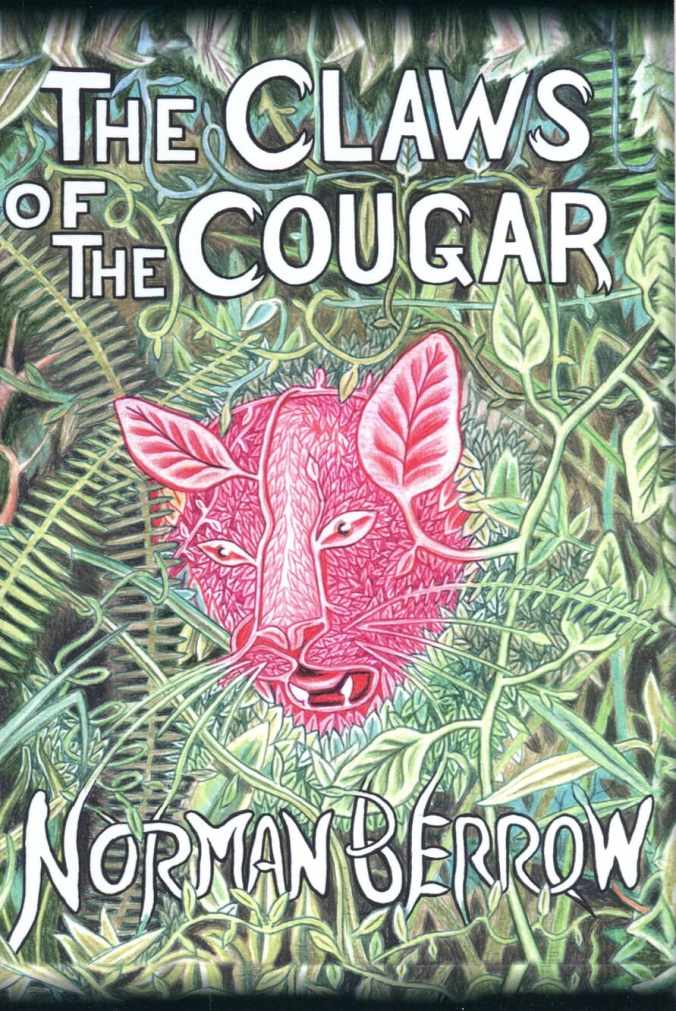


Immediately after being thoroughly exasperated by The Penrose Mystery (1936) by R. Austin Freeman, I picked up The Claws of the Cougar (1957) by Norman Berrow with low expectations — sorry, Norman — and breezed through it in a couple of hours of sheer delight. If authors are supposed to do their weakest work at the end of their career, no-one told Norman Berrow: this and preceding title The Lady’s in Danger (1955) are very strong, and he didn’t publish another new novel before his death in 1986 (Ghost House (1979) doesn’t count, since it was an edited version of Ghost House (1940) and we’ll find out what all that was about in due course).
Not concerning, you may be disappointed to learn, a group of men in their 20s trying to avoid the attentions of a sexually liberated woman in her forties, this instead focusses on Rafe Harding, who is dispatched to South American to collect back his aunt’s favourite nephew, the somewhat dissolute artist Wilmot Foy. Arriving in the village of San Roque, where Foy is rumoured to have washed up, Harding stumbles upon a half-glimpsed woman fleeing from Foy’s house, and the village drunk J. Shane Meredith passed out on the veranda. Before long, Harding and Meredith happen upon a corpse which has been attacked by the cougar — of the big cat variety — known to hide in the forests surrounding the village, and that is only the start of their problems.
This is far from the most complex novel you’ll ever read, but Berrow does a strong job in realising the particulars of San Roque and its denizens, with a handful of characters filling out the cast. As well as the drunken Meredith — known throughout as the Professor — there’s the hotelier and all-round businessman Pereira, the comely Lelanie Watkins-Smythe and her somewhat standoffish husband, identical twins Niccolina and Vittoria Spezza — adding to games, since all the women in the village are also dressed identically (“Similarity and identity are two different things…” the Professor declares early on) — and, foremost of all, the Chief of Police, Ramon Ortega Felipe del Castelar, “one of the biggest, fattest men Rafe had seen outside a circus”.
Now. Part of the joy of this fast-moving book — it occurs over maybe 24 hours, and something like five people will die in its 152 pages — is simply sitting back and letting the developments take you. Del Castelar is a key example of this: very evidently a big fish in a small pond, with the potential for self-aggrandising that his position allows, he’s a somewhat magnificent creation, and a lot of my enjoyment of this book came in watching the various sides of his personality assert themselves as the bodies pile up. Whether he proves asset or antagonist to Harding in his various missions, however, I’ll not say.
Instead, enjoy some of Berrow’s wonderful phrases, like…
[The mosquitos] weren’t showing any great interest in the Professor — perhaps there was too much alcohol in his blood for their tastes…
…or…
It was [Harding’s] private opinion that one didn’t drink [the local brandy], one fought it.
…and enjoy the occasional swerve into Great Detective territory such as Harding being told at one point that the various events of the night have raised five questions which all have the same answer. Additionally, while I’m not a fan of phonetic dialogue, Berrow is to be commended on the way the disparate characters can be discerned by their speech patterns: the languorous tones of Lelanie, the Professor’s louche meandering, Del Castelar’s child-like interest in English idioms, the Cockney letter-dropping of Mrs. Bompas who has been in the village for twenty years. It’s just another little way that Berrow brings his tiny community to life, and completely superb.
This also, possibly because I was so caught up in its pages or maybe it’s a well-drawn mystery and would have done it anyway, managed to drop a good surprise on me in the closing stages, though in fairness this has been something of a strength of Berrow’s over his career. The man does love a secret passage — not a spoiler, there’s none of that sort of thing here — but in other plot-related regards he’s actually great at something that I don’t think I’ve given him due credit for before now. And I suppose I still haven’t, because I can’t tell you what it is without tipping the gaff. Sorry, Norman.
Having gone into The Claws of the Cougar anticipating that it would evince many flaws and obvious reasons why its author never picked up his pen again for a novel-length murderous sally, I leave it wishing that it didn’t represent the end of his career. The sweaty atmosphere stifles, the sense of panic really gets into your bones, and the plot machinations delight as the deaths litter the landscape. Not one for fans of formal detection, but if you’re looking for an author who got better in their final couple of novels, then, wow, does Berrow ever fit that bill. It is to be lamented that we have no more of him from the ensuing 30 years, and I hope he lived out his days doing something that made him very happy indeed.
~
Norman Berrow reviews on The Invisible Event
Featuring Bill Hamilton:
The Smokers of Hashish (1934)
It Howls at Night (1937)
The Terror in the Fog (1938)
Featuring Richard Courtenay:
The Secret Dancer (1936)
One Thrilling Night (1937)
Featuring Michael & Fleur Revel:
Fingers for Ransom (1939)
Murder in the Melody (1940)
Featuring Lancelot Carolus Smith:
The Three Tiers of Fantasy (1947)
The Bishop’s Sword (1948)
The Spaniard’s Thumb (1949)
Don’t Go Out After Dark (1950)
The Footprints of Satan (1950)
Featuring J. Montague Belmore:
Don’t Jump, Mr. Boland! (1954)
Non-series:
Oil Under the Window (1936)
Ghost House (1940)
The Lady’s in Danger (1955)

