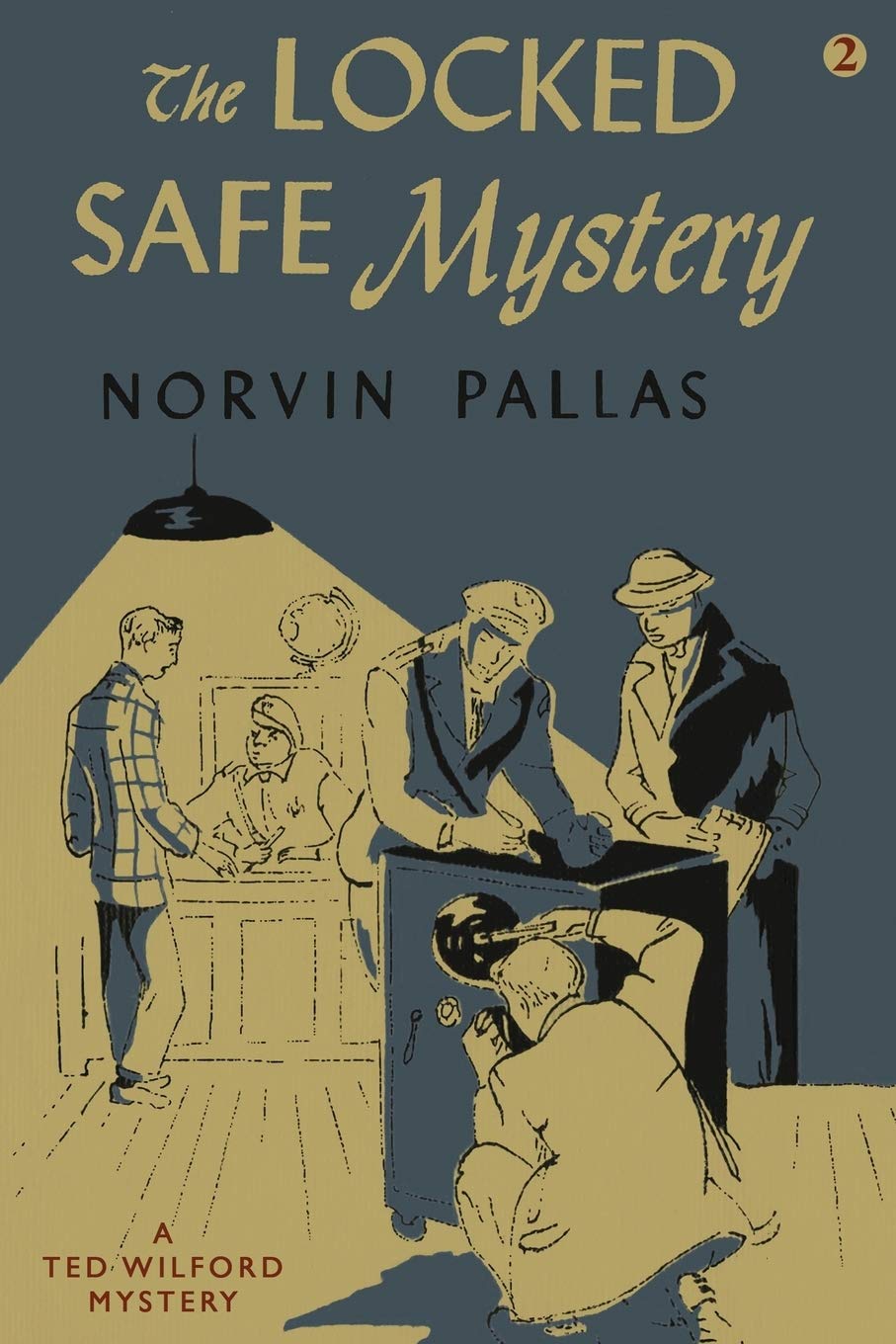
I’ve been searching around for a juvenile mystery series not from the 21st century to take the place of the Five Find-Outers on the blog (I still have several Ken Holt books to read, it’s true, but I grew a little weary of those) and stumbled upon a reference to an impossible crime in the shape of The Locked Safe Mystery (1954), the second of fifteen juvenile mysteries by Norvin Pallas published between 1951 and 1967. And it’s in Skupin, so, well, why not?
Voted in as his high school newspaper’s editor at the start of the academic year, Ted Wilford is going to have a busy time ensuring that the paper runs smoothly, he completes his studies as required, and that he’s able to spend enough time helping deputy principal Mr. Clayton prepare for the Forestdale Fall Festival of Fun and Frolic, and annual charity event that raises thousands of dollars. It’s just as well that he broke his ankle in an adventure earlier in the year in which he discovered a gold mine and it isn’t quite healed enough to let him join the football team again, or else how would he fit it all in?
Eventually, the Fall Festival happens and, on the night after it is completed, Ted is phoned at home at 2.30am by the principal Mr. Brackline with some bad news: the money raised at the festival has been stolen, taken from the school’s safe, to which only three people knew the combination. And Mr. Clayton was seen leaving town on the latest possible train and his whereabouts cannot be accounted for. So it looks like Mr. Clayton has stolen the money…but Ted refuses to believe it, and over the coming months — the book takes places over, like, a whole semester, I think — he sets out to prove it.
While also doing a lot of journalism. And I did men a lot of journalism.

If you want to know the highlights of this review, then, well, this book is boring. I want to praise Pallas for writing a juvenile novel that tries to get into the rhythm of small town life against the background of this baffling and embarrassing theft, but fact is that pages and pages of this are given over to things like a crossword being printed on the front page of the student newspaper, and Ted having to turn down stories by his friends because there’s not enough space, and oh-so-much self-aggrandising talk about the noble art of journalism and how papers must be the most upstanding and blameless recorders of the unvarnished truth which makes — unfortunately for Pallas — horrible reading all these years later when you know how far the gutter presses across the world have sunk in their rush to vilify celebrities, immigrants, and just about anyone else that hateful tossers can gather round and bare their teeth at and blame for, or distract themselves from, their problems.
“We have to ask not only whether the story is true, but if we can prove it; whether it is malicious; whether it invades anyone’s right to privacy; whether it prejudices a court verdict or in other ways impedes the case of justice.”
Yes, this was a more innocent time, but the constant banging on about the nobility of the Press hasn’t merely aged badly, it’s dull dull dull, and probably of no interest to the young people reading this who are more concerned with how the money was taken from the safe. Because that, when you mix in the plot thread of the man who made the claim on the mine with Ted dumping his injured juvenile son on Ted’s family and then apparently vanishing in a plane crash, ends up being relegated to about the fourth thread of the plot, and the examination of it is disappointing even if I hadn’t been anticipating an impossible crime.
Three people know the combination to the safe — one of those three people is Mr. Clayton — two of whom had keys to the school –one of those is not Mr. Clayton — one of whom also had a key to the cashbox (not that this matters, because the cashbox is found in the open safe, prised open). The ones who aren’t Mr. Clayton never come under suspicion for even a fraction of a second, because, er, upstanding presence in the community…?
Mr. Brackline, then? That was preposterous.
The similarly newspaper-focussed Ken Holt would at least examine the possibility of the guilt of these people, and it would be easy to place them beyond consideration — they could have been having dinner with their families, or giving a lecture in front of 300 people — but Pallas just goes ‘Nah, don’t worry about it’ and goes back to planning the school newspaper for three chapters.
He knew that newspaper carry considerable weight, and though they try to be impartial, the way a story is presented may influence public opinion a great deal…
It’s more frustrating because there are almost glimmers of an intelligent novel here. The early reasoning about the anonymous note is good, and the crime scene itself presents some nice principles: why break into the safe and leave the cashbox clearly prised open, when the thief could simply pick up the box and run? If Mr. Clayton had gone to the effort of planing the crime, wouldn’t he have thought more carefully about his behaviour afterwards, rather than conspicuously hanging around the train station drawing attention to himself? Since the school wasn’t broken into, could the thief have hidden themselves in the building after the festival? There’s always the threat of something clever breaking through, but that newspaper’s not gonna arrange its front page itself…
It’s true that newspapers try to print facts, but he thought they should also be leaders of public opinion. On the basis of this story, public opinion was likely to take a course which Ted felt was unfair…
Also, like Marty McFly, be careful how you talk to Ted Wilford:
There was nothing Ted detested more than being called “sonny”.
Also, to hell with Ted’s friend Nelson, who sounds like an idiot:
“It might be fun to read a book, but who wants to read about a book?”
The eventual solution to the safe-cracking is certainly interesting from a technical standpoint, though it’s perhaps rather more what you fear Freeman Wills Crofts might be than Adventures on Trains. I certainly wouldn’t call this an impossible crime, even allowing for the slightly looser considerations of mysteries for young ‘uns, but if you can wade through the eleven plot strands to get there, those of you with an interest in this sort of ‘Huh, so that’s how that works…’ style of solution will probably enjoy it. Alas, for all its cleverness, I’m not sure it saved this book enough for me to want to make Ted Wilford a regular thing on The Invisible Event. So maybe I’ll have to go back to Ken Holt after all…
 The Invisible Event