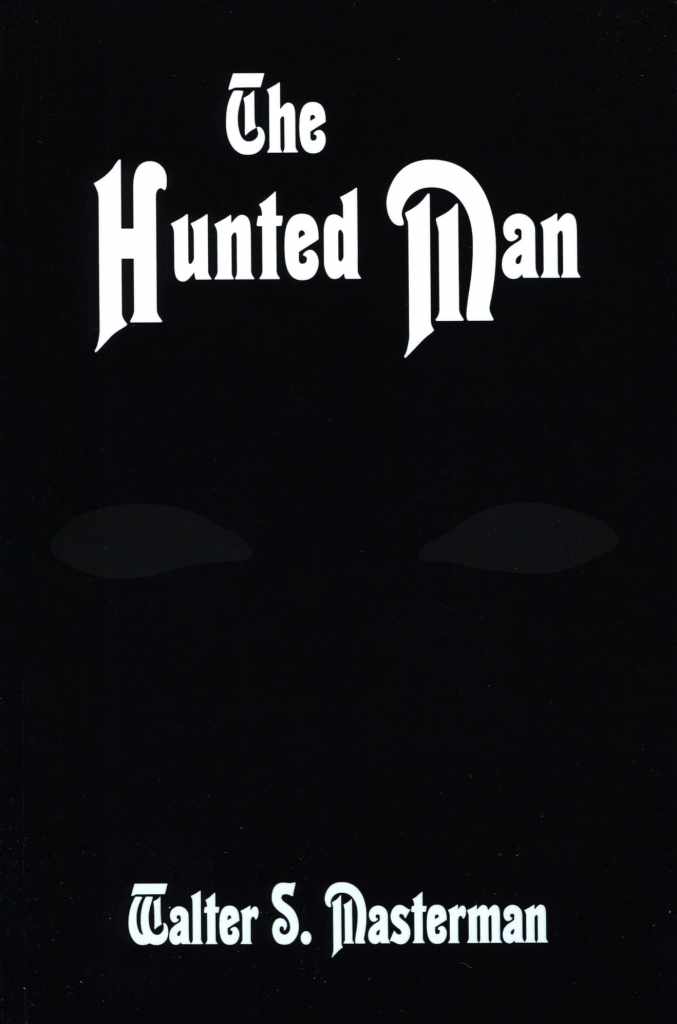


Having had an unexpectedly delightful time with one of Ramble House’s loons in The Claws of the Cougar (1957) by Norman Berrow last week, I headed with similarly low expectations into another author from their stable, the equally-variable Walter S. Masterman. The Hunted Man (1938) is, incredibly, my fifteenth read by Masterman, and I still don’t really feel that I know him as an author, especially as this dramatically reverses the downward trend of the last couple of his I read. With about six of his books remaining to me, I’d be amazed if I didn’t read all his works, but there’s as good a chance of them all being superb as there is of every single one driving me to distraction. For god’s sake, Walter, pick a lane; please.
Responding to a request for help from a young woman in a restaurant, recent university graduate Robin Martin chaperones her to a taxi and is assaulted and knocked unconscious. When he comes to, he unable to see, the attack having left him blind, and that he has been brought to a private hospital. All of this occurs in the first chapter, and of the plot from here I shall attempt to say as little as possible — not because its necessarily terribly surprising, but because I was fortunate to go into this very entertaining book, er, blind, and would like to extend the same courtesy to any readers inclined to pick it up after this review. Masterman typically veers between the jack-knifing surprise and the drawn-out bleedin’ obvious, and half the fun of reading him is not knowing which is going to strike next.
Before long, ex-Scotland Yard man Sir Arthur Sinclair is involved in proceedings and, as enemies seem to bristle at every corner, it’s a matter of whether he’ll be able to get to the bottom of things before yet another antagonist comes from an unsuspected quarter. In that regard, it’s very similar to almost everything else I’ve read by Masterman, and contains much of what makes him a sometimes frustrating prospect: the essential idea here is quite simple, but, good lord, doesn’t it ever get convoluted in the telling. “This complicated plot would have puzzled the best of lawyers,” he says on the final page, and I can’t help but think that it’s actually quite simple, just mixed up with so many filigrees that it seems harder work than it needs to be.
Masterman is, though, having plenty of fun, with some wonderful turns of phrase like the “entirely fictitious guidebooks” on sale at Leveringe Castle, some great descriptions…
Tobacco smoke and the faint halitus of food hung round like the epilogue to a debauch.
…and some enjoyably bonkers developments as things speed along. In one especially playful moment, he even addresses the reader directly as Sinclair gives a summary of events, telling us that “it will be evident to the clever reader that Sinclair, for all his shrewdness, had missed one very important point”.
Most of the book rests on Sinclair’s shoulders, and I do like the old man: lying by omission to put someone’s mind at ease, then encountering an ex-con and offering him the cash to get back on his feet in a way that moves the man to tears (“I can stand the rough stuff, but I can’t stand generosity.”). He’s also an adept and savvy sleuth, with the realisation about the light switch, say, dropped with the lightness of the very best proponents of this art (Masterman spoils it, of course, by immediately pointing it out to you, but the intent and capability are there); and I like the note about how is life is spent helping young people out of jams only for them to move on almost immediately (“Youth soon forgets.”) — there’s a real sense of truth in that.
Some good games of knowledge and identity are played, too, with it being unclear who is in on the plot and what others might know — sure, there’s one coincidence so outlandish that it beggars not mere belief but also the centuries-old achievements of the Mathematics, but Masterman usually crams some of this in, so at least you know he’s hitting the high spots. A few historical precepts raise their head, too: the police referred to as “the slop” and a man in his cups having partaken in “boose” (and later, a pub referred to as a “booser”). All new to me, and I’ve read enough of this sort of thing that I would have expected to come across it before now. See also mass production coming under fire as in The Penrose Mystery (1936) by R. Austin Freeman from two weeks ago, with a man’s cheap calling cards giving away his charlatanism.
When on this sort of spry, energetic, creative form, Masterman really does compel as one of the genre’s second-stringers (to steal a classification from TomCat). The permanent balancing act of whether you’re about to plunge into mediocrity is part of the fun with Masterman — even if I don’t enjoy it when he plunges thither — but to see him pull off a creative and engaging coup such as this is why I persevere. This, of course, means that the next book I’ll read by him, The Hooded Monster (1939), will probably be bloody terrible and make me question my commitment to his output, but what’s life without a little despair now and then?
~
Walter S. Masterman on The Invisible Event
Featuring Chief Inspector Arthur Sinclair:
The Wrong Letter (1926)
The Curse of the Reckaviles, a.k.a. The Crime of the Reckaviles (1927)
The Mystery of Fifty-Two (1931)
The Nameless Crime (1932)
The Baddington Horror (1934)
The Rose of Death (1934)
Death Turns Traitor (1935)
The Avenger Strikes (1936)
The Wrong Verdict (1937)
The Hunted Man (1938)
The Secret of the Downs (1939)
Back from the Grave (1940)
Featuring Inspector Richard Selden:
The Bloodhounds Bay (1936)
The Border Line (1937)
Standalone:
The Perjured Alibi (1935)

