Reviews
#624: Bob’s Yer Uncle – Locked Room Murders Supplement (2019) ed. Brian Skupin
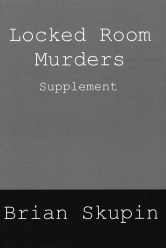
The reprinting of Robert Adey’s Locked Room Murders (2nd ed., 1991) at the end of 2018 was a delightful turn-up for those of us who had been dreaming of owning that reference bible. And once the excitement settled, I’m sure more than a few people started thinking “Hey, they should really do another one of these…”.
Continue reading
#623: Mr. Pottermack’s Oversight (1930) by R. Austin Freeman
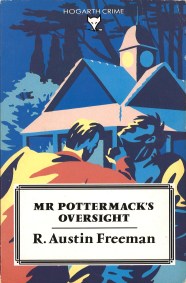


When digging his garden to lay a foundation for a new sundial, quiet, unostentatious bachelor Marcus Pottermack uncovers a previously-unknown well. That same day, he receives yet another demand for money from the man who is blackmailing him, and it’s only a matter of time before one problem is used to solve the other. And when curiosities about the man’s disappearance are raised in passing with Dr. John Thorndyke, it’s only a matter of time before that pillar of truth is on the trail of quiet, unostentatious Marcus Pottermack. And yet, for all its conventional-sounding setup, Mr. Pottermack’s Oversight (1930) is a delightfully unconventional inverted mystery.
Continue reading
#621: The Borrowers Afield in The Mystery of the Moaning Cave (1968) by William Arden
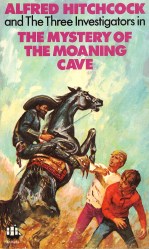
As the current glut of Golden Age detective fiction reprints is making us all aware, copyrights can be a tricky thing. An author’s intellectual property is the characters and plots they create, and allowing others to have access to them is correctly something which is very closely guarded.
Continue reading
#620: The D.A. Breaks a Seal (1946) by Erle Stanley Gardner
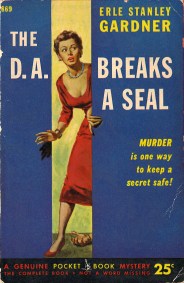
In a recent conversation on the GAD Facebook group, I was reminded that I haven’t read any of Erle Stanley Gardner’s Doug Selby novels in a while. In fact, it’s been a year — where does the time go? So, Project One for 2020 is to get these Selby novels finished so that I can move on to the 30 cases featuring Bertha Cool and Donald Lam. And then the eighty-four Perry Mason cases, which, at this rate, will keep me in blogging material until I’m about 146 years old. But, for today and my belated return to Gardner’s world, we enter a very different Madison County: one where D.A Doug Selby isn’t the D.A — I suppose The Guy Who Used to Be D.A. Breaks a Seal just ain’t that catchy…
Continue reading
#617: The Black Honeymoon (1944) by Constance and Gwenyth Little [a.p.a by Conyth Little]
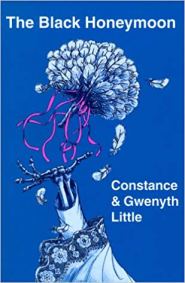
Sisters Constance and Gwenyth Little occupy an unusual place in the firmament of GAD. Together they wrote 21 novels and, thanks to the Rue Morgue Press reissuing them in the early 2000s, there’s sufficient awareness around them for the term “forgotten” to be thoroughly inappropriate…but you’d have to be a genre nerd to name more than a handful of their books. Their lack of a series character and the fact that they wrote no short stories (and a single novella, presumably harder to anthologise) doubtless play a part, but I think more telling is the fact that they’re remarkably difficult to pigeonhole. You’re never quite sure what you’re getting, and that cuts both ways.
Continue reading
#614: The Silent Murders (1929) by A.G. Macdonell [a.p.a. by Neil Gordon]
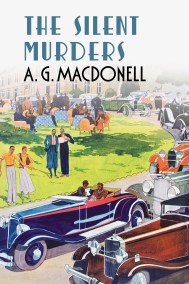
Aaah, the serial killer of yore. With a sizeable proportion of GAD ne’er-do-wells restricting themselves to one victim, and a lot of them adding a second to help out a floundering narrative, it’s often easy to overlook that classic era detective fiction produced more than a few really dedicated murderers. The Silent Murders (1929) isn’t the first, though it is quite an early one for GAD, and so while the usual punctilios are observed — and may feel a little hoary nowadays — it pays to remember where you’re walking. As an entry in an under-represented stratum of GAD, this is easily good enough to make you rue the brevity of Macdonell’s detective-esque output.
Continue reading
#612: A Snapshot in the Family Album – Opportune Character Development in Monk Season 2, Episodes 9-16 (2003-2004)

Okay, I’ve made a concerted effort to get on with the second half of this second season of Monk, so how do the cases taken on by OCD-afflicted police consultant Adrian Monk (Tony Shalhoub) and his assistant Sharona Fleming (Bitty Shram) stand up after a slightly disappointing first eight episodes?
Continue reading
#611: The Seventh Hypothesis (1991) by Paul Halter [trans. John Pugmire 2012]
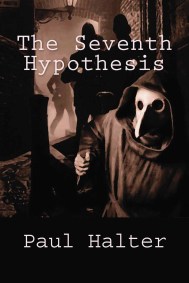
Aaah, Christmas; time to drop into the comforting arms of the ones we know and love. I tried to mix things up a bit this year, starting two Christmas mysteries to review this week…but neither really worked for me, and so I’m following my own advice and adding another pre-blogging Paul Halter title to my archives. I distinctly remembered The Seventh Hypothesis (1991, tr. 2012) to be a doozy, with less of a focus on the impossibilities — though we get two in quick succession — and more attention drawn to a complex switchback of mellifluous plotting…so how’d it stand up to a second look? Rather well, as it turns out.
Continue reading
#609: The Hooded Gunman: An Illustrated History of the Collins Crime Club (2019) by John Curran


