

Hired by Texan businessman Lawson C. Corning to find the whereabouts of Mrs. Yvonne Wells, the Cool and Lam Detective Agency has reason to believe that there might be more in back of the request than they’re told. Finding the woman’s house doesn’t prove too difficult, but her surly, uncommunicative husband is unwilling to help Donald Lam in his enquiries, and so Lam has to cast his net a little wider. Which is how he ends up at the next door neighbour’s house where Mrs. Raleigh tells him that she heard an argument in the Wells house a couple of nights before, and that Drury Wells then exited the house carrying a body.
Given that You Can Die Laughing (1957) was the seventeenth novel published by Erle Stanley Gardner under his A.A. Fair nom de plume, one could suspect that he would start to run out of plots — by 1957 Gardner had written 55 novels featuring Perry Mason as well as the entire Doug Selby series and countless others, not to mention all the pulp stories that poured out of his steaming engine of a brain. And, indeed, I spent much of the book — or the two-and-a-half hours it took me to read — waiting for the other shoe to drop, and for the complications which betokened the earlier entries in this series to come to light.
The truth is, there are no complications: this is perhaps the simplest plot Gardner has steered Bertha and Donald through for a while, told pretty much linearly, and resolved for Donald and this reader both just after the two-thirds mark.
The whole thing was now crystal-clear.
And yet, that’s not to the book’s detriment at all. There’s a slickness here which undoubtedly comes from the great confidence Gardner had in his own plotting chops, and even as the terminal development is being played out slowly to a conclusion that’s obvious to everyone, I was never once bored or frustrated by the experience — quite the reverse: this would probably go in my top five entries in the series to date.
It works in part because we’re so familiar with the characters and their relationships, to the extent that the little tropes bring a smile as they occur: see the start of chapter 8 in which Bertha, almost in one breath, calls Donald a “pint-sized sonofabitch”, then a “little bastard” and then tells him “underneath it all I’m sort of halfway proud of you”. See, too, the end of that chapter in which Bertha professes her absolute belief in Donald’s tactics and promises to stand “shoulder to shoulder” with him when facing the disaster which has just struck them. It’s not Big Emotion of the sort that wins Booker Prizes, but there’s a wonderful foundation of trust binding these two that comes out in the most superb of ways.
I’m going to keep this review short because the relative paucity of plot means that too many references to later events might spoil the book for the reader who wishes to come to it relatively pure. And I do recommend it, for both the Cool and Lam neophyte — who won’t get too lost amidst all the switchbacks that betoken the likes of the similarly-excellent early titles such as Owls Don’t Blink (1942) — and to anyone who’s looking to skim off merely the high points of this 30-book series. Enjoy being a step ahead of Donald for a change, and admire the way he manages to pull the various threads together to ensure that he and his partner still come out on top despite the multiple forces arrayed against them.
This is quick, slick, professional, and highly-enjoyable, showing that these characters can still deliver the goods despite now being in an age which perhaps commended form over narrative complication. If you’re looking to be convinced about the joys of Cool and Lam, well, I think Gardner stopped caring about you a long time ago; those of you either on the train or looking to join it in motion are in for a rollicking time.
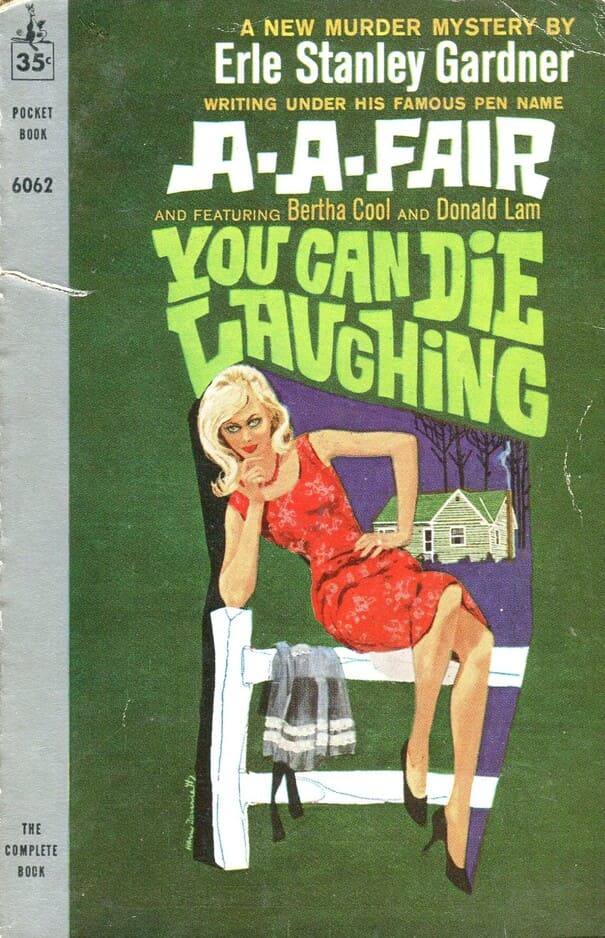
Incidentally, I have no idea why there’s a blonde woman on the cover of this edition. None of the several women featured herein are blonde, so…your guess is as good as mine.
~
The Cool & Lam series by Erle Stanley Gardner writing as A.A. Fair:
1. The Bigger They Come, a.k.a. Lam to the Slaughter (1939)
2. Turn on the Heat (1940)
3. Gold Comes in Bricks (1940)
4. Spill the Jackpot (1941)
5. Double or Quits (1941)
6. Owls Don’t Blink (1942)
7. Bats Fly at Dusk (1942)
8. Cats Prowl at Night (1943)
9. Give ‘Em the Ax, a.k.a. An Axe to Grind (1944)
10. Crows Can’t Count (1946)
11. Fools Die on Friday (1947)
12. Bedrooms Have Windows (1949)
13. Top of the Heap (1952)
14. Some Women Won’t Wait (1953)
15. Beware the Curves (1956)
16. You Can Die Laughing (1957)
17. Some Slips Don’t Show (1957)
18. The Count of Nine (1958)
19. Pass the Gravy (1959)
20. Kept Women Can’t Quit (1960)
21. Bachelors Get Lonely (1961)
22. Shills Can’t Cash Chips, a.k.a. Stop at the Red Light (1961)
23. Try Anything Once (1962)
24. Fish or Cut Bait (1963)
25. Up for Grabs (1964)
26. Cut Thin to Win (1965)
27. Widows Wear Weeds (1966)
28. Traps Need Fresh Bait (1967)
29. All Grass Isn’t Green (1970)
30. The Knife Slipped (2016)


I know this is annoying, but any special ESG/AA Fair recommendations? I know few people with as strong a fascination for plotting as you who also read a lot of ESG. I know it’s a toss-up whether a Perry Mason is a GAD puzzler, a proto-noir character drama, or Rudolph Masonic lawyer shenanigans, so knowing where to start is so difficult…
LikeLike
Not annoying in the least — he has a daunting back catalogue, and choosing from his, like, 130+ novels is a difficult task to undertake unaided. You’ve come to the right place!
For Mason and puzzle plots, try The Case of the Lame Canary or The Case of the Substitute Face.
For Cool & Lam, try Owls Don’t Blink or Bats Fly at Dusk.
For Doug Selby, try The D.A. Holds a Candle or The D.A. Draws a Circle.
For novellas, Two Clues featuring Bill Sheldon is a good volume with two nice puzzles in.
Or The Case of the Turning Tide, the first Gramps Wiggins book, which I tracked down recently and enjoyed.
There — that gives you something to work with. Happy reading!
LikeLiked by 1 person
I knew I could count on you, thanks for the quick reply! I could learn a thing or two from you about punctuality. Excited to read the Perry Masons because the only experience I have with actually courtroom-focused puzzle mysteries is the excellent Ace Attorney series and works clearly inspired by it (such as the Japanese fairytale murder mystery Cinderella Castle Murder). It’s a shockingly underexplored genre, the fusion of courtroom drama and puzzle mystery, and feel Perry Mason and Ace Attorney have made it their own… Perhaps want to write my own, but who the Hell knows if I’m gonna do that anytime soon?
Anyway, sorry! I’m rambling, you know I’ve got a habit for habit for it. Point is, thanks, I appreciate it!
LikeLike
If it’s specifically courtroom stuff you’re after then some different titles would be better — a surprising number of Masons never go near a courtroom. But from a puzzle plot perspective, the ones I’ve suggested would be a good place to start. I hope it helps direct you towards something you enjoy; that’s why we read, after all!
LikeLike
I was looking forward to your review of this because this is the only Fair that I’ve read…and then I realized I’ve forgotten most of the details. But you’re right, the mystery is pretty thin here, the joy comes from seeing Donald turn the tables on the bad guys. The title drop is great. Fun book overall.
LikeLike
“Fun book overall” is a pretty good summary of the Cool and Lam corpus, if I’m being honest. You’re right that the mystery here is thin, but Gardner’s skill is in making the book hugely enjoyable even with what’s going on being transparent. Usually that would be the death of my interest, but somehow he makes it work — the technique should be studied 🙂
LikeLike