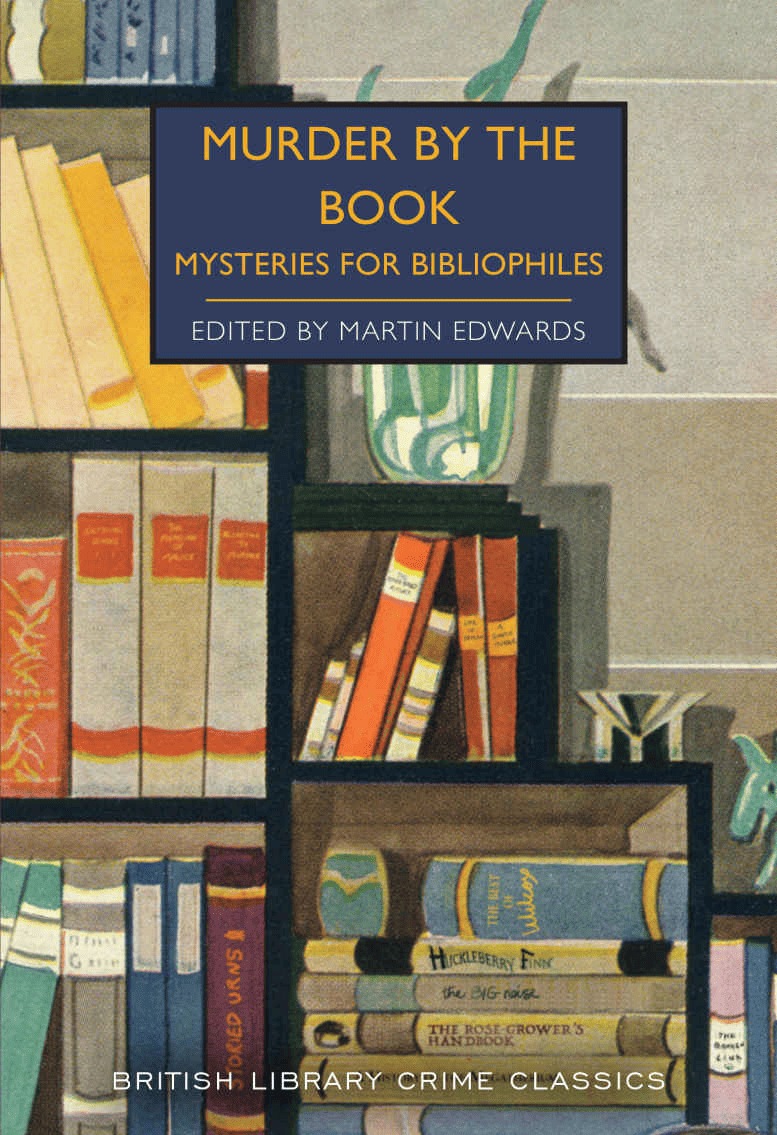
Another collection from the British Library Crime Classics range, edited by Detection Club President Martin Edwards, this time focussing on mysteries based around books — what’s not to love?!
My opting to read this collection is again inspired by its unfamiliarity: of the 16 stories herein, I’d encountered only one before. And that’s really one of the strengths of these digests — it must get increasingly hard to find stories on a certain theme, and harder still not to drop familiar titles over and over, so once again Edwards is to be commended for the work that has gone into this selection.
So how do those stories he has chosen stack up? Let’s find out…

‘A Lesson in Crime’ (1933) by G.D.H. & M. Cole concerns the wildly successful thriller author Joseph Newton, on his way to his “pleasant little seaside cottage with twenty-seven bedrooms”. Encountering a reader of his work on the train…well, to say more would be too much. This is good at taking jabs at the literary world (“[H]e [opens a magazine] to a story by himself. For the moment he cannot remember who wrote it.”), and I like the asperity of our villain, but it’s slightly less successful as a story of crime and detection. I’m intrigued by the Coles, but have yet to find much which actually makes them seem worth pursuing.
A man marries a woman much younger than himself, and in due course the marriage sours. When the man falls ill, his new wife insists on being present at all dealings with his lawyers, presumably concerned about her place in his will. That’s the essential setup of ‘Trent and the Ministering Angel’ (1938) by E. C. Bentley, and the way it plays out won’t surprise anyone, but the use of doggerel Latin is fun even if this does feel a trifle overlong.
A third story in a row by an author who is yet to prove compelling, ‘A Slice of Bad Luck’, a.k.a. ‘The Assassins’ Club’ (1939) brings Nicholas Blake into things, and gets off to an unfortunate start…
It was in an attempt to dispel this cloud of uneasiness that Nigel [Strangeways] began to play with himself…
…but this story of a murder at a dinner for detective fiction authors contains a good idea that is, unfortunately, needlessly withheld from the reader until private agent Strangeways is willing to reveal the killer. Some good complications, but loses marks for lack of fair play.
One of S.C. Roberts‘s Sherlockian pastiches was included in Crimson Snow [ss] (2016), and ‘The Strange Case of the Megatherium Thefts’ (1954) is his second and, I regret to say, apparently his last. Holmes is consulted by the doddery Professor Whiskerton concerning the theft of an assortment of books from the eponymous gentlemen’s club, and with typical elan he solves the case with barely a turn of a hair. But Roberts captures the atmosphere well, and includes a little more clewing than one traditionally found in the Holmes stories, and as a piece of pastiche this serves mainly to make me wish that Roberts had written a full dozen of ’em.
I am dimly aware of ‘Malice Domestic’ as a crime fiction conference in the United States, but had no idea it was a title shared with a 1946 story by Philip MacDonald. Perhaps fittingly, given his work in Hollywood, this unfolds in a series of very filmic scenes in which we’re pretty sure we know what’s going on but the slow reveal of details is well-handled. Many people will finish this and say the conclusion was obvious, but for me this is an excellently-wrangled piece fiction that fits somewhere amidst Suspense, Noir, pure crime fiction, and something altogether more refined.
Inevitable Stanley Ellin Comparison: If you told me Stanley Ellin had written this, I’d believe you; and for me a short stories there’s rarely any higher praise. So despite a lack of detection, this is a lovely little story that unfurls under the manipulations of an expert hand.
I love the opening idea of ‘A Savage Game’ (1949) by A. A. Milne that a detective writer can “[i]nvent a story which accounts of all the facts and suspicions and discrepancies” a crime presents. And thus the semi-impossible death by stabbing of a miserly old bastard is enjoyably simple and thus allows at least two possible solutions. It’s a neat idea, and Milne’s scarcity of criminous writing is to be lamented on this evidence.
Alas, my ebook edition of this lacked the plan of the room which is discussed and proves so key here. Is it in the paperback? I’m not convinced it’s quite as telling a clue as claimed — rot13: fur pbhyq unir ure unaqf va ure ync, ab znggre juvpu jnl fur’f snpvat — but it does show a remarkably acute intuition for the finer points of Golden Age plotting. If only Milne’s over-celebrated novel The Red House Mystery (1922) showed half the ingenuity of this!
There’s a certain unlikely idea at the core of ‘The Clue in the Book’ (1952) Julian Symons which probably just about works, but — alas, it happens sometimes — as soon as the thread was introduced, the way it was going to be used simply jumped into my mind and so this dying message story contained no surprises. If anything, it made me question the validity of the dying message as a principle — the dying person’s suspicions are, after all, not really proof of anything (“I suspect mice!”) — but that’s a discussion for another time.
A reclusive author using the experiences of old lags to inform his writing provides the basis of ‘The Manuscript’ (1953) by Gladys Mitchell. It’s an interesting idea, but nothing in the setup leads you to the conclusion: a sense that the key things were similar would have been easy to mix in, even if this was short newspaper story, and, since that’s missing, the conclusion here is just sort of…sure, why not. Still, I’m intrigued at the idea of a man culling grey squirrels, this clearly being the era when they were recognised as the pest they are.
‘A Man and His Mother-in-Law’, a.k.a. ‘The Man Who Could Not Hold Women’ (1953) by Roy Vickers opens superbly…
In a letter written on the eve of execution, Arthur Penfold seems to share the judge’s astonishment that a man of his calibre should turn to murder to extricate himself from a domestic difficulty.
…and builds on this with Vickers’ undeniable talent for thumbnail sketches that are sometimes brutal in their gentle familiarity. This story of a marriage in which a man’s wife is overly-subservient to her adoptive mother has a clever idea at its core, but, as with a lot of Vickers’ Department of Dead Ends stories, the joy of the criminal being hoist by his own petard is somewhat undercut by the fussy and often too elaborate telling that gets you to that — all-too-easily-anticipated — moment.
I don’t think I’ll ever warm to the work of Michael Innes. ‘Grey’s Ghost’ (1956) is marked by prolixity, and really does not compel either itself or its creator to me. The eternal struggle continues.
Having waded through Innes’ verbiage, I think I must have been in a bad mood when I read ‘Dear Mr. Editor…’, a.k.a. ‘Dear Mr. MacDonald’ (1959) by Christianna Brand, because this, too, struck me as rather too flippant and obscure. I get why Brand structured her story this way, and the inventiveness of the framing as well as the final twist shows why she was so successful…but for reasons I cannot fathom I found it more vexing than enjoyable.
A universally-liked playwright is found shot dead in ‘Murder in Advance’ (1958) by Marjorie Bremner, and our detective is able to narrow the field of suspects to three men the deceased had lunched with in the week prior to his murder. This feels like a story from the turning point of the genre, with an almost American fixation on the status of the suspects (“The head of a nationalised industry, an influential editor, and a Cabinet Minister!”) rather than any sympathy with the victim or particular interest in the manner of the malefactor’s detection (the key clue’s meaning is withheld from the reader until the very end).
I’m also not sure the series of events makes sense — why would the killer (rot13) or jevgvat va gur arjfcncre gb ortva jvgu? The problem with a lot of this era of crime writing, where the focus has moved on from the puzzle, is that the events are often circular, with oddnesses happening just so the killer can be caught on account of the little oddness. This story is therefore perhaps most interesting in pointing the way to what the genre became and, to a certain extent, still is.
There’s a neat little thriller in ‘A Question of Character’ (1960) by Victor Canning, in which a fading author decides to murder his wife, who has eclipsed him in both plaudits and sales in the profession. The old Someone Who Plots Fictional Murders Must Now Plot a Real One trope is always good fun to observe, and Canning has fun with this, all the way from his hissable protagonist — he plays golf, for god’s sake — down to the quite excellent final line.
Good heavens, if I didn’t know John Creasey had written ‘The Book of Honour’ (1956), it would have been a long time before I would have guessed. This is a marvellously subtle, graceful, and delightfully atmospheric tale set in partition-era India, charting to friendship between our English narrator and a street beggar. It’s not a ‘proper’ crime story in the typical definition of things, but it’s so full of grace and heartbreak and tiny moments of beauty that I can absolutely see why Edwards was minded to include it. These collections are increasingly throwing out uncommon finds like this which don’t quite fit the brief but are completely wonderful, and I’m absolutely in favour of it.
The perma-interrupted writer of ‘We Know You’re Busy Writing, but We Thought You Wouldn’t Mind if We Just Dropped in for a Minute’ (1969) by Edmund Crispin stimulates a certain amount of sympathy, but I still don’t see why he had to open the door when someone rang the bell. Yes, yes, I’m missing the point of this witty tale of accumulated frustrations, and it’s always fun to revisit this and see the various elements take their strain on him — plus, I think Edwards hits on a key point in his introduction which made me read this a little differently this time. Good work.
The date of ‘Chapter and Verse’ (1973) by Ngaio Marsh puts us well out of the Golden Age, and the story is bloated past the point of tolerance, but there’s a nice clue revealed at this end of this tale of an old family Bible and the various ancient denizens of the town where Roderick Alleyn has settled down with his wife. Like Innes, I’m not sure I’m ever going to be a fan of Marsh, but, unlike Innes, she has a talent with description that manages to capture a lot in very concise language.
Before we go any further, a top 5:
- ‘The Book of Honour’ (1956) by John Creasey
- ‘Malice Domestic’ (1946) by Philip MacDonald
- ‘The Strange Case of the Megatherium Thefts’ (1954) by S.C. Roberts
- ‘A Savage Game’ (1949) by A. A. Milne
- ‘A Question of Character’ (1960) by Victor Canning
Any collection of short stories is going to represent a range of responses, and in that regard Murder by the Book is no different from the other anthologies Edwars has assembled in this series. It does, though, mark itself out for the different side shown to the likes of A.A. Milne, John Creasey, and Philip MacDonald, and for keeping the interest high over — and Edwards is always very good at this — a set of stories which utilise the collection’s theme in a variety of ways. I just wish I could see in Michael Innes the joy that others seem to find, not least because it would give me anogther 30-odd novels to read by someone I could get excited about. Ah, well, can’t win ’em all.
I really am enjoying dedicating some time to these collections; see you in a month or so for another one.
~
British Library Crime Classics anthologies on the Invisible Event, edited by Martin Edwards
Capital Crimes: London Mysteries (2015)
Silent Nights: Christmas Mysteries (2015)
Crimson Snow: Winter Mysteries (2016)
Continental Crimes (2017)
Foreign Bodies (2017)
The Long Arm of the Law (2017)
Settling Scores: Sporting Mysteries (2020)
Guilty Creatures: A Menagerie of Mysteries (2021)
Murder by the Book: Mysteries for Bibliophiles (2021)
Final Acts: Theatrical Mysteries (2022)
Crimes of Cymru: Classic Mystery Tales of Wales (2023)
Who Killed Father Christmas? and Other Seasonal Mysteries (2023)
Lessons in Crime: Academic Mysteries (2024)
Cyanide in the Sun and Other Stories of Summertime Crime (2025)
As If by Magic: Locked Room Mysteries and Other Miraculous Crimes (2025)
 The Invisible Event
What makes the Coles worth pursuing? They’re second-tier writers, so not worth hunting down en masse, but at their best, they enlivened the humdrum detective story with wit and social commentary (complete with titles that riff off their fellow Fabian, Bernard Shaw). They’re more playful writers than Crofts, Rhode, Connington, Wade or Freeman. I had a score or so of their books, but sold them last year. You’ve read Death of a Millionaire, I know, and “In a Telephone Cabinet” (I first read it when I was 13; it has a terrific murder method). Otherwise, I’d recommend The Man from the River (plenty of period charm), Dead Man’s Watch, and Death in the Quarry, among others.
Assassins’ Club isn’t Blake’s finest hour; I reread it a couple of years ago, and was underwhelmed by the lack of fair play. Blake’s normally first-rate as a whodunnit writer.
And I really see I’ll have to revive the blog and talk about Innes (and other people). I was about to embark upon a rereading of him anyway – I picked up last week an early Gollancz edition, in jacket, of The Daffodil Affair (the one with the telepathic horse and the vanishing haunted house, that ends in the Amazon jungle); and I’ve got a Penguin Innes in my backpack as we speak. A pint or four of Innes would be refreshing; as they say, Innes is good for you…
LikeLike
I’d hate for you to feel the need to defend Innes, Nick — it’s only my opinion, in the dame way that I love Erle Stanley Gardner and you don’t.
I’m imagining — read, hoping — that in another couple of decades, when I’ve all but run out of other things, I’ll return to the likes of Innes and Blake and find wonders in them which eluded my more juvenile self. I doubt I would have been a Crofts or a Freeman fan twenty years ago, so there’s hope for me yet.
Thanks for the recommendations for the Coles. Given that someone is clearly happy for the stories to be included in these BL collections, I’m surprised no-one at the BL had picked up one of their more highly-regarded novels (apparently there’s a good early inverted mystery, the title eluding me) for the BLCC range.
So now we wait…
LikeLike
I think Grey’s Ghost is extremely characteristic of what people like about Innes, so yeah, if it leaves you cold I don’t think you’re ever going to like him.
LikeLike
Yes, I no longer think I’m looking to be convinced about Innes — I’ve tried his novels and some short stories and the guy simply doesn’t work for me. But that’s cool, can’t love everyone 🙂
LikeLike
I can’t decide if it says something that I can’t tell if I’ve read this collection. I know I’ve read Malice Domestic, I know I’ve read We Know You’re Busy Writing…, and I remember a BLCC collection ending with an overly long Marsh story with a Bible, but if I genuinely don’t remember any of the others, am I wasting my time taking this one out (possibly again)?
LikeLike
I enjoyed this collection overall, I have to say, so I don’t think it would be a waste of time to reread it. You could always opt to read my Top 5, and if they ring bells then there’s a chance you’ve encountered this one already and can (re)put it aside for another couple of years…
LikeLike