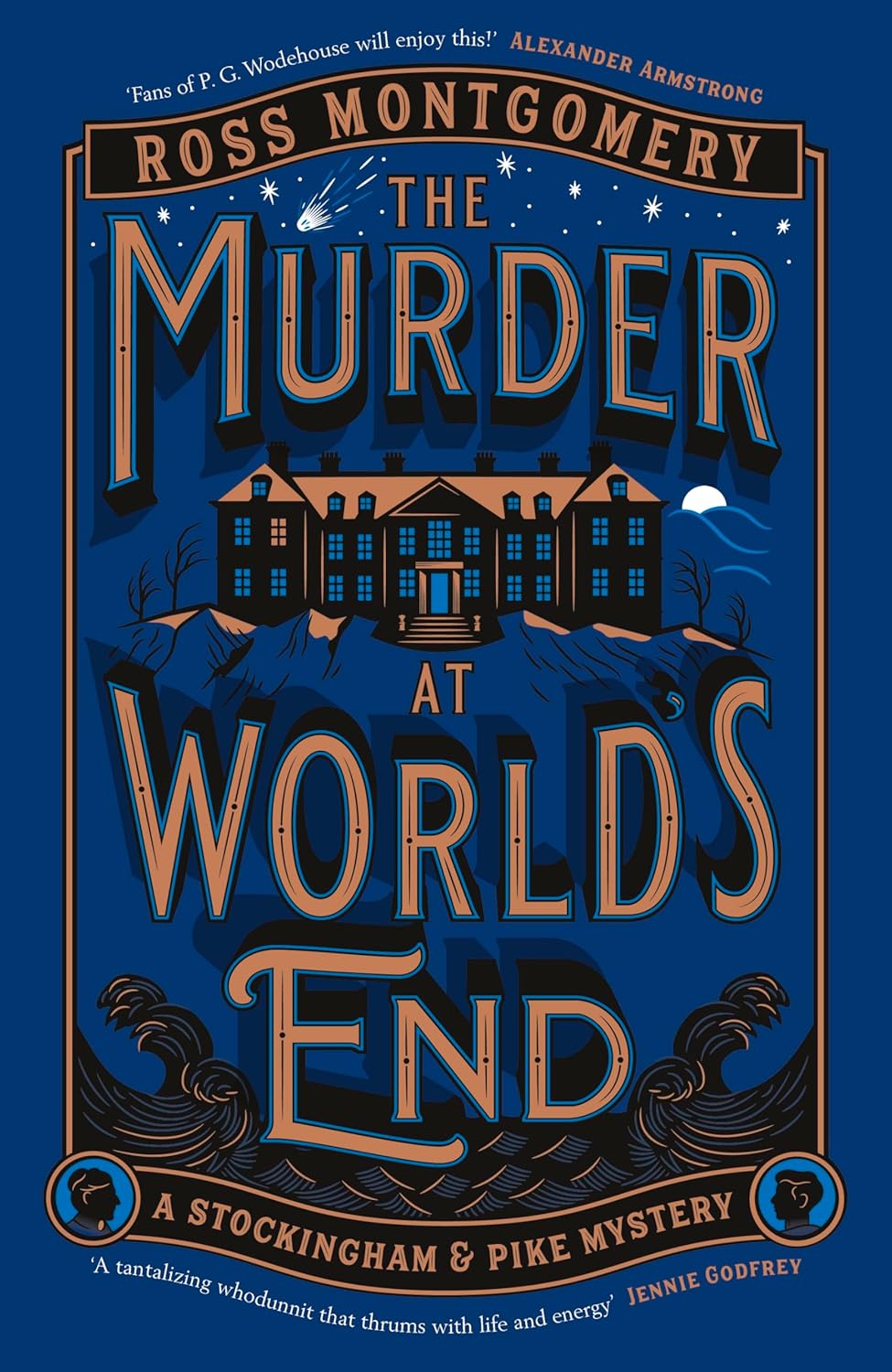
Okay, no, The Murder at World’s End (2025) by Ross Montgomery doesn’t really qualify for this ongoing feature of my blog, in which I pick books purely because they’re modern impossible crime novels. This, I was going to read anyway, and I only knew it happened to feature an impossible crime because Puzzle Doctor told me. But, well, here we are.
World’s End is “the largest tidal island in the country”, located in Cornwall and now home to Viscount Stockingham-Welt, “one of the finest scientific minds in the country [who] has transformed [ancestral home] Tithe Hall into perhaps the most technologically-advanced house in Europe” — no mean feat in 1910. And, due to the Viscount’s scientific proclivities, Tithe Hall is about to become the scene of some deeply unusual behaviour and, in time, an apparently-impossible murder.
I don’t want to say too much about the scientific reasoning behind the events at Tithe Hall– they’re undoubtedly historically accurate, since Montgomery has gone to the lengths of finding contemporary newspaper clippings to insert at the start of each day in the house, and it’s a rather wonderful conceit around which to base a novel. Suffice to say, staff and guests alike will be locked in their rooms with all cracks and apertures blocked to the best of the era’s capabilities and, at the behest of the lord of the manor, enough food has been shipped into the house to last everyone for a long while yet. The house is, naturally, in uproar trying to get everything organised in time, with servants running hither and thither and plenty of back-stabbing family and suspicious guest with alternative motives on hand.

Into this stumbles our narrator Stephen Pike, a young man recently out of borstal, who is taken on as an under-footman and told to wait out events with Lady Decima Stockingham, the elderly aunt of the master of the house — a formidable old crone who seems to go through servants at a rate that would make Meghan Markle blench. And yet, Miss Decima, for all her sweary bluntness, seems at times almost to be one of the few sane people at Tithe Hall:
“The entire scientific community has been saying [one thing] for months, and the only people that have said otherwise have been given the front page of every single newspaper in this country and beyond, precisely because what they have to say is outlandish. Sadly, my nephew is one of those men who thinks that disagreeing with established thought is a prerequisite of genius. People listen to him because he is rich and he has the great fortune of having been born a man.”
Any similarity with real world events or people, etc., etc.
Morning comes, the Viscount fails to respond to knocking at his study door, and, when the room is entered forcibly, he’s found sitting at his desk shot through the eye with a crossbow bolt in a way that echoes events from the family’s tragic past. The only problem: howdunnit?
Montgomery’s book gets off to a great start, populating his busy house with plenty of people without every feeling too busy to keep track of who everyone is, and finds lovely character notes in the likes of Mr. Stokes, the Compleat Head Butler (“Mrs. Pearce, if you wouldn’t mind.”) and the handful of other staff who are brought to our attention. Some lovely, almost visceral descriptions litter some of the later pages (“Back when I lived in Romney there was a prize boar which weighed nearly 2,000 pounds and which had to be retired because it kept breaking the sows’ spines. Jolyon looked like that, with trousers.”), and, for all the panic and urgency behind events, it’s tremendously clear that Miss Decima is enjoying herself very much indeed as everyone else twitches, broods, and wonders when they’re going to be allowed to return to the mainland.
I liked, too, that the reason for the apparent impossibility of the slaying plays into the era’s upstairs/downstairs dynamic, with uneducated minds indulging in scurrilous gossip and content to not think things through too carefully:
“[The killer’s] aim was not simply to kill him but to make it seem like it was impossible. Because that would produce hearsay, suspicion, prejudice and all the worst excesses of human nature. Because that would elicit so much chaos and confusion that the truth would become occluded.”
Into this, mix a few classic tropes — the guests are, of course, excluded from consideration by the police — and a compelling need for Stephen to investigate the murder (Scotland Yard man Inspector Jarvis seems intent on arresting him for the crime) and the stage is set for Stephen to clear his name, keep his past secret, and somehow stay out of sight of the family and guests while doing so. And for the most part it rattles long at a good pace, keeps the incident high, and generally has a jolly old time while doing so.
It’s not, however, a complete success.
As detective fiction, this falls a little short, with most of the book relying on Stephen telling us that something was different about the study the second time he saw it yet unable to bring it to mind for a vexingly large number of pages. As clues go, that’s about it, and when we do finally find out what it is…well, there really was no other way to communicate it except for Stephen to remember it, and so that whole edifice feels slightly inauthentically delayed. Also, Inspector Jarvis really does feel telegraphed in from a different, more broadly comical book…even if the culmination of his story is rather perfect.
The locked room murder, too, is…well. I could only see one way for it to be achieved, and was excited for Montgomery to unveil some clever idea I’d not thought of, because there’s no way someone would go to all this effort just to trot out that musty old chestnut. And then he does, and I found it tremendously underwhelming. And, most damningly, I’m not even sure it makes sense (rot13 for minor spoilers: jbhyq gur yvtug fjvgpu ernyyl or ba gur uvatrq fvqr bs gur qbbe, fb gung lbh unir gb fgrc nebhaq oruvaq gur bcra qbbe gb fjvgpu gur yvtugf ba?). There’s also a veeeery long denouement which involves running into the woods and being imperilled which all feels a little hoary: the book’s written in the first person, after all, so we know Stephen’s not going to die (and the cover calls it “A Stockingham & Pike Mystery”, too, so you know more are on the way).
But, well, with that said…
Like Montgomery’s books for younger readers, this is an exceptionally easy read, I really liked the dynamic of Stephen and Lady Decima — invective-spewing old ladies seem a bit base as dredging for laughs goes, but holy hell did she have me snorting at some of her expletive-filled expressions — and the milieu (both physical and historical) is beautifully drawn. Ross Montgomery deserves huge kudos for throwing his hat into the ring of detective fiction (it’s exceptionally hard to write, I can tell you from experience!), and I’d read another six of these right now if I had the chance. So here’s hoping the many successes he enjoys here encourage him to be even bolder and more successful with Book 2 (2026, probably).
~
Finding a Modern Locked Room Mystery ‘for TomCat’ attempts:
The Botanist (2022) by M.W. Craven
Hard Tack (1991) by Barbara D’Amato
The Darker Arts (2019) by Oscar de Muriel
Mr. Monk is Cleaned Out (2010) by Lee Goldberg
Death on the Lusitania (2024) by R.L. Graham
The Dog Sitter Detective Plays Dead (2025) by Antony Johnston
Impolitic Corpses (2019) by Paul Johnston
The Secrets of Gaslight Lane (2016) by M.R.C. Kasasian
Murder at Black Oaks (2022) by Phillip Margolin
Murder by Candlelight (2024) by Faith Martin
Murder Most Haunted (2025) by Emma Mason
Angel Killer (2014) by Andrew Mayne
The Magic Bullet (2011) by Larry Millett
The Murder at World’s End (2025) by Ross Montgomery
Black Lake Manor (2022) by Guy Morpuss
The Direction of Murder (2020) by John Nightingale
Holmes, Margaret and Poe (2024) by James Patterson and Brian Sitts
The Paris Librarian (2016) by Mark Pryor
Midnight and Blue (2024) by Ian Rankin
Lost in Time (2022) by A.G. Riddle
The Real-Town Murders (2017) by Adam Roberts
By the Pricking of Her Thumb (2018) by Adam Roberts
Murder in the Oval Office (1989) by Elliott Roosevelt
Murder at the Castle (2021) by David Safier [trans. Jamie Bulloch 2024]
With a Vengeance (2025) by Riley Sager
Red Snow (2010) by Michael Slade
Ghost of the Bamboo Road (2019) by Susan Spann
 The Invisible Event
Perfect timing on your part; I just saw this in Booklist a couple of days ago and thought it sounded interesting. Glad to see you enjoyed it. It’ll go on the TBR list.
LikeLike
While you’re at it, get The Return of Moriarty by Jack Anderson, too! 🙂
LikeLike
Noted!
LikeLike
vs ohgyre vf tbvat gb or ybpxrq vagb gur ebbz, jul fubbg uvz guebhtu gur puvzarl? N orggre fbyhgvba jbhyq unir orra: ivfpbhag jnf xvyyrq ol cbvfba naq frg va cbfvgvba. Gurer’f n zrpunavfz va gur yvtug fjvgpu juvpu gevttref gur fhvg bs nezbhe gb sver gur neebj qbja gur bcra qbbe (yvtugf pnzr ba 3 frpbaqf yngre, naq gur ubhfr jnf ‘nqinaprq’) va gur zbeavat.
LikeLike
Yes, this is an excellent point and one that I didn’t want to get into in the review because of spoilers. But yes, the issue you raise is a big one, and not fully considered in the text.
LikeLike