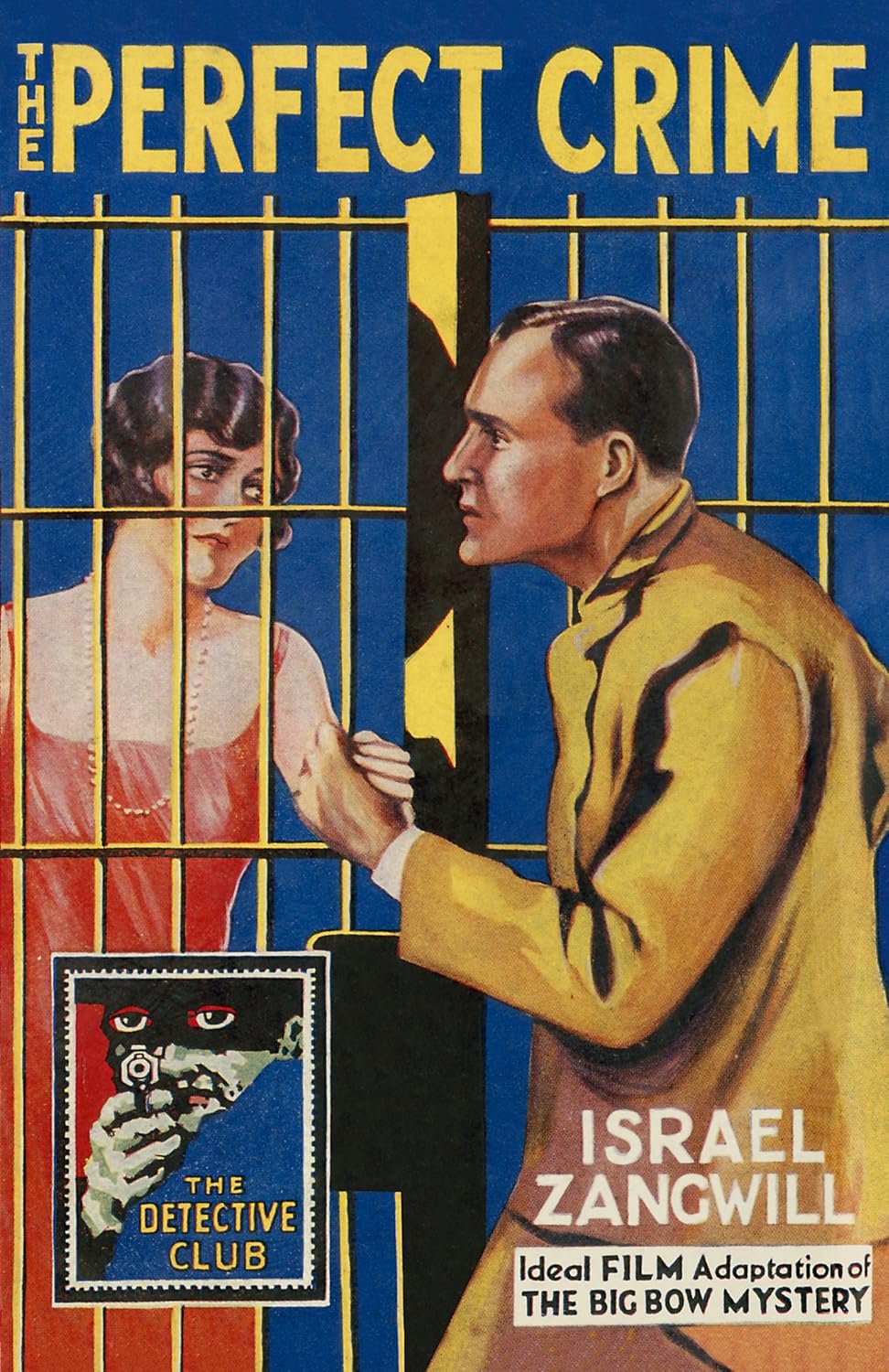

When I first heard of The Big Bow Mystery (1892) by Israel Zangwill, I legitimately thought it was about a big, y’know, bow — the fancy knot one ties in a piece of ribbon. I also anticipated, given its era, that it would be a dry and soulless tale which would dully wander its way to an obvious conclusion — and, well, I couldn’t have been more wrong on both counts. This story of a man found with his throat slit in his locked bedroom in Bow in London’s East End is, I’m delighted to find after a 15-year gap, still fresh, humorous, and remarkably readable. Indeed, as a novel, it might arguably be the most successful impossible crime story ever written, so wonderfully does it retain its pace, lightness, and acuity.
It is the murder of Arthur Constant, champion of the working man, that sets up a problem which will “[tease] the acutest minds in Europe and the civilized world”. Unable to rouse him one morning, his landlady Mrs. Drabdump calls on retired Scotland Yard man Grodman and the two break in Constant’s door to discover him with his throat slit yet no weapon present and all the windows shut, the door locked and bolted, and the chimney too slim to admit anyone (not even a trained monkey, one of the many suggestions with which the newspapers of the time are besieged).
So far, so classical; but what elevates Zangwill’s story is the lightness he injects into his setup, giving us dose after dose of trenchant observations whose savagery is only apparent once you get over the tightness of the wit employ in delivering the thrust. From dismissing the police as an organisation working behind the motto “First you catch your man, then you cook your evidence” who “could not even manufacture a clue” to resolve the puzzle, to newspaper writers who “revelled in recapitulating the circumstances of ‘The Big Bow Mystery,’ though they could contribute nothing but adjectives to the solution”, Zangwill seems to cast a wry eye over everyone and everything, and it’s glorious.
His own characters are, of course, far from safe, with Mrs. Drabdump giving evidence at the inquest which “occupied a considerable time, unduly eked out by Drabdumpian padding”, the poet Denzil Cantercot who “never wrote comic verse intentionally”, and even the general household habits of the idle rich falling under his sword:
In lower circles it is customary to call your wife your mother; in somewhat superior circles it is the fashion to speak of her as “the wife” as you speak of “the Stock Exchange,” or “the Thames,” without claiming any peculiar property. Instinctively men are ashamed of being moral and domesticated.
Never lose sight in all this fun of the fact that Zangwill can really write, too, with the opening atmospheric description of the fog which wreaths Bow on the morning of the tragedy (“…even unto Hammersmith there draggled a dull, wretched vapour, like the wraith of an impecunious suicide come into a fortune immediately after the fatal deed.”) one of many excellent passages throughout. That he mixes in elements of reportage — detailing the testimony of the inquest with character’s names in Small Caps — feels like a touch of genius, too, as do the repeated uses of “(Sensation)” and its like as a shorthand to communicate responses.
That details of the crime, and the rival investigations by Grodman and his replacement at the Yard Mr. Edward Wimp, weave amongst these accomplishments is even more of an achievement, with alternative solutions cropping up and various people from Cantercot to union man Tom Mortlake, who also rooms with Mrs. Drabdump, coming under suspicion. That this was written at a time when casual references to women not having the vote and “the Whitechapel murderer” are contemporaneous sort of staggers, too; how can those things feel like such isolated corners of history, yet the book ripple with such relevance and insight?
If The Big Bow Mystery has one flaw — and it has only one — it’s that Zangwill’s wit begins to thin in the latter stages, leading to a few purple passages that did slightly test my patience this time around, as if he had committed to this undertaking and wished it was only ten chapters rather than twelve. Of course, the guilt or innocence of an accused man, his neck being forfeit if the former is proven, is hardly the background for lightness at the best of times, but when you’re robbed of his magnificent archness…
Mr. Crowl felt no sense of victory. He had no desire to crow over his partner and to utter that “See! didn’t I tell you so?” which is a greater consolation than religion in most of the misfortunes of life.
…the stifling earnestness that replaces it recalls the feeling of the sun vanishing behind a cloud. That aside, this remains in my estimation a deserved classic, all the way down to its bitter and ironic ending, and a book whose influence on the Grandest Game in the World cannot be overstated.
~
My Harper Collins edition above — part of the magnificent and too-short-lived Detective Club reprints of about a decade ago — also contains ‘The Murders in the Rue Morgue’ (1841) by Edgar Allan Poe. I’ve talked about that already, however, and have nothing to add. I wanted to acknowledge it, though, since the two together really do make a nice primer in the dawn of the impossible crime story.


The original publication was in serial form, and of course the readers chimed in with their opinions on the murderer. Zangwill was still writing the book & decided that if someone thought a character did it- they’d be crossed off the list. If the story is true it explains the choice of “least likely suspect” and the slightly convoluted method – though it’s carried out well.
LikeLike
It would be interesting to know — Floating Admiral-style — what his plan for resolving the murder would have been if someone had picked out the correct party (and, indeed, given the apparent volume of mail this motivated, I find it hard to believe that no-one mentioned them).
Maybe someone should do an Alternative Solutions to the Big Bow Mystery sort of thing, but I guess it would require a very close reading…and, indeed, most of the tricks one could employ have doubtless been used to death by now. Okay, forget I said anything.
LikeLike
Still one of my favorite and most formative reads. I had planned to spoil this book in every novel as a joke, but I stopped after three times because (in the words of every crooked politician) “Think of the children!” Plenty of younger people haven’t read it and it wouldn’t be fair (or funny) to them.
It has been a while since I’ve read it though. I’ll have to dig out my copy and see if I still like it as much.
LikeLike
I avoided it for many years, convinced it was going to be a dud, and only then read it to sort of prove a point to myself. And, golly, what a fool I was!
It definitely stood up for me second time. Hopefully you’ll enjoy it just as much.
LikeLike
Been an age since I read this one (well, 40 years at least). Was never too impressed by the solution to the murder mystery, which I remember clearly, while having little recollection about the style. So must re-read, especially now that the film version, THE VERDICT from 1946, has come out on Blu-ray. Happy new year, Jim!
LikeLike
You read everything 40 years ago, dude 🙂 I feel like your whole life has just been a huge pause since last picking up a book… 😄😄
LikeLike
Let’s play Mystery Mad Libs:
__________ (person) claims that __________ (novel) was the inspiration for __________ (movie).
Whatever you came up with, it probably sounds less crazy than “Quentin Tarantino claims that THE BIG BOW MYSTERY was the inspiration for DIRTY HARRY.” But in CINEMA SPECULATION, his book on ’70s movies which was published a few years ago, he made a pretty good case that T.B.B.M.’s movie adaptation THE VERDICT is the spiritual ancestor of HARRY–both were directed by Don Siegel, and the protagonists of both stories are police detectives with a rather similar attitude toward justice.
LikeLike
Yeah, I don’t see this. Tarantino is so inexplicably popular that he could say Little Women was the inspiration for John Wick and 400 cinephiles would bend themselves out of shape to make it true.
LikeLike
I dimly remember thinking something similar when first hearing of The Big Bow Mystery (like a long bow?). What I remember a lot clearer is being much more impressed with the prescient plotting and one of the false-solutions than the writing, but a reread is in order. Maybe I can provide one or two alternative solutions.
Happy New Year!
LikeLike
Haha, I’m glad I’m not the only one — there’s almost something of first period Ellery Queen in how the title seems to promise one thing but then delivers another, eh?
Happy new year indeed! Let’s see how many times we can disagree in 2026 🙂
LikeLike
If you mean The Dutch Shoe Mystery, than yes. The American Gun Mystery, on the other hand, delivered as promised. Americans shooting guns (*pew* *pew*).
LikeLike
Sure, I’m thinking more Dutch Shoe, Chinese Orange, Spanish Cape…than Roman Hat, Siamese Twin, Greek Coffin.
LikeLike
THE VERDICT actually has a lot in common with the 1941 version of THE MALTESE FALCON. Besides being made at the same studio and sharing some of the same cast (Sidney Greenstreet, Peter Lorre, Creighton Hale) and crew (Perc Westmore, Leo Forbstein), they are both the most well-known third film versions of famous mystery novels. Unfortunately, the earlier two film versions of The Big Bow Mystery are not nearly as easily available as the two earlier versions of Falcon. I really don’t know if the original, 1928 silent version, THE PERFECT CRIME, still exists. The 1934 version THE CRIME DOCTOR does still exist, but only shows up occasional film festivals. It’s hard to tell from reviews whether either of the earlier versions employs the classic locked room solution of which The Big Bow mystery seems to be the locus classicus.
I think THE VERDICT is an excellent film which, beyond its other merits, presents its alternate solutions in what comes off as an equivalent to Carr’s locked room lecture, sas presented by police informant crook Clyde Cook. There’s one flaw in the plotting of the film, IMO, but was an element included against the wishes of Don Siegel, who seemed to have an excellent grasp on the genre.
Perhaps a bit overlong, I consider it one of the three greatest impossible crime films, the other two being THE KENNEL MURDER CASE and WAKE UP, DEAD MAN
A very happy New Year to you both, gentlemen!
LikeLike
I’ve not seen The Verdict, but did finally watch Wake Up Dead Man and agree that it’s a fabulous example of the impossible crime on screen. If only they’d not repeatedly said “locked door mystery” throughout…
LikeLike