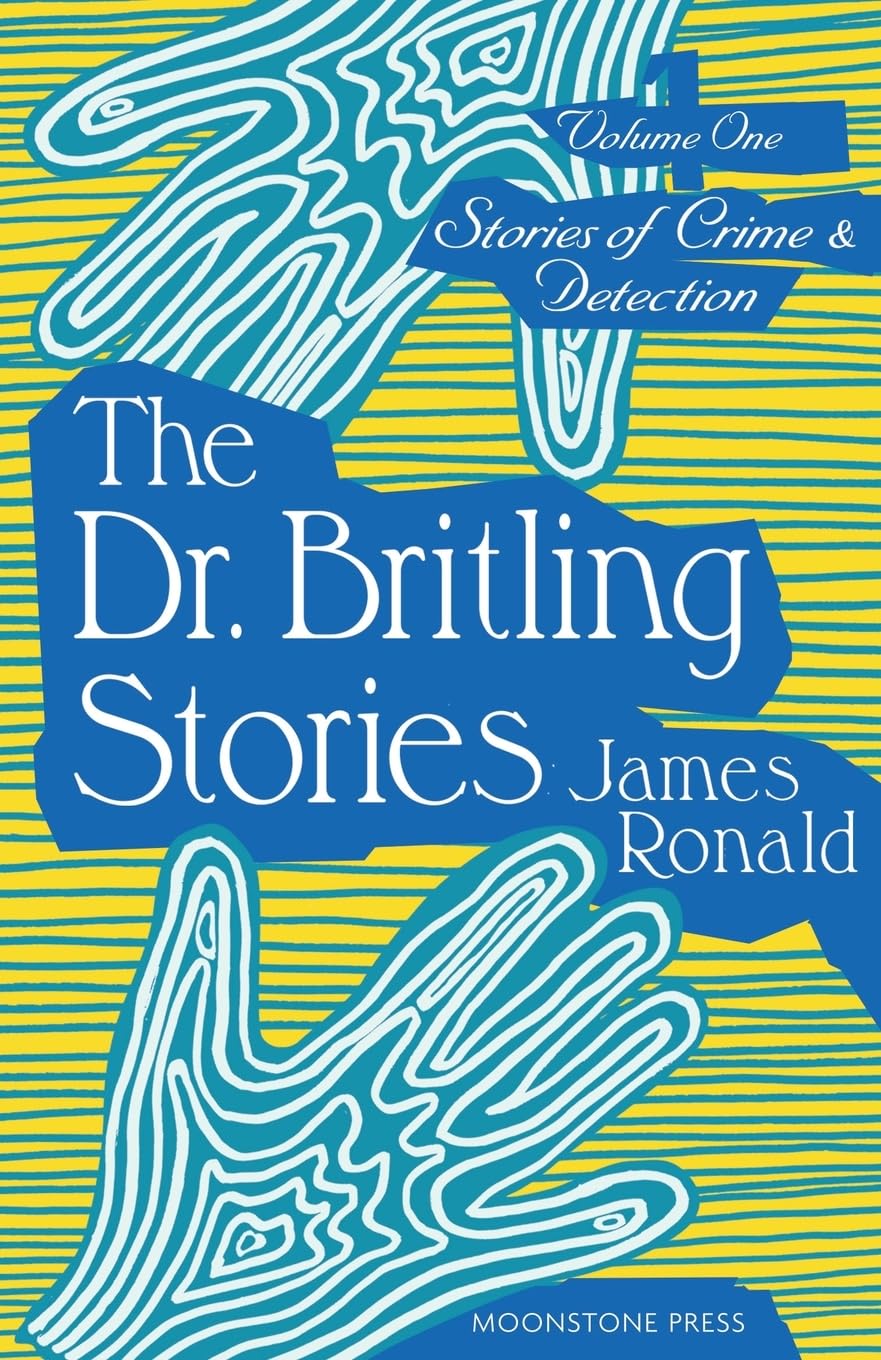
I’m reviewing this out of order, because it’s been a busy week and so I’ve not had time to read the 180-page novella which comes next in this collection, but a 12-page short story…yeah, I’ve been able to fit that in.
In a week it won’t matter, but the order of titles in this first collection of James Ronald’s crime fiction is:
- ‘The Green Ghost Murder’ (1931)
- ‘Too Many Motives’ (1930)
- ‘Find the Lady’ (1930)
- Six Were to Die [n] (1932)
- ‘Blind Man’s Bluff’ (1929)
‘Blind Man’s Bluff’ (1929) is — as far as any of us know — Ronald’s debut piece of crime fiction, and I very much enjoy how his first foray into the genre was a slightly uncommon idea. The capacity of a blind man in a sighted world was far from original, Ernest Bramah having explored the idea already in his superb Max Carrados tales, but Ronald could certainly have picked an easier milieu in which to operate. Indeed, one suspects that it’s the very difficulty of this setup which intrigued him, and set him on the path he was to follow for a number of years in writing inventive, compelling crime fiction that did such excellent work in bringing unexpected wrinkles into the genre.
We are introduced to 41 year-old Martin Longworth, who has been blind for twenty years, having sacrificed his eyesight at the altar of “over-study” while at Cambridge University. Having moved to a small village, Longworth enjoys a full life simply by dint of failing to allow his blindness to define him. Ronald is alive to the possibilities that restricted sight offers — the compensations of sound, for one — as well as realistic about how such a life would have to be led: certain objects must be placed in precise locations in order to be easily found, of course, but when these considerations are observed there’s nothing unrealistic about how Ronald writes Longworth’s existence. Blindness is not a superpower, but nor is it the barrier that those of us yet to experience it might imagine it to be.

Much like with Baynard Kendrick’s Captain Duncan Maclain, Longworth is a capable and practical man, who embraces the world he inhabits on the terms he must accept, and his confidence in doing so has resulted in even those who know of his ailment to forget it. Indeed, when he meets the village’s new tobacconist Blaine, that gentleman doesn’t even realise Longworth is blind at first, such is his comportment. Now, yes, such effects are easily achieved in fiction, where characters are free to notice as much or as little as their creators allow, but the point is that Ronald makes you believe it in a very short space of time.
Things develop from here in a way that makes a literal truth of the title, and while some aspects of Longworth’s behaviour might border on the fanciful, it’s a fun little time that builds to a good suspense sequence and pays off well. The refrain of ‘I take my weakness and turn it into a strength in Situation X’ is a narrative conceit that I especially enjoy, if only because it enables creative authors to do something that might otherwise be considered precluded on account of their limitations (in particular, one of the weakest Jack Reacher novels by Lee Child uses this idea very cleverly in its inevitable all-action finale — which again highlights the intelligence that went into so much of Child’s writing for a number of years…but I digress).
I’m not going to pretend that I can drag this out to 1,000 words, but I am moved to reflect on the way classic era crime fiction utilised blindness to very clever effect, viewing the condition from the perspective of how information might be processed differently in a way that is pure Golden Age reinterpretation. Carrados, Maclain, and the street peddler from Bats Fly at Dusk (1942) by A.A. Fair are recent examples that I’ve encountered, but I’ll add Longworth to the list and keep an eye out for other examples…do let me know below of any notable ones you’ve encountered in your own wanderings.
Knowing this shorter story finished off the collection, I’d been intending to reflect on this first volume as a way to give the post a little more meat, but time is short and, frankly, I’m not sure what to add to the posts I’ve already done on the earlier Daniel Britling stories herein (he does not, incidentally, appear in this one, in case you were wondering). I remain in frank disbelief that this undertaking of Moonstone’s to reprint all Ronald’s crime fiction is really happening, and I look forward to more experiences with his writing as he grows in confidence — anyone who starts this strongly more than likely had something to bring to the genre, and in the months and years ahead I look forward to exploring that with you all.
All four of you who read these posts, I mean. I’m not kidding myself.
A very merry pre-Christmas panic to all who observe. Hopefully I’ll find time amidst my own disorganisation to revisit Six Were to Die (1932) before next week rolls around.
~
The James Ronald Stories of Crime and Detection, published by Moonstone Press:
- The Dr. Britling Stories (1929-31)
- Murder in the Family (1936)
- This Way Out (1939)
- They Can’t Hang Me (1938)
- The Dark Angel (1930)
- Cross Marks the Spot (1933)
- Death Croons the Blues (1934)
- Hard-Boiled (1937)
- Murder for Cash (1938)
- Counsel for the Defence (1932)
- The Sealed Room Murder (1934)
- She Got What She Asked For (1941)


And a very merry pre-Christmas panic to you as well! As a Carrados fan, I’m definitely going to gift this—and the entire intriguing-sounding volume—to myself once it’s more readily available in the States.
LikeLike
Don’t forget that the likes of Blackwells and Wordery offer free international shipping — so you can always buy it from a UK retailer while it’s still hot off the press…
LikeLike
Had forgotten about that…thanks! That definitely opens up a few more volumes for me.
LikeLike
There’s a dreadful collection of pulp stories by Wyatt Blassingame featuring a detective John Smith. Smith was blind for 10 years, during which he developed all sorts of heightened senses, before having his sight restored by an operation. Now he battles villains like The Murder Master in an effort to save New Orleans.
I’m more than happy to send the book your way. Research and all…
LikeLike
Oh, my god! I’ve just looked him up on the Fiction DB and the titles alone make this an enticing proposition:
‘No Parole for the Dead’
‘Steeplechase for Corpses’
‘Madam Murder’s Children’
‘Death Trap for the Parole Killer’
‘The Voodoo Murders’
‘John Smith, Graveyard Detective’
I appreciate the offer, but I think you’re going to want to read these yourself 🙂 I, however, shall put Blassingame on my list and keep an eye out for anything by him — much appreciated!
LikeLike
I always enjoy your content but perhaps don’t comment enough. I hope you find a lot more readers than the four you mention! Your blog is a delight, and also merry Christmas. xxx
LikeLike
There are five of us now! Five!
Thanks for the kind words; have a wonderful Christmas yourself.
LikeLike