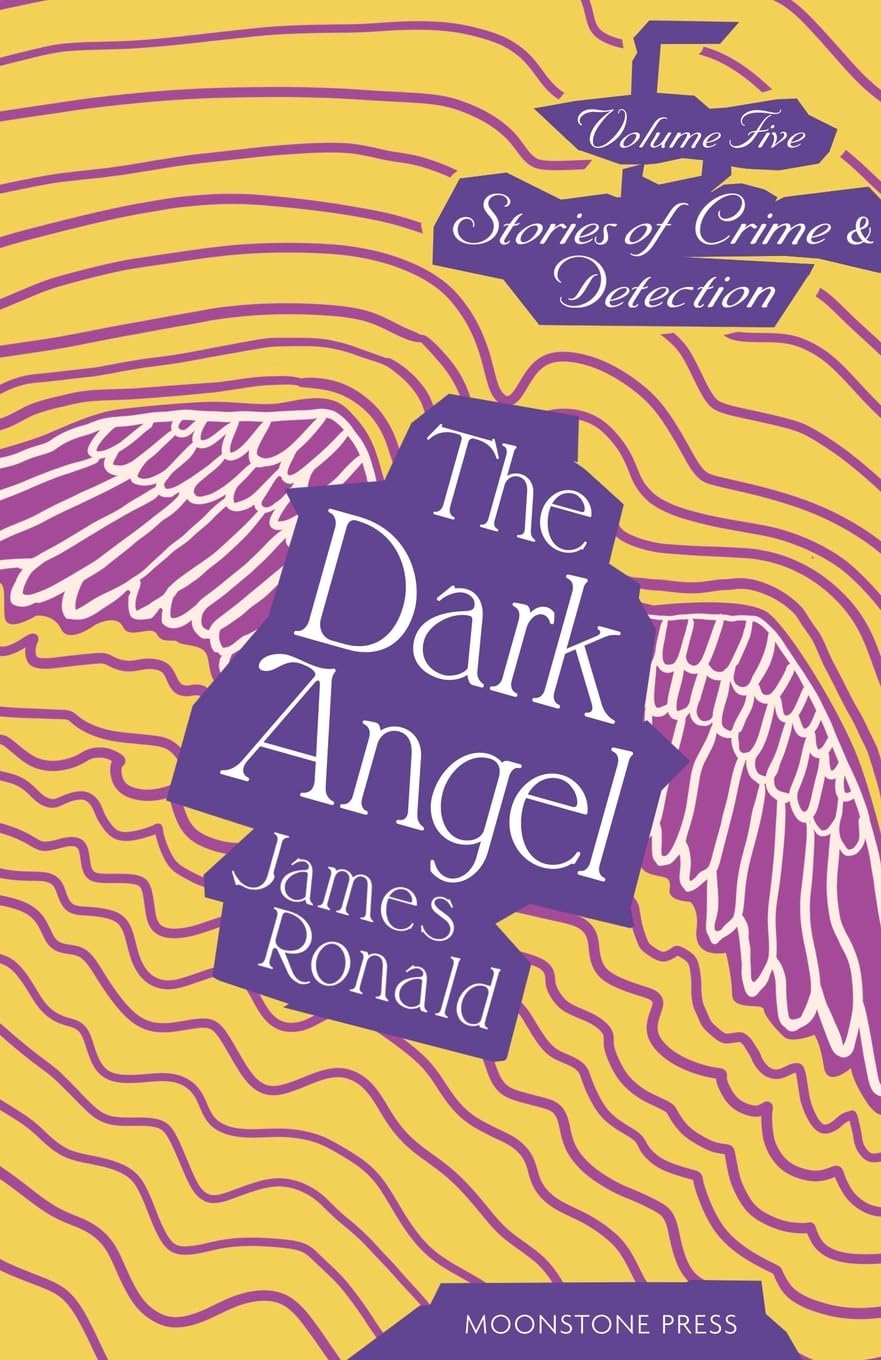


There were, I think, few people more excited than me when it was announced that Moonstone Press would be republishing the complete mystery fiction of James Ronald. I’ve been adding to my existing posts with quick reviews of the novellas and short stories included in earlier volumes, but fifth volume The Dark Angel (1930) marks the first time that I’m reading a new-to-me James Ronald novel, one that I would in all probability have had no opportunity to experience but for the excellent collaboration of Moonstone and Chris Verner. And a selfless old lady receiving a demand to pay £5,000 (£400,000 in today’s money) is exactly the sort of pulpy setup Ronald could doubtless spin to entertaining ends.
We are, of course, in the Golden Age, when a woman is talked about in Methuselean terms when she hits 40, so Elspeth Brownrigg is, in fact, a positively sprightly 60 years old. But the fact remains, this apparently blameless woman, who has devoted her life to raising money for various charities, nevertheless receives an anonymous note — signed with a pair of black wings — warning that she “will die a particularly painful death within forty-eight hours” if she does not pay the sum named. Luckily, her nephew is Scotland Yard man Detective Sergeant Norman Brownrigg, who is able to bring the full force of the organisation to investigate, in the person of his boss Detective Inspector Sir Frederick Stanley.
The ante is upped when Ms Browrigg is poisoned and millionaire Sir Montgomery Bulger is then threatened by a similar note, similarly signed. Stanley is quick to note that several of the people involved in both cases could be equally responsible, and here is where the fun begins, since “almost every new clue points equally to all three [suspects]”. And from here the problem only deepens as millionaire business tycoon Peter Brayd is similarly threatened, and draws even more people who could also have been involved in the first two cases into the rumpus.
Ronald clearly had a lot of fun writing this. It’s not properly clewed in the traditional sense, but witness the ways in which each new development like the laced rum points in several directions — witness, too, the seemingly endless multiplying and then vanishing of typewriters which could have been used to write the letters — and tell me he’s not thrashing this out with a huge smile on his face. His pulp sensibilities inevitably shine through, but there’s more under the surface here, not least in the characterisation of Brayd, who is at once a bullying and forthright presence with a surprising streak of humanity in him, and Brayd’s wife, who is really the heart of the whole endeavour.
You see here flashes of Ronald’s growing authorly skill, such as how he writes about the effect of cumulative strain on those at the centre of this devilish scheme, or the moment one of the victims dies and their body is talked about as “lifeless clay [that had] lost its entity and represented only a problem”. Alongside this, there’s some subtle humour, and a couple of places where Ronald wrung a laugh from me in the most delightful way:
“I will [go to the theatre], if you choose a show that requires absolutely no intelligence.”
He had a paper on the desk beside him, and he glanced down the list of entertainments looking for an American musical comedy.
The final deduction of our guilty party, and the way it is achieved, lacks rigour, but opens up an interesting premise about those multiplying clues, and the note on which Ronald ends things is, honestly, one of the most perfect concluding beats I’ve encountered in a long while. This is not a complex or subtle tale, but I’d be willing to give it an extra star except for the fact that Ronald seems to leave one rather key detail — (rot13 for spoilers) jub qbrf birecbjre gur avtugjngpuzna…? — unresolved.
Of particular interest, too, is the way Ronald seems to write about forriners. Elspeth Brownrigg’s personal secretary Sydney Martin is of dubious origin, and has his early life painted in the most unflattering terms, as if civilisation ends at the M25, yet seems to take his othering in his stride as if it’s the sort of ignorance one should just expect of the English at this time. Ronald’s not along in his somewhat unedifying writing about anyone from Elsewhere, but this late reflection could imply that he was rather more aware of this blinkered view than a surface-level read might suggest.
Also, on a note of historical interest, when it is suggested that someone might be “stalling” in not being forthcoming with information, the turn of phrase is dismissed as “vulgar slang” and “swinging the lead” is suggested as an interpretation of the phrase. Now, doubtless this is my own vulgar 21st century brain at work, but surely “swinging the lead” is slang and “stalling” is plain English, no? Or maybe the past is a foreign country, and the middle classes of 1930 would be disgusted with the relaxing of linguistic barriers that has occurred in the 94 years since this was published.
~
As with these other Moonstone editions, alongside the title novel we have two additional stories. The novella The Unholy Trio (1933) is the most successful of Ronald’s pulpy thrillers yet, with ex-Yard man Peter Norton setting up as a private detective and, for his first case, having a beautiful young woman who cannot remember her name stumble into his office convinced that a terrible crime is about to be committed. There’s a breezy air of fun about this — witness the Hon. Montague Featherstonehaugh as an example of character-naming — and soon Norton is on the track of the eponymous trio of crooks who will stop at nothing to prevent his snooping.
It reminded me of a good Sexton Blake adventure, not least in the Tinkeresque character of the homeless boy Ginger who saves Norton’s life early on and becomes a confederate in his search. There’s some lip service about the importance of detection, but this mostly passes in a series of entertaining confrontations, some good quips (“Insanity runs in his family He had an uncle who thought he was a beer barrel and spent his whole life trying to fill himself.”), and a propulsive and creative flight on its way to a surprisingly good all-action confrontation.
~
Finally, the short story, ‘A Tired Heart’ (1959), previously published in Ellery Queen Mystery Magazine, which concerns hard-up furrier Sam Abrams, whose warehouse burns down just as the $50,000 he’ll receive in insurance payout becomes necessary to extend his ill wife’s life, and George Benson, the tireless fraud investigator who would “send up his own grandmother” who is assigned to the case. It’s a superbly-written little problem from later in Ronald’s career, and you really get a sense of how he matured as a writer over the years from the subtle phrasing and tidy payoff. A lovely little addition to a very nice volume in this most welcome series.
~
The James Ronald Stories of Crime and Detection, published by Moonstone Press:
- The Dr. Britling Stories (1929-31)
- Murder in the Family (1936)
- This Way Out (1939)
- They Can’t Hang Me (1938)
- The Dark Angel (1930)
- Cross Marks the Spot (1933)
- Death Croons the Blues (1934)
- Hard-Boiled (1937)
- Murder for Cash (1938)
- Counsel for the Defence (1932)
- The Sealed Room Murder (1934)
- She Got What She Asked For (1941)


“Pronounced ‘Fuff.'”
LikeLike
Well, exactly — why not?
LikeLike